- 29/12/2025
- MyFinanceGyan
- 314 Views
- 3 Likes
- Finance
GDP Explained Simply: What It Measures, What It Misses, and Why It Matters to You?
Whenever news channels talk about the economy growing or slowing down, one term appears again and again — GDP, or Gross Domestic Product. It is often treated as the ultimate scorecard of a country’s economic health.
But what does GDP actually measure? Does a rising GDP mean people are living better lives? And why should an ordinary citizen care about this economic number?
This guide explains GDP in simple terms — what it shows, what it overlooks, and how it quietly influences your job, income, prices, and future decisions.
Table of Contents:
- What Is GDP?
- How GDP Is Measured
- Nominal GDP vs. Real GDP
- Why GDP Growth Rates Matter
- What GDP Truly Tells Us
- What GDP Fails to Capture
- GDP and Other Measures of Well-Being
- How GDP Affects Your Daily Life
- Common Myths About GDP
- The Future of Measuring Prosperity
- Final Thoughts
1. What Is GDP?
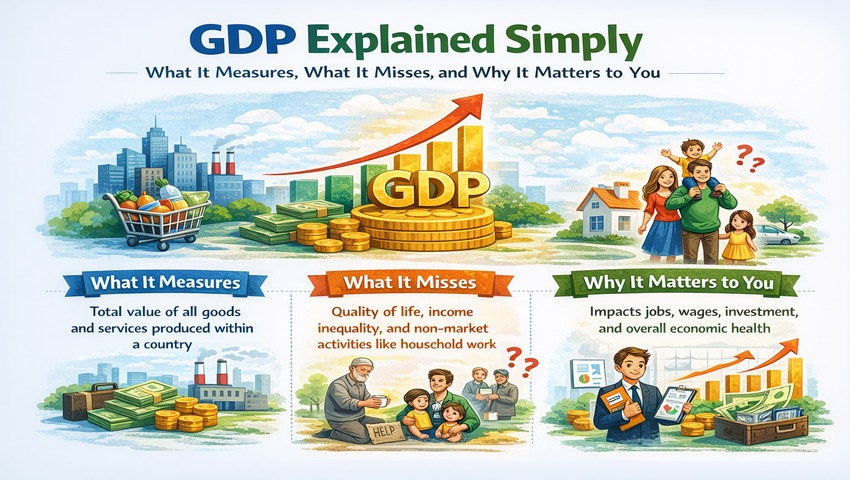
Gross Domestic Product (GDP) is the total monetary value of all final goods and services produced within a country’s borders during a specific time period, usually a year or a quarter.
In simple words, GDP adds up everything an economy produces — food, houses, mobile phones, hospital services, transport, education, and much more.
Imagine tracking every economic transaction around you — a meal at a restaurant, a new laptop purchase, a cab ride, or a medical consultation. When all such transactions across the country are added together, the result is GDP.
GDP helps governments, businesses, and investors understand how active and productive an economy is.
2. How Economists Measure GDP?
- Production (Output) Approach:
This method calculates the value added at every stage of production across industries.
For example, when raw materials are turned into finished products, the additional value created at each stage contributes to GDP.
- Expenditure Approach:
This is the most commonly used method. It adds up total spending in the economy.
GDP = C + I + G + (X – M)
Where:
- C = Household consumption
- I = Business investment
- G = Government spending
- X – M = Exports minus imports
When people spend more, businesses invest more, and governments increase spending, GDP rises.
- Income Approach:
This method totals all incomes earned within the economy, including:
- Wages and salaries
- Business profits
- Rent
- Interest income
Together, these three approaches give a complete picture of economic activity.
3. Nominal GDP vs. Real GDP:
Not all GDP growth tells the same story.
- Nominal GDP measures output using current prices. It does not adjust for inflation.
- Real GDP adjusts for inflation and reflects actual growth in production.
For example, if GDP grows by 8% but inflation is 5%, the real growth is only about 3%. This is why economists rely more on real GDP to judge true economic progress.
4. Why GDP Growth Rates Matter?
The GDP growth rate shows how fast an economy is expanding or contracting.
- Positive growth means rising production, higher spending, and job creation.
- Negative growth for two consecutive quarters usually signals a recession.
Most healthy economies grow at around 2–4% per year. Growth that is too slow leads to stagnation, while growth that is too fast can trigger inflation and financial bubbles.
Governments and central banks use GDP growth data to adjust taxes, spending, and interest rates.
5. What GDP Really Measures Well?
When used correctly, GDP offers valuable insights:
- Size of the economy: It allows comparisons between countries.
- Economic momentum: Rising GDP suggests increasing production and demand.
- Policy outcomes: It helps assess whether economic policies are working.
- Investment confidence: Investors often prefer economies with steady GDP growth.
GDP acts like a speedometer — it tells how fast the economy is moving, but not where it is headed.
6. What GDP Misses?
Despite its importance, GDP has clear limitations.
- Income inequality:
GDP can grow even if most benefits go to a small group, leaving others behind.
- Environmental damage:
Activities that harm nature may increase GDP in the short term, even though they reduce long-term sustainability.
- Unpaid work:
Household work, caregiving, and volunteering are not counted, despite their real social value.
- Quality improvements:
Better technology or longer-lasting products may not reflect strongly in GDP figures.
- Happiness and well-being:
GDP does not measure mental health, safety, or life satisfaction.
- Informal economy:
In many countries, informal work and small-scale businesses remain undercounted.
GDP is useful, but it shows only part of the picture.
7. GDP and Other Well-Being Indicators:
To get a broader understanding of progress, economists use additional indicators:
- GDP per capita: Average economic output per person
- GNI (Gross National Income): Includes income earned abroad
- HDI (Human Development Index): Combines income, education, and life expectancy
- GPI (Genuine Progress Indicator): Adjusts GDP for inequality and environmental damage
- Happiness Index: Measures life satisfaction and emotional well-being
Some countries, like Bhutan, even prioritize Gross National Happiness over GDP.
8. How GDP Affects Your Daily Life?
Even if it seems distant, GDP influences everyday decisions.
- Jobs and income: Strong GDP growth usually leads to more hiring and better wages.
- Inflation and prices: Rapid growth can increase prices, affecting your budget.
- Government spending: Tax revenues and welfare programs depend on economic performance.
- Markets and investments: GDP data strongly impacts stock and financial markets.
- Living standards: Long-term growth in real GDP per capita often improves quality of life.
GDP quietly shapes the opportunities and costs you face every day.
9. Common Myths About GDP:
- Myth: GDP measures happiness
- Reality: It measures production, not well-being.
- Myth: High GDP guarantees prosperity
- Reality: Growth without fairness or sustainability can harm society.
- Myth: GDP can grow forever
- Reality: Resources, demographics, and climate impose limits.
- Myth: GDP includes everything valuable
- Reality: Many meaningful activities are excluded.
10. The Future of Measuring Prosperity:
As economies change, traditional GDP is being re-evaluated.
- The “Beyond GDP” movement adds social and environmental metrics.
- The UN’s environmental accounting systems track natural resources alongside output.
- Digital economies raise new questions about valuing free online services.
Future measures of progress are likely to balance growth, equality, and sustainability.
11. Final Thoughts:
GDP remains a powerful tool for understanding economic activity, but it is not a measure of overall happiness or fairness.
A country can grow richer on paper while many citizens struggle with rising costs, inequality, or environmental damage. That’s why GDP must be read alongside inflation, income distribution, and quality-of-life indicators.
Understanding GDP — and its limits — helps you read economic news more critically and make better financial and civic decisions. Numbers tell a story, but real progress depends on how growth improves everyday lives.
Disclaimer:
The views expressed in this article are personal and intended solely for educational and awareness purposes. This content does not offer or recommend any financial, investment, or commercial products.