- 12/02/2026
- MyFinanceGyan
- 8 Views
- 0 Likes
- GST
GST Refund Time Limit – Complete Process Explained
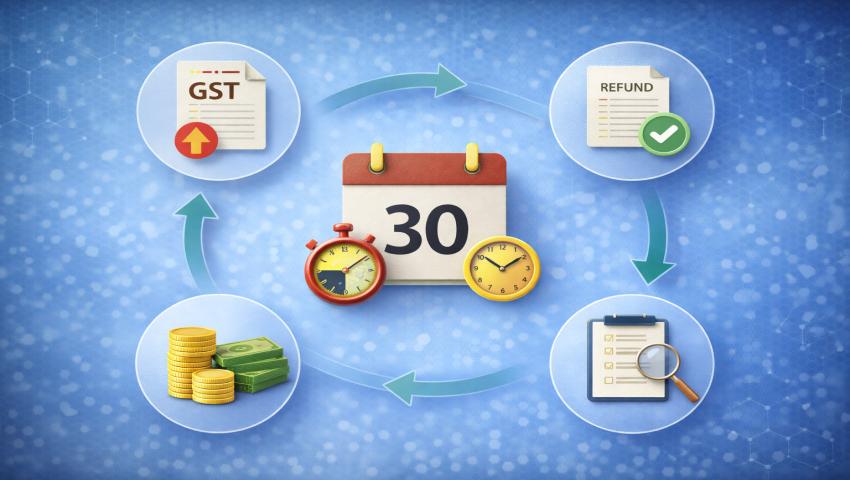
Under the Goods and Services Tax (GST) regime, refunds are vital for ensuring adequate cash flow and liquidity for businesses. Refunds commonly arise due to excess tax payments, unutilised input tax credit (ITC), exports, or appellate decisions. Despite this, many taxpayers remain unclear about the GST refund time limit, eligibility criteria, and the procedural steps involved.
This article explains the GST refund time limit and the complete refund process in a simple and structured manner, helping taxpayers claim refunds efficiently and avoid rejection due to non-compliance.
What Is a GST Refund?
A GST refund refers to the repayment of excess tax or unutilised ITC to a taxpayer. Refunds may arise in several situations, including:
- Excess GST paid due to error or miscalculation
- Export of goods or services without payment of tax
- Supplies made to SEZ units or developers
- Accumulation of ITC due to inverted duty structure
- Finalisation of provisional assessment
- Refunds arising from appellate or court orders
GST law provides a systematic and time-bound mechanism to process such refunds.
GST Refund Time Limit – The Core Rule:
As per Section 54 of the CGST Act, a GST refund application must be filed within two years from the relevant date.
The meaning of the “relevant date” varies depending on the nature of the refund claim. Identifying the correct relevant date is crucial, as refund applications filed beyond this period may be rejected on the grounds of limitation.
Relevant Date for Different Types of GST Refunds:
The GST refund time limit depends on the category of refund:
1. Refund on Export of Goods:
- Relevant date: Date of shipping bill or export manifest
- Refund must be claimed within two years from this date
2. Refund on Export of Services:
- Relevant date: Date of receipt of payment in convertible foreign exchange
3. Refund of Unutilized ITC (Inverted Duty Structure):
- Relevant date: End of the financial year in which the claim arises
4. Refund of Excess Payment of Tax:
Relevant date: Date on which the tax was paid
5. Refund Arising from Court or Appellate Orders:
- Relevant date: Date of communication of the order
Correct identification of the relevant date ensures compliance with the GST refund time limit.
GST Refund Process – Step-by-Step Guide:
The GST refund process is completely online and follows a defined workflow.
Step 1: Determine Refund Eligibility:
Before filing the refund application, the taxpayer must ensure:
- Eligibility under GST law
- Correct classification of refund type
- Availability of required supporting documents
Incorrect selection of refund category is a common cause of delay.
Step 2: File Refund Application (Form GST RFD-01):
The refund application is filed online in Form GST RFD-01 through the GST portal. The application includes:
- Type of refund
- Relevant tax period
- Amount claimed
- Bank account details
- Supporting documents
Upon submission, an Application Reference Number (ARN) is generated.
Step 3: Acknowledgement or Deficiency Memo:
After preliminary scrutiny:
- Acknowledgement (Form RFD-02) is issued if the application is complete, or
- Deficiency Memo (Form RFD-03) is issued if errors or missing details are found
In case of a deficiency memo, the taxpayer must rectify the issues and file a fresh application.
Step 4: Provisional Refund (Where Applicable):
For zero-rated supplies such as exports, eligible taxpayers may receive a provisional refund of up to 90% of the claim within 7 days of acknowledgement, subject to conditions. This provision supports working capital requirements for exporters.
Step 5: Detailed Verification:
The GST officer conducts a detailed examination, including:
- Verification of returns filed
- Validation of ITC claims
- Scrutiny of supporting documents
- Review of compliance history
This step ensures refunds are granted only for legitimate claims.
Step 6: Refund Sanction or Rejection:
After verification:
- Refund Sanction Order (Form RFD-06) is issued if approved
- Payment Order (Form RFD-05) is generated for credit to the taxpayer’s bank account
- If rejected (partially or fully), a reasoned speaking order is issued
Time Limit for Processing GST Refunds:
Once the refund application is acknowledged:
- The refund must be sanctioned within 60 days
- If delayed, interest at 6% per annum is payable to the taxpayer
- In cases involving appellate orders, a higher rate of interest may apply
Timely refund processing strengthens trust in the GST framework.
Common Reasons for GST Refund Delays:
Refunds may be delayed due to:
- Incorrect refund category selection
- Mismatch between returns and refund data
- Incomplete or incorrect documentation
- Errors in bank account details
- Pending notices or compliance issues
Regular reconciliation and accurate filing help prevent such delays.
Documents Required for GST Refund:
Depending on the nature of the refund, required documents may include:
- Statement of invoices
- Shipping bills and export invoices
- BRC or FIRC for export of services
- Declaration relating to unjust enrichment
- Chartered Accountant certificate (where applicable)
Proper documentation significantly speeds up refund processing.
GST Refund and Unjust Enrichment:
GST law follows the principle of unjust enrichment, which means:
- Refunds are allowed only if the tax burden has not been passed on to another person
- In certain cases, refunds are credited to the Consumer Welfare Fund
Export-related refunds are generally exempt from unjust enrichment provisions.
Importance of Complying with the GST Refund Time Limit:
Adhering to the GST refund time limit:
- Prevents rejection of refund claims
- Ensures timely recovery of funds
- Improves cash flow management
- Reduces disputes and litigation
Missing the deadline may result in permanent loss of refund eligibility.
Practical Illustration:
If excess GST was paid in April 2023, the refund application must be filed on or before April 2025. Filing beyond this period may lead to rejection due to limitation.
Conclusion:
Understanding the GST refund time limit and the end-to-end refund process is essential for businesses, exporters, and registered taxpayers. Although GST law provides a clear and time-bound refund mechanism, successful claims depend on timely filing, correct classification, and proper documentation.
By staying compliant with refund timelines and procedures, taxpayers can ensure faster refunds, improved liquidity, and smoother GST compliance.
Disclaimer: This article is for general informational purposes only and does not constitute legal, tax, or professional advice; readers are advised to consult a qualified tax professional for guidance specific to their situation.