- 15/01/2026
- MyFinanceGyan
- 131 Views
- 2 Likes
- Finance
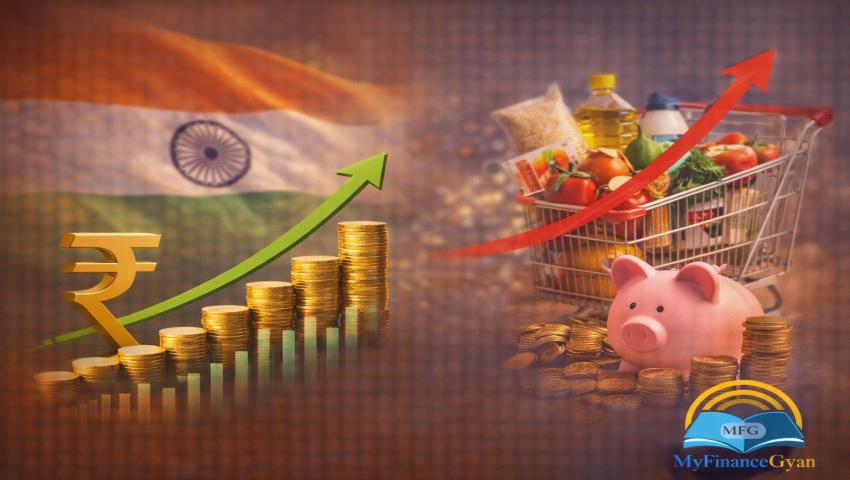
India’s GDP Growth vs Inflation: Are Indian Households Truly Getting Richer?
Growth Numbers vs Ground Reality
India has emerged as one of the fastest-growing major economies in recent years. With real GDP growth touching 8.2% in Q3 FY26 and consumer price inflation (CPI) dropping below 1%, the macroeconomic picture appears remarkably strong. On the surface, such a combination suggests rising prosperity and improving living standards.
But does rapid economic growth combined with low inflation automatically mean Indian households are getting richer?
The answer is more nuanced. While low inflation preserves purchasing power and high GDP growth expands overall economic output, household wealth depends on factors such as wage growth, employment quality, inequality, and consumption patterns. This article examines whether India’s impressive macro numbers are translating into meaningful gains for households.
India's GDP Growth Momentum:
India recorded 8.2% year-on-year GDP growth in Q3 FY26 (July–September), exceeding market expectations of 7.3% and accelerating from 7.8% in the previous quarter. This marked the strongest growth since early 2024.
The expansion was supported by:
- Increased government capital expenditure
- GST rationalisation boosting consumption
- Resilient domestic demand despite external pressures such as U.S. trade tariffs
Earlier quarters reinforced this momentum. Q1 FY26 growth stood at 7.8%, aided by easing inflation and steady investment activity. Nominal GDP growth during the same period was approximately 8.8%, reflecting price stability rather than overheating.
Looking ahead, the Reserve Bank of India (RBI) projects 7.3% GDP growth for FY26, while medium-term estimates suggest growth stabilising around 6.5% in 2026, positioning India as a global growth leader.
Inflation: A Rare Period of Price Stability
Inflation has been unusually benign. CPI inflation fell to a historic low of 0.25% in October 2025, rising modestly to 0.71% in November—well below the RBI’s medium-term target of 4%.
This moderation was driven by:
- Cooling food prices
- Stable fuel costs
- Policy interventions to manage supply chains
With inflation comfortably within tolerance bands, the RBI maintained the repo rate at 5.50%, signaling confidence in balancing growth and price stability. Forecasts for FY26 suggest inflation in the 2.0–2.5% range, which, if sustained, would support real income growth.
Real vs Nominal Growth: Why Inflation Matters?
Real GDP growth adjusts for inflation, offering a clearer view of economic expansion. In Q3 FY26, real growth stood at 8.2%, while nominal growth hovered around 9%. With inflation under 1%, households effectively retain most of their nominal income gains as real purchasing power.
Private Final Consumption Expenditure (PFCE), which accounts for 55–60% of GDP, grew steadily—an important signal that households are participating in the growth story. Meanwhile, gross fixed capital formation (25–30% of GDP) continued to support job creation and future income prospects.
However, part of the growth surge was driven by government spending—9.7% growth in Q1 FY26—which raises questions about how evenly private-sector benefits are spreading.
Are Households Seeing Real Wealth Gains?
Households experience real enrichment when disposable incomes rise faster than inflation. The exceptionally low inflation in 2025 preserved wage value and improved affordability for essentials. Consumer sentiment strengthened following GST adjustments, though PFCE growth lagged overall GDP in early quarters—suggesting uneven income distribution.
Key supporting factors include:
- Employment gains in construction, infrastructure, and services
- Remittance inflows supporting both rural and urban consumption
- Equity market performance boosting middle-class financial wealth
That said, inequality remains a concern. High-income households benefit more directly from asset appreciation and service-sector growth, while informal-sector workers—nearly 90% of India’s workforce—face more variable income gains, even in low-inflation environments.
Inequality: The Missing Link in the Growth Story
Strong GDP numbers often conceal distributional imbalances. Government-led capital expenditure drove much of the growth momentum, while private consumption and investment growth were relatively subdued.
Urban households benefit disproportionately from services and manufacturing expansion, whereas rural households remain dependent on agriculture and monsoon outcomes. Although inequality indicators remain moderate, wage stagnation risks persist in informal employment.
Policy tools such as direct benefit transfers (DBT) and welfare schemes help distribute gains more evenly, but long-term wealth creation depends on empowering micro and small enterprises and expanding formal employment.
Sectoral Contributions and Household Impact:
Services led growth, manufacturing rebounded through domestic focus, and agriculture benefited from falling food prices—collectively supporting household purchasing power.
Policy Support and Household Confidence:
Monetary and fiscal policies have played a stabilising role:
- RBI’s neutral stance and potential future rate cuts support housing and consumer credit
- GST rationalisation improved disposable incomes
- Government capex created employment via multiplier effects
These measures helped ensure that the divergence between GDP growth and inflation worked in favor of households.
Outlook: Can the Momentum Continue?
The RBI projects 7.3% growth for FY26 with inflation around 2%, creating favorable conditions for real income expansion. While global risks such as trade tensions remain, India’s domestic demand provides a strong buffer.
If structural reforms continue and inequality narrows, India’s per-capita income trajectory could accelerate meaningfully over the next few years.
Conclusion: Are Households Getting Richer?
India’s combination of 8%+ GDP growth and sub-1% inflation strongly supports real wealth creation. Purchasing power has been preserved, employment opportunities expanded, and consumption remains resilient.
However, the benefits are not evenly distributed. While many households are better off, sustained enrichment across income groups will depend on inclusive growth, job formalisation, and continued policy support.
In short: yes, Indian households are getting richer—but with important caveats.
Disclaimer:
The views expressed in this article are personal and solely those of the author. This content is intended for educational and awareness purposes only and does not constitute investment advice or product recommendations.