
- 19/01/2026
- MyFinanceGyan
- 128 Views
- 2 Likes
- Finance
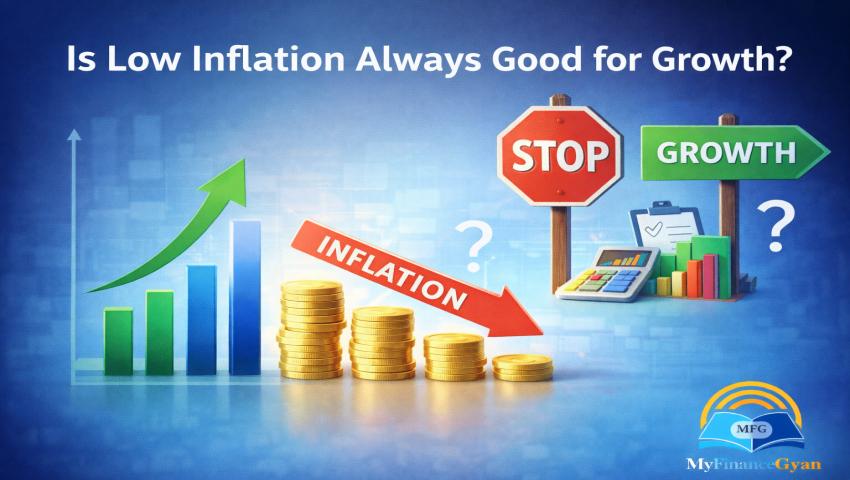
Is Low Inflation Always Good for Growth?
Economists, investors, and policymakers often gravitate toward simple stories. One of the most appealing is the idea of the Goldilocks economy—an economy that is neither too hot nor too cold. Inflation stays low and steady (typically around 2%), growth is stable, and unemployment remains subdued. It feels reassuring, predictable, and safe.
Yet real-world economies are rarely so tidy. While low inflation can indeed be healthy in certain circumstances, it can also signal deeper structural weaknesses—such as weak demand, stagnant productivity, excessive debt, or entrenched expectations that prices will not rise.
This article examines when low inflation supports growth, when it undermines it, and how policymakers, businesses, and investors should interpret the trade-offs. The key message is simple: low inflation is not a guarantee of economic health—it is a symptom that must be diagnosed.
What Do We Mean by "Low Inflation"?
Before evaluating its impact, it is essential to clarify terminology:
- Low inflation generally refers to modest positive inflation, roughly between 0.5% and 2.5% annually.
- Very low inflation lies close to zero.
- Deflation is a sustained decline in the general price level (negative inflation).
- High inflation usually means double-digit or highly volatile price increases.
These distinctions matter. Low but positive inflation behaves very differently from outright deflation, even if headline numbers appear similar.
Why Moderate, Stable Inflation Can Support Growth?
Low and predictable inflation is often associated with healthy economic conditions for several reasons:
- Encourages spending and investment: When prices are expected to rise gradually, consumers are less likely to delay purchases. Businesses, in turn, are more willing to invest when future revenues appear stable. This forward-looking behaviour supports both consumption and capital formation.
- Facilitates wage adjustments: Mild inflation allows firms to adjust real wages without cutting nominal pay, which is politically and psychologically difficult. Reduced wage rigidity helps labour markets adapt during downturns and lowers the risk of persistent unemployment.
- Eases real debt burdens: Moderate inflation gradually erodes the real value of fixed-rate debt, making it easier for households, firms, and governments to service obligations. This reduces default risks and supports credit flows.
- Preserves monetary policy space: Positive inflation allows central banks to keep interest rates above zero, giving them room to cut rates during downturns. When inflation is too low, the zero lower bound constrains policy effectiveness.
- Reduces uncertainty: Stable inflation anchors expectations. Lower uncertainty encourages long-term planning, investment, and risk-taking—key drivers of sustainable growth.
When Low Inflation Signals Trouble?
Low inflation is not always benign. In many cases, it reflects weak economic fundamentals that suppress growth:
- Weak demand and idle capacity: Persistently low inflation may indicate that aggregate demand is insufficient. Firms operate below capacity, hiring slows, and investment weakens.
- Debt overhang and deleveraging: After financial crises, households and firms often prioritise debt repayment over spending. This suppresses demand, keeping prices low and growth subdued.
- Stagnant productivity masked by price stability: An economy can exhibit low inflation alongside weak productivity growth. Without innovation and productive investment, output growth falters—even if prices remain stable.
- Deflationary expectations: If consumers and firms expect prices to fall, they delay spending and investment. This self-reinforcing cycle reduces demand, output, and employment.
- Corporate “zombification”: Very low inflation combined with cheap credit can keep inefficient firms alive, crowding out productive ones. This weakens aggregate productivity and drags down long-term growth.
Historical Lessons: When Low Inflation Was Not Benign
Japan’s “lost decades”: Since the 1990s, Japan has experienced prolonged low inflation and intermittent deflation alongside sluggish growth. High debt, demographic aging, and weak demand limited the effectiveness of monetary policy.
Advanced economies after the global financial crisis
Throughout the 2010s, many advanced economies struggled with low inflation despite aggressive monetary easing. Weak demand, slow credit recovery, and subdued wage growth constrained economic momentum.
These episodes show that low inflation can coexist with—and even entrench—structural stagnation.
When Low Inflation Truly Helps Growth?
Low inflation is most beneficial when it reflects positive supply-side dynamics rather than weak demand:
- Productivity-driven cost reductions: Technological progress and competition can reduce production costs, raising real incomes and purchasing power while keeping prices stable.
- Credible macroeconomic institutions: When monetary and fiscal authorities are trusted, low inflation tends to remain stable and predictable—an environment conducive to long-term investment.
- Healthy structural transitions: If productivity gains translate into rising real wages and incomes, low inflation can coexist with robust and inclusive growth.
Policy Trade-Offs: What Should Governments and Central Banks Do?
- Monetary policy choices: If low inflation reflects weak demand, easing policy may be appropriate. However, when interest rates are already near zero, monetary tools become less effective, requiring fiscal support.
- The role of fiscal policy: Targeted public investment, income support, and demand-enhancing measures can revive growth when monetary policy is constrained.
- Structural reforms: Improving productivity, enhancing labour market flexibility, encouraging competition, and allowing inefficient firms to exit are critical to avoiding stagnation.
- Managing expectations: Anchoring inflation expectations is essential. Once expectations fall persistently below target, restoring inflation becomes significantly harder.
Implications for Businesses and Investors:
For businesses:
- Track demand indicators, not just headline inflation.
- Focus on productivity, innovation, and cost efficiency.
- Avoid excessive leverage when growth prospects are uncertain.
For investors:
- Low inflation can support fixed-income assets, but real returns depend on growth.
- Equity performance suffers if low inflation reflects weak earnings growth.
- Sector selection matters, and inflation-linked instruments can hedge policy surprises.
How to Judge Whether Low Inflation Is "Good" or "Bad":
Key indicators to watch include:
- Output gap
- Employment and labour participation
- Wage growth
- Credit availability
- Business investment trends
- Inflation expectations
- Productivity growth
Rising productivity with stable inflation is positive. Falling productivity combined with low inflation is a warning sign.
Common Myths About Low Inflation:
Myth 1: Low inflation always boosts purchasing power
Reality: If incomes stagnate or jobs disappear, living standards can still decline.
Myth 2: Central banks can always fix low inflation
Reality: Policy effectiveness is limited near the zero lower bound and by structural constraints.
Myth 3: Deflation benefits consumers
Reality: Persistent deflation raises real debt burdens and discourages spending.
The Way Forward: A Balanced Policy Mix
A coordinated response is most effective when low inflation threatens growth:
- Targeted fiscal investment
- Flexible monetary policy
- Productivity-enhancing structural reforms
- A healthy, well-capitalised banking system
- Clear communication to anchor expectations
A Quick Diagnostic Checklist:
Ask the following questions:
- Is unemployment rising or falling?
- Are wages keeping pace with productivity?
- Are inflation expectations stable?
- Is credit flowing normally?
- Is business investment recovering?
- Are structural headwinds present?
If weak demand dominates, policy should be expansionary. If supply-side gains drive low inflation, stability may be appropriate.
Conclusion: Low Inflation Is a Signal, Not a Guarantee
Low inflation can reflect stability, efficiency, and productivity-driven progress—but it can just as easily signal weak demand, excessive debt, and deflationary risk. It is not an automatic passport to strong growth.
The so-called Goldilocks economy is not a permanent state but a moving target. Achieving it requires careful diagnosis, coordinated policy, and attention to the real economy behind headline inflation numbers.
Frequently Asked Questions (FAQs):
Not necessarily. It is a practical benchmark, not a universal rule. Optimal inflation depends on country-specific conditions.
Yes, particularly if weak demand and falling expectations reinforce each other.
No. Rates depend on growth, expectations, and policy choices.
By strengthening productivity, pricing power, balance sheets, and market diversification.
Please note:
The views expressed in this article are personal and intended solely for awareness and educational purposes. This content does not provide product recommendations or professional advice.