- 21/01/2026
- MyFinanceGyan
- 136 Views
- 2 Likes
- Investment
The Impact of AI, Trade Wars, and Geopolitical Instability on Global Markets and Asset Allocation
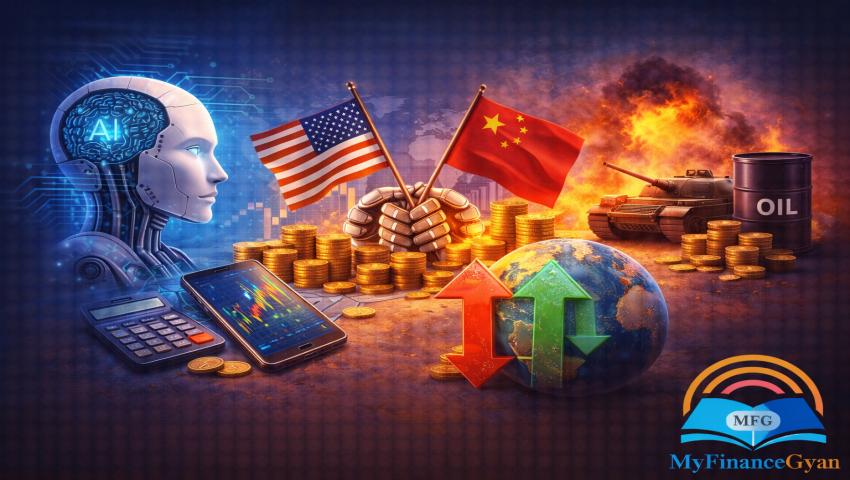
Artificial intelligence, rising trade tensions, and ongoing geopolitical instability are profoundly reshaping global financial markets. Together, these forces are influencing economic growth, inflation dynamics, risk premia, and—most importantly—the way investors think about diversification and asset allocation across regions and asset classes.
For investors, this environment demands a rethink of traditional portfolio construction. Static models based purely on historical averages are increasingly insufficient. Instead, there is a growing need for dynamic allocation, deeper sector and regional analysis, and a stronger focus on structural and geopolitical risk factors.
Why These Forces Matter Now?
What makes the current environment particularly challenging is that these three forces are unfolding simultaneously.
Artificial intelligence is accelerating productivity, transforming industries, and driving new investment cycles. At the same time, trade wars and geopolitical conflicts are fragmenting supply chains, reshaping global trade flows, and increasing policy uncertainty. Together, they amplify macroeconomic volatility and market risk.
From an asset allocation perspective, their impact is most visible through three key channels:
- Growth: AI has the potential to raise long-term growth, while trade wars and conflicts typically weaken near-term growth prospects.
- Inflation: Tariffs and supply disruptions tend to be inflationary, whereas AI-driven efficiency gains can be disinflationary.
- Risk premia: Heightened geopolitical and policy uncertainty usually leads investors to demand higher compensation for holding risky assets, particularly in emerging and frontier markets.
AI's Influence on Global Markets:
AI is transforming both financial markets and the real economy. In finance, AI and machine learning are increasingly used for algorithmic trading, portfolio optimization, risk modeling, credit assessment, and fraud detection.
Key market implications include:
- Faster price discovery: AI systems process vast amounts of structured and unstructured data—earnings calls, news, and even social media—leading to quicker market reactions.
- Liquidity effects: AI can improve liquidity, even in less liquid markets such as corporate credit and some emerging assets. However, it can also amplify sudden market moves when many models respond similarly to new information.
- Higher operational risk: Greater reliance on complex and opaque models increases exposure to model risk, bias, and cyber threats.
At the macro level, AI is expected to boost productivity, reshape labour markets, and drive large-scale investment in semiconductors, data centres, cloud infrastructure, and software. This creates long-term growth tailwinds for technology-intensive economies, while posing challenges for slower adopters and highly automatable sectors.
Trade Wars and Market Dynamics:
Trade wars—through tariffs, sanctions, and non-tariff barriers—introduce uncertainty into global growth and corporate earnings. They disrupt supply chains, raise input costs, and reduce export volumes, particularly for trade-dependent economies.
Historically, trade tensions tend to:
- Increase equity market volatility, especially in export-oriented sectors such as industrials, autos, and technology hardware.
- Pressure corporate margins, affecting earnings expectations and valuations.
- Drive investor rotation toward defensive sectors like utilities, consumer staples, and healthcare.
In currency and bond markets, trade conflicts often weaken trade-sensitive currencies while supporting safe-haven assets. Government bonds face mixed forces: weaker growth supports bond prices, while tariff-driven inflation can push yields higher.
Over time, persistent trade conflicts encourage supply-chain reconfiguration and regionalisation. This has lasting implications for country allocations, sector competitiveness, and global capital flows.
Geopolitical Instability and Risk Premia:
Geopolitical risks—including wars, sanctions, political fragmentation, and strategic rivalry—have become more frequent and persistent. Periods of elevated geopolitical risk are often associated with spikes in volatility and broad risk-off behaviour.
Major geopolitical shocks can:
- Trigger equity market sell-offs, particularly in regions directly exposed.
- Increase sovereign risk premia, especially in emerging markets with weaker fiscal positions.
- Drive sharp moves in currencies and commodities, notably energy prices.
Investors typically respond by increasing exposure to perceived safe havens such as high-quality government bonds, the US dollar, and gold. Certain sectors, including defence and energy, may benefit, while tourism, airlines, and cyclical industries often suffer.
How AI, Trade Wars, and Geopolitics Interact?
These forces are deeply interconnected. AI is now central to geopolitical competition, influencing national security, industrial policy, and technological sovereignty. Trade policies increasingly reflect strategic concerns around advanced technologies, data control, and critical supply chains.
This interaction creates powerful feedback loops:
- Technology sanctions and export controls directly affect semiconductor, cloud, and AI-related valuations.
- Regional blocs and alliances redirect trade and capital flows along geopolitical lines.
- AI-driven trading systems can amplify market reactions to geopolitical headlines, accelerating repricing across asset classes.
AI is a structural, long-term force, while trade wars and geopolitical shocks are more cyclical and event-driven. Yet together, they increasingly define the global investment landscape.
Implications for Asset Allocation:
Strategic asset allocation must adapt to higher uncertainty, fatter tail risks, and more frequent regime shifts. Models based solely on historical correlations may underestimate the impact of severe geopolitical or trade-related shocks.
Key implications include:
- Greater emphasis on resilience: Portfolios must withstand sudden volatility spikes and liquidity stress.
- More granular diversification: Sector, factor, and regional tilts matter more than broad index exposure.
- Dynamic risk management: Scenario analysis, stress testing, and conditional hedging are becoming essential tools.
Sector and Thematic Positioning in the AI Era:
AI is increasing return dispersion across sectors and firms. Beneficiaries include semiconductors, cloud providers, software companies, and data-centre infrastructure. Meanwhile, sectors slow to adopt AI may face margin pressure.
Investors often consider:
- Strategic overweight to high-quality AI enablers with strong balance sheets and durable competitive advantages.
- Selective exposure to AI adopters in healthcare, finance, and industrials.
- Active risk management to avoid overconcentration and valuation excesses in popular AI themes.
Regional Allocation and Trade Fragmentation:
Trade fragmentation is reshaping geographic diversification. Economies with large domestic markets or diversified trade relationships may be more resilient than smaller, export-dependent economies.
In practice, investors may:
- Adjust regional weights based on exposure to tariffs and supply-chain realignment.
- Increase exposure to nearshoring and “friend-shoring” beneficiaries.
- Monitor currency risk more closely, as exchange rates play a larger adjustment role during trade conflicts.
Geopolitical Risk and Safe-Haven Assets:
Persistent geopolitical stress reinforces the role of defensive assets in portfolios. Common responses include:
- Higher allocations to high-quality government bonds.
- Strategic exposure to gold and precious metals.
- Defensive equities and infrastructure assets with stable cash flows.
However, no single asset is a perfect hedge. Diversification across multiple defensive instruments remains essential.
Risk Management and Portfolio Construction:
Asset allocators are increasingly embedding AI, trade, and geopolitical risks into formal frameworks through stress testing, scenario analysis, and tail-risk modeling.
Evolving practices include:
- Scenario-based allocation across different geopolitical and technological regimes.
- Factor and thematic overlays to fine-tune exposure.
- Explicit tail-risk hedging using options and volatility strategies.
Regulators are also increasing expectations around model governance, operational resilience, and transparency, particularly where AI is involved.
Practical Takeaways for Investors:
Investors navigating this environment may consider:
- Reassessing long-term assumptions for growth, inflation, and correlations.
- Diversifying by underlying exposure, not just by asset label.
- Building resilience through liquidity buffers and balanced defensive allocations.
AI itself can also be used as a risk-management tool, supporting data analysis and early-warning signals—provided human oversight remains central.
By integrating AI-driven innovation with disciplined risk management and geopolitical awareness, investors can better position portfolios for a world where technological disruption, trade fragmentation, and geopolitical tension are enduring features rather than temporary shocks.
Disclaimer:
The views expressed in this article are personal and solely those of the author. The content is intended for educational and awareness purposes only and does not constitute investment advice or a recommendation of any financial product.