- 13/01/2026
- MyFinanceGyan
- 142 Views
- 2 Likes
- Finance
Why 6% GDP Growth With 5% Inflation Feels Very Different From 6% With 2%?
When Growth Doesn't Feel Like Prosperity?
Economic headlines love one number: GDP growth. A 6% growth rate is often presented as proof of strength, momentum, and national success. But for households, entrepreneurs, and investors, that single number rarely captures reality.
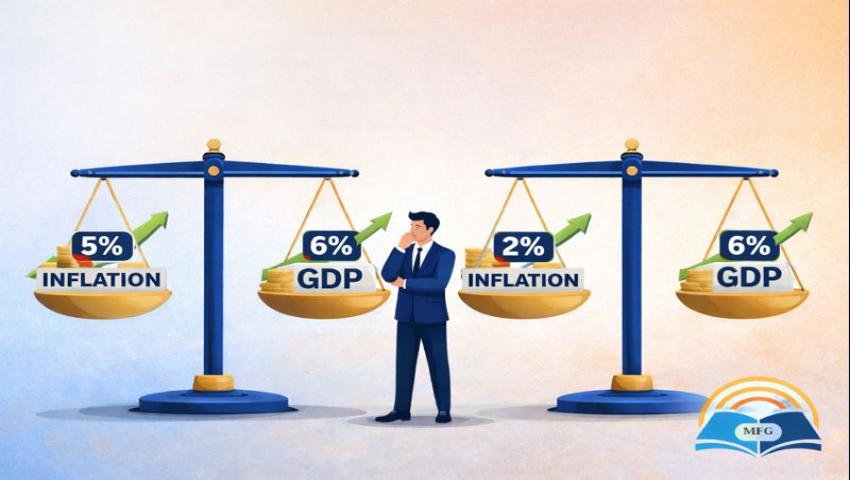
The real question isn’t just how fast the economy is growing, but how fast prices are rising alongside it. A 6% GDP growth rate paired with 2% inflation creates a very different lived experience than the same growth accompanied by 5% inflation.
On paper, both scenarios look equally healthy. In everyday life, they feel worlds apart. One fuels confidence and opportunity; the other quietly strains budgets and erodes trust. Understanding why reveals what truly drives prosperity.
GDP Growth vs Inflation: What the Numbers Actually Mean?
To understand the difference, it’s important to distinguish between nominal GDP and real GDP.
- Nominal GDP measures the total value of goods and services produced, without adjusting for price changes.
- Real GDP adjusts for inflation, showing how much actual output has increased.
In simple terms:
Real GDP growth = Nominal GDP growth – Inflation:
So, if nominal GDP grows by 11% and inflation is 5%, real growth is roughly 6%.
If nominal GDP grows by 8% and inflation is 2%, real growth is also about 6%.
Statistically, both economies grow at the same pace. But people don’t live in “real GDP” — they live in a world of salaries, prices, EMIs, and savings. That’s where the difference becomes tangible.
Why 6% Growth With Low Inflation Feels Better?
Although real output grows at the same rate in both cases, inflation determines whether people feel that growth.
1. Purchasing Power and Real Wages:
Inflation decides how much of your income you get to keep.
If wages rise 7%:
- With 5% inflation, real wage growth is only 2%
- With 2% inflation, real wage growth jumps to 5%
That gap defines whether households feel progress or pressure. High inflation quietly consumes salary increases, making essentials like food, fuel, rent, and healthcare feel more expensive even when incomes rise.
2. Interest Rates and Borrowing Costs:
Higher inflation forces central banks to raise interest rates.
In a 6% growth, 5% inflation environment:
- Home loans and personal loans become costlier
- EMIs rise
- Business borrowing slows
- Consumer spending weakens
With inflation at 2%, policymakers can keep rates lower, supporting investment, housing demand, entrepreneurship, and job creation. Growth becomes self-reinforcing rather than restrictive.
3. Savings and Wealth Creation:
Inflation directly eats into savings.
A fixed deposit earning 6%:
- With 5% inflation, delivers just 1% real return
- With 2% inflation, delivers 4% real return
Low inflation rewards patience and long-term planning. High inflation encourages people to chase riskier assets or simply spend quickly, weakening financial discipline across the economy.
4. Business Confidence and Planning:
Stable inflation makes business decisions easier.
When prices rise slowly and predictably:
- Cost planning improves
- Wage negotiations stabilize
- Expansion decisions feel safer
At 5% inflation, uncertainty dominates. Companies raise prices defensively, delay hiring, or postpone investments. Growth continues, but its quality deteriorates.
The Psychological and Political Impact of Inflation:
Economics isn’t just mathematics — it’s emotion.
- The Illusion of Growth: High inflation creates a “money illusion.” Salaries rise, revenues grow, GDP expands — but purchasing power barely improves. Over time, optimism turns into frustration as people realize they aren’t actually better off.
- Political Sensitivity: Inflation hits hardest where it matters most — essentials. Governments may highlight strong GDP numbers, but voters focus on grocery bills, rents, and fuel prices. Growth with high inflation rarely feels socially or politically sustainable.
Real-World Evidence: India and Beyond
- India’s Growth Experience: India frequently reports strong nominal growth of 8–10%, translating into real growth near 6%. When inflation stayed around 3–4%, growth felt supportive — lower EMIs, stronger consumption, and rising confidence. Post-2022, higher inflation changed that experience. The growth rate stayed similar, but higher fuel costs, rising interest rates, and weaker real returns made life feel tighter. The GDP number didn’t change much — its impact did.
- The U.S. Post-Pandemic Contrast: After the pandemic, the U.S. experienced rapid growth alongside inflation peaking near 9%. Despite strong GDP figures, real wages fell and household stress increased. When inflation cooled toward 2–3% by 2024, similar growth rates suddenly felt far healthier. The same economy — a very different experience.
Why Inflation Changes the "Quality" of Growth?
Lower inflation strengthens balance sheets and confidence. Higher inflation drains trust and squeezes the middle class — even when growth looks identical on paper.
The Policy Balance: Growth vs Price Stability
Economic policy isn’t about maximizing growth at any cost. It’s about sustainable growth.
- Low inflation allows investment, innovation, and long-term planning.
- High inflation forces households and businesses into defensive behavior — hoarding assets, chasing hedges, and avoiding productive risk.
That’s why central banks target inflation carefully. Growth without price stability often ends up being fragile, uneven, and short-lived.
How Inflation Shapes Sectoral Growth?
Even within the same GDP growth rate, inflation changes which sectors thrive:
- Consumer goods: High inflation weakens discretionary spending
- Real estate: Inflation raises costs but attracts speculative demand
- Manufacturing & tech: Low inflation supports R&D and expansion
- Financial services: High inflation distorts savings and credit pricing
Low-inflation growth tends to be broad-based and consumption-driven. High-inflation growth often relies more on nominal price effects than genuine demand.
Why Global Investors Care?
Foreign investors focus on real returns.
An economy growing at 6% with 5% inflation offers weaker currency stability and higher volatility than one growing at the same rate with 2% inflation. Low inflation signals credibility, discipline, and sustainable growth — key ingredients for long-term capital.
What Growth Feels Like at Home?
At the household level, the difference is simple:
With 2% inflation:
- Predictable expenses
- Manageable EMIs
- Positive savings returns
- Confidence to plan
With 5% inflation:
- Rising grocery bills
- Costlier loans
- Eroding savings
- Uncertainty about the future
That’s why growth isn’t felt in GDP reports — it’s felt at the checkout counter and in the bank statement.
Conclusion: Growth Is Real Only When Inflation Is Tamed
A 6% GDP growth rate can represent prosperity or pressure — depending entirely on inflation.
With low inflation, growth empowers households, rewards savers, and fuels optimism. With high inflation, growth feels hollow, even stressful, as purchasing power quietly slips away.
True prosperity isn’t just about expanding output — it’s about preserving the value of income and savings. For economies like India, balancing growth with price stability is the difference between impressive statistics and genuine well-being.
Because in the end, growth only matters if people can feel it.
Disclaimer:
The views expressed in this article are personal and solely those of the author. This content is intended for educational and awareness purposes only and does not constitute any product or investment recommendation.