- 12/01/2026
- MyFinanceGyan
- 122 Views
- 3 Likes
- Finance
Why Fast GDP Growth Can Coexist with High Unemployment and Inequality
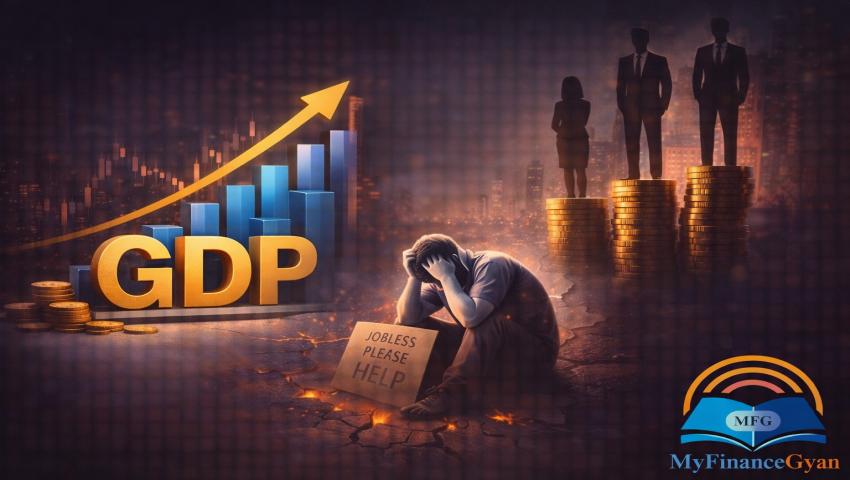
Economic growth is often celebrated as the ultimate sign of national progress. Headlines highlighting fast-rising GDP figures create an impression of prosperity and success. Yet, across the world, many countries experience a puzzling reality — GDP grows rapidly, but unemployment remains high and inequality continues to widen.
This paradox raises an important question: How can an economy expand while large sections of its population feel excluded from progress?
This article explores why rapid GDP growth does not automatically translate into jobs, equality, or shared prosperity.
Understanding GDP — And What It Fails to Capture:
Gross Domestic Product (GDP) measures the total value of goods and services produced within a country over a specific period. It is a useful indicator of overall economic activity and productivity, which is why governments and policymakers track it closely.
However, GDP has important limitations. It does not reveal:
- Who benefits from economic growth
- How income and wealth are distributed
- Whether employment opportunities are increasing or shrinking
- If growth is socially or environmentally sustainable
An economy may grow due to rising corporate profits, automation, or export-led sectors — without improving job creation or reducing inequality. In short, GDP measures the quantity of economic activity, not its quality or inclusiveness.
Why GDP Growth Doesn't Always Create Jobs?
One major reason growth and employment diverge is the changing nature of modern economies.
Technology and Automation:
Technological progress boosts productivity — producing more output with fewer workers. While this raises GDP, it often reduces demand for labour.
- Automation replaces routine manufacturing jobs
- Artificial intelligence handles administrative and analytical tasks
- Digital platforms centralise services, displacing traditional roles
As companies become more efficient, profits and GDP rise, but employment growth slows or declines — leading to what economists call jobless growth.
Capital-Intensive Growth:
Certain industries generate high output with minimal employment. Sectors like oil, mining, finance, and high-tech manufacturing contribute significantly to GDP but employ relatively few people.
When growth is driven by such sectors, the benefits remain concentrated. For example, parts of India’s growth in the 2010s were led by IT and financial services — sectors that added substantial value but created limited jobs for the country’s large low-skilled workforce.
Structural Shifts and Globalisation:
As economies modernise, they often shift from agriculture to manufacturing and then to services. While this transition boosts GDP, many workers struggle to adapt.
Globalisation further complicates the picture:
- Low-cost imports can destroy domestic industries
- Manufacturing jobs may move overseas
- Service jobs may be outsourced
Without adequate reskilling programs or safety nets, workers displaced by these changes remain unemployed or move into informal, low-paying work — even as GDP continues to grow.
Why Inequality Rises During High Growth?
Contrary to the idea that “a rising tide lifts all boats,” many countries have experienced rising inequality during periods of rapid economic growth.
Unequal Distribution of Income and Wealth:
Growth increasingly benefits those who own capital rather than those who rely on wages.
- Corporate profits rise faster than salaries
- Wealth accumulates through stocks, real estate, and financial assets
- Low-skilled wages grow slowly or stagnate
As a result, while average income increases, the median worker often sees little improvement in living standards.
The Growing Skills Gap:
Modern economies reward education, technology skills, and specialization. Workers in sectors like software, finance, and biotechnology earn far more than those in manual or routine jobs.
Limited access to quality education and digital infrastructure deepens inequality between:
- Skilled and unskilled workers
- Urban and rural populations
- Digitally connected and disconnected communities
Global Capital Mobility:
In today’s globalised economy, capital moves freely across borders in search of higher returns. While foreign investment can boost GDP, it often favours automation-heavy projects that generate limited employment.
Moreover, profits may be repatriated abroad or captured by domestic elites, further concentrating wealth rather than spreading it widely.
Policy and Institutional Weaknesses:
Economic growth outcomes depend heavily on policy choices.
- Tax systems that favour corporations and the wealthy
- Weak labour protections
- Limited social spending
These factors prevent growth benefits from reaching the broader population. Countries with strong institutions and redistributive policies — such as Denmark or South Korea — tend to achieve more inclusive growth than those with weaker governance structures.
Technology and the Digital Economy: Growth Without Inclusion
The digital economy highlights how GDP growth can occur without broad participation.
- Technology firms generate enormous value and exports
- They employ far fewer people than traditional industries
- Wealth concentrates among founders, shareholders, and executives
The result is a winner-takes-all economy. Even the gig economy, often praised for flexibility, frequently involves informal work, low wages, and little job security — reinforcing inequality despite rapid digital-led growth.
Globalisation and Job Displacement:
Globalisation boosts efficiency by allowing countries to specialise based on comparative advantage. While this raises global GDP, it redistributes jobs unevenly.
- Manufacturing shifts from high-wage to low-wage countries
- Routine services are outsourced
- Local industries collapse under foreign competition
Regions that lose industries face unemployment and wage stagnation, even as national or global GDP figures look strong.
Looking Beyond GDP: Better Measures of Progress:
Recognising GDP’s limitations, economists increasingly rely on alternative indicators:
- Gini Coefficient: Measures income inequality
- Human Development Index (HDI): Combines income, education, and health
- Inclusive Development Index (IDI): Assesses how equitably growth is shared
- Gross National Happiness (GNH): Focuses on well-being and quality of life
These measures often reveal that fast GDP growth does not always improve everyday living conditions.
The Role of Policy in Making Growth Inclusive:
Governments play a crucial role in ensuring growth benefits more people. Key policy measures include:
- Investing in education and skill development: Focus on vocational, digital, and future-ready skills
- Promoting labour-intensive industries: Support SMEs and local manufacturing
- Strengthening social safety nets: Provide unemployment benefits and direct income support
- Reforming taxation and redistribution: Use progressive taxes to reduce inequality
- Encouraging inclusive innovation: Support rural entrepreneurship and digital access
- Balancing globalisation with local development: Liberalise gradually while protecting vulnerable sectors
Real-World Examples:
India: Service-Led Growth:
India’s rapid GDP growth has been driven by IT, finance, and communication services. However, these sectors employ a small, skilled workforce, leaving much of the population in informal or low-income jobs — widening regional and income inequality.
United States: The Automation Paradox:
Despite strong growth in technology and finance, middle-class wages in the U.S. have stagnated. Automation, outsourcing, and declining union power have polarised the labour market.
China: Growth and Rebalancing:
China’s industrial growth lifted millions out of poverty, but recent capital-intensive growth has increased inequality. The government’s focus on “common prosperity” reflects efforts to rebalance development.
Why GDP Growth Still Matters — But Isn't Enough:
GDP growth remains important. It provides governments with resources to invest in infrastructure, welfare, and innovation. However, growth without inclusion creates social tension, political instability, and long-term economic risks.
Sustainable development requires both economic expansion and equitable distribution.
Conclusion:
Fast GDP growth can coexist with high unemployment and inequality because economic output and human welfare do not always move together. Technology, globalisation, and unequal access to resources can boost GDP while excluding large sections of society.
True progress requires looking beyond headline growth numbers to how incomes, opportunities, and well-being are distributed. Only by combining growth with inclusive policies — focused on education, employment, and social protection — can nations ensure prosperity that is both real and widely shared.
Disclaimer:
The views expressed in this article are personal and solely those of the author. This content is intended for awareness and educational purposes only and does not constitute any product or investment recommendation.