- 23/02/2026
- MyFinanceGyan
- 143 Views
- 2 Likes
- Company Law
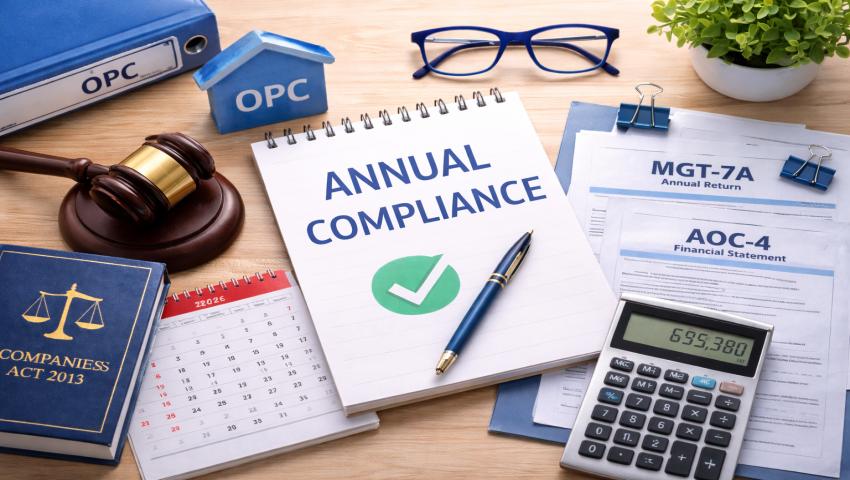
Annual Compliance of One Person Company (OPC): Complete Guide for Business Owners (2026)
The One Person Company (OPC) structure was introduced under the Companies Act, 2013 to encourage individual entrepreneurs to operate within a corporate framework while enjoying limited liability and separate legal identity.
An OPC combines the simplicity of sole proprietorship with the credibility and recognition of a private limited company.
However, many business owners mistakenly believe that since there is only one member, compliance requirements are minimal or optional. This is incorrect. Annual compliance of One Person Company is mandatory and must be completed on time to avoid penalties and maintain active status.
This guide explains OPC annual compliance requirements, due dates, audit rules, penalties, and best practices in a simplified manner.
What Is Annual Compliance of One Person Company?
Annual compliance of an OPC refers to statutory obligations that must be fulfilled every financial year under:
- The Companies Act, 2013
- The Income Tax Act, 1961
- MCA rules and related regulations
These compliances ensure:
- Financial transparency
- Director accountability
- Updated records with the Ministry of Corporate Affairs (MCA)
Even though an OPC has a single shareholder and director, it is treated as a separate legal entity and must follow corporate compliance norms.
Why OPC Annual Compliance Is Important?
Compliance is not merely procedural—it safeguards both the company and its owner.
Key Benefits of Timely Compliance:
- Keeps the OPC legally active
- Prevents late fees and penalties
- Avoids director disqualification
- Ensures smooth banking and financial transactions
- Builds credibility with lenders and vendors
- Facilitates easy conversion into a private limited company
Non-compliance can lead to financial penalties, legal notices, and even strike-off proceedings.
Who Is Responsible for OPC Compliance?
In an OPC, the sole director is responsible for ensuring compliance.
Even if professionals (CA/CS) are engaged to handle filings, the legal responsibility ultimately rests with the director. Therefore, every OPC owner should understand the basic annual compliance framework.
Key Annual Compliance Requirements for OPC:
The major compliance requirements include:
- Board Meetings
- Statutory Audit
- Filing Financial Statements (Form AOC-4)
- Filing Annual Return (Form MGT-7A)
- Income Tax Return Filing
- Director KYC (DIR-3 KYC)
One major advantage: OPCs are not required to hold an Annual General Meeting (AGM), which simplifies compliance compared to other companies.
Board Meetings in OPC:
Even though there is only one director, certain provisions apply.
Board Meeting Rules:
- At least one board meeting in each half of the calendar year
- Minimum gap of 90 days between two meetings
If the OPC has only one director, meeting requirements are relaxed, but decisions must still be properly recorded in the minutes.
Audit of Accounts – Mandatory for All OPCs:
Unlike LLPs, statutory audit is compulsory for every OPC, regardless of turnover or profit.
Audit Requirements:
- Auditor must be appointed within 30 days of incorporation
- Annual statutory audit must be conducted by a Chartered Accountant
- Audit report is required for MCA and income tax filings
Audit ensures accuracy, transparency, and adherence to accounting standards.
Filing Financial Statements – Form AOC-4:
What Is AOC-4? -> Form AOC-4 is used to file the company’s financial statements with the Registrar of Companies (ROC).
Documents Included:
- Balance Sheet
- Profit & Loss Account
- Auditor’s Report
- Notes to Accounts
Due Date for OPC: Within 180 days from the end of the financial year. This extended timeline is a special benefit available to O
Filing Annual Return – Form MGT-7A:
What Is MGT-7A? -> MGT-7A is the simplified annual return form applicable to OPCs and small companies.
Information Covered:
- Shareholding details
- Director information
- Registered office details
- Capital structure
Due Date: Within 60 days from the date of filing AOC-4. OPCs are required to file MGT-7A (not MGT-7).
Income Tax Return Filing for OPC:
Every OPC must file its income tax return annually.
Applicable Form: ITR-6
Due Date: 31st October (since audit is mandatory). Even if there is no business activity or income, filing remains compulsory.
Director KYC – DIR-3 KYC:
Every director holding a DIN must complete annual KYC.
Key Points:
- Mandatory for OPC directors
- Filed using DIR-3 KYC or DIR-3 KYC Web
- Non-filing leads to DIN deactivation
DIN deactivation can block company filings and cause operational issues.
Due Date: 30th June (as per latest update)
OPC Annual Compliance Timeline Summary:
Penalties for Non-Compliance:
Failure to meet deadlines may result in:
Monetary Penalties:
- ₹100 per day late fee on AOC-4 and MGT-7A (subject to limits)
- Penalties under the Companies Act
- Additional tax penalties and interest
Non-Monetary Consequences:
- Director disqualification
- Company marked non-compliant on MCA portal
- Difficulty in opening bank accounts or raising funds
- Risk of strike-off by ROC
Continuous non-compliance can severely impact business continuity.
Common Myths About OPC Compliance:
- Only One Owner Means No Compliance: Incorrect. OPCs are companies and must comply with corporate law.
- No Business Means No Filing: False. Even dormant OPCs must complete annual filings.
- No AGM Means No Obligations: AGM exemption reduces one requirement but does not remove annual compliance.
OPC vs Private Limited Company – Compliance Comparison:
Best Practices for Smooth OPC Compliance:
To manage compliance efficiently:
- Maintain updated accounting records
- Plan compliance calendar in advance
- Monitor MCA and tax deadlines
- Conduct audit preparation early
- Seek professional advice when needed
Timely compliance avoids penalties and ensures business stability.
Conclusion:
Annual compliance of One Person Company is a critical responsibility for every OPC owner. Though OPCs benefit from certain relaxations and extended timelines, statutory filings are mandatory.
Understanding the requirements—AOC-4, MGT-7A, audit obligations, income tax filing, and director KYC—helps entrepreneurs stay compliant, avoid penalties, and build long-term business credibility.
In today’s regulatory environment, compliance is not just about following the law—it is about safeguarding your business and strengthening its foundation for future growth.
Disclaimer:
The views expressed in this article are personal and intended solely for educational and awareness purposes. This content does not constitute professional, legal, or financial advice and is not intended to recommend any specific product or service.