
- 20/12/2025
- MyFinanceGyan
- 327 Views
- 4 Likes
- Finance
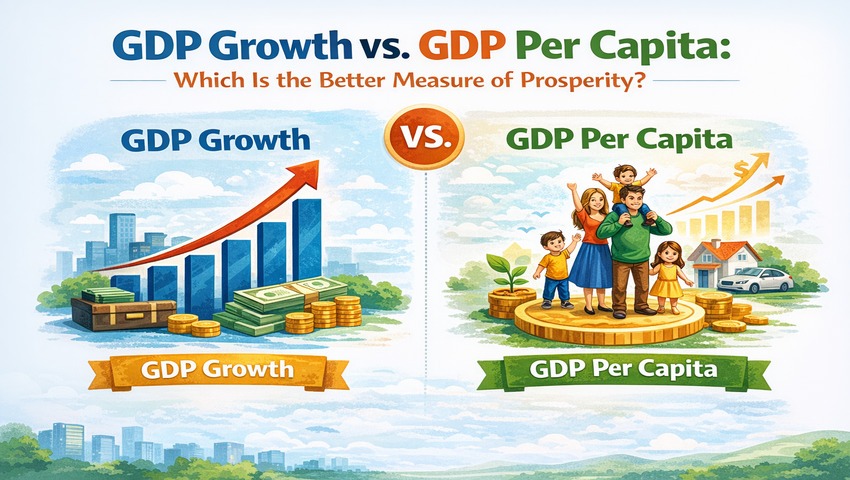
GDP Growth vs. GDP Per Capita: Which Is the Better Measure of Prosperity?
In discussions about the global economy, few numbers receive as much attention as Gross Domestic Product (GDP). Governments, investors, economists, and media outlets rely on GDP data to judge how well a country is performing.
Yet an important question often goes unanswered: Is rising GDP enough to claim a nation is truly prosperous? Or does GDP per capita provide a clearer picture of how well people are actually living?
This article explores the difference between GDP growth and GDP per capita, explains why both matter, and examines which indicator offers a more accurate measure of real prosperity.
Understanding GDP: The Foundation of Economic Measurement:
What Is GDP?
Gross Domestic Product (GDP) represents the total market value of all goods and services produced within a country during a specific period, typically a year.
In simple terms, it measures how much an economy produces. The more goods and services created and sold, the higher the GDP.
GDP is calculated using three standard methods:
- Production approach: Adds the value created by all industries
- Expenditure approach: Totals spending on consumption, investment, government expenditure, and net exports
- Income approach: Adds all incomes earned, including wages, profits, rent, and interest
Each approach captures the same economic activity from a different angle.
GDP Growth: Measuring Economic Momentum:
GDP growth refers to the percentage increase in a country’s total economic output over a given period.
For example, if an economy grows from $3 trillion to $3.3 trillion in one year, it has recorded 10% GDP growth. Strong growth generally indicates rising production, increased investment, expanding businesses, and job creation.
Why GDP Growth Matters?
Policymakers and investors pay close attention to GDP growth because it often:
- Signals expanding economic activity
- Supports job creation and higher employment
- Increases government revenues
- Attracts foreign and domestic investment
In developing economies, rapid GDP growth is especially important for building infrastructure and reducing poverty.
The Limits of GDP Growth Alone:
While GDP growth is vital, relying on it alone can be misleading.
- Unequal distribution: Growth may benefit only a small section of society
- Environmental damage: Fast growth can come at the cost of pollution and resource depletion
- Short-term booms: Debt-driven growth may not be sustainable
- Population pressure: If population grows faster than GDP, individual prosperity can fall
Countries like India and Nigeria often show strong GDP growth, yet average living standards remain modest due to large populations and inequality.
GDP Per Capita: Prosperity Per Person
GDP per capita is calculated by dividing total GDP by the population. It reflects the average economic output or income per individual.
This adjustment makes GDP per capita a better indicator of how prosperous people are on average.
Why GDP Per Capita Matters?
A higher GDP per capita generally suggests:
- Better access to healthcare and education
- Improved housing and infrastructure
- Higher disposable incomes
- Greater overall living standards
It allows meaningful comparisons between countries of different sizes.
A Simple Comparison:
Consider two countries:
Country A:
- GDP = $1 trillion
- Population = 50 million
- GDP per capita = $20,000
Country B:
- GDP = $1 trillion
- Population = 200 million
- GDP per capita = $5,000
Although both economies are the same size, citizens of Country A enjoy a significantly higher standard of living. This demonstrates why GDP per capita often tells a more realistic story.
Limitations of GDP Per Capita:
Despite its usefulness, GDP per capita is not perfect:
- Ignores income inequality: Averages can hide extreme wealth gaps
- Excludes unpaid work: Household and caregiving activities are not counted
- Overlooks well-being: Mental health, safety, and happiness are absent
- Purchasing power differences: Cross-country comparisons require PPP adjustments
Thus, GDP per capita is closer to measuring prosperity, but still incomplete.
Prosperity Beyond Numbers:
A Broader Definition of Prosperity:
True prosperity includes more than income. It encompasses:
- Health and education
- Safety and governance
- Social trust and freedom
- Environmental sustainability
Indices like the Legatum Prosperity Index and Human Development Index (HDI) capture these dimensions more effectively than GDP alone.
Countries such as Norway and Switzerland rank high not just because of income, but because of balanced investment in human well-being.
GDP Growth vs. GDP Per Capita: A Clear Comparison
When GDP Growth Matters More?
- Early-stage or emerging economies
- Infrastructure development
- Employment generation
When GDP Per Capita Becomes More Important?
- Developed economies
- Quality-of-life improvements
- Productivity and wage growth
Real-World Examples:
United States vs. China:
China often grows faster in total GDP, but its per capita income remains far lower due to population size. The U.S., despite slower growth, delivers higher individual prosperity.
Small but Wealthy Nations:
Countries like Luxembourg and Qatar demonstrate how high GDP per capita can exist with relatively small total economies.
India:
India’s rapid GDP growth has made it a global economic force, yet improving GDP per capita remains key to raising living standards across its population.
Population and Prosperity:
Population trends heavily influence prosperity metrics:
- Fast population growth can dilute per capita gains
- Aging populations may slow GDP growth despite high living standards
This is why economists often track real GDP per capita growth, which combines both output and population changes.
Alternative Measures of Progress:
To capture a fuller picture, many economists use additional indicators:
- Genuine Progress Indicator (GPI)
- Gross National Happiness (Bhutan)
- Social Progress Index (SPI)
- Green GDP
These frameworks reflect a growing emphasis on sustainable and inclusive growth.
Which Is the Better Measure of Prosperity?
There is no single winner.
- GDP growth shows how fast an economy is expanding
- GDP per capita shows how well people are living
In simple terms:
- GDP growth measures speed
- GDP per capita measures outcomes
Used together — and supported by social and environmental indicators — they offer the clearest view of real prosperity.
Final Thoughts:
A growing economy is important, but growth alone does not guarantee better lives. True prosperity is about ensuring that economic gains translate into meaningful improvements for people — fairly, sustainably, and inclusively.
The ultimate goal is not just a larger economy, but a better quality of life for all citizens.
Disclaimer:
The views expressed in this article are personal and intended solely for educational and awareness purposes. This content does not provide or recommend any financial, investment, or commercial products.