
- 09/01/2026
- MyFinanceGyan
- 211 Views
- 3 Likes
- Finance
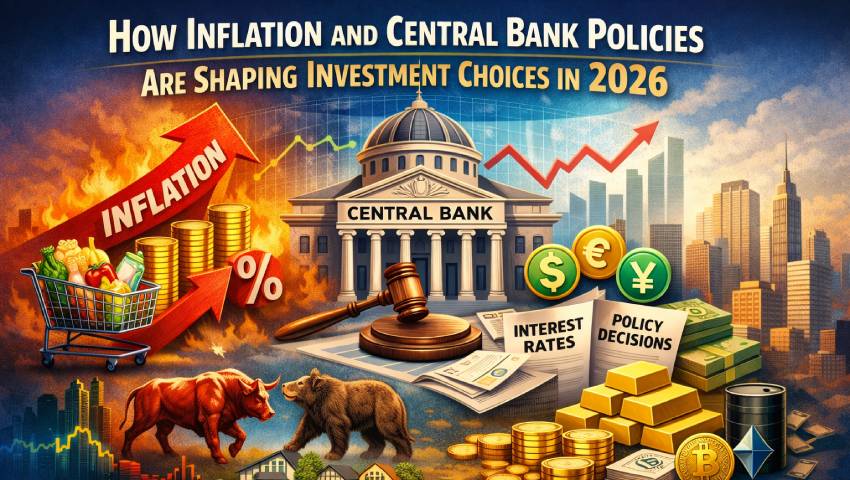
How Inflation and Central Bank Policies Are Shaping Investment Choices in 2026?
Inflation across many advanced economies has cooled significantly from the post-pandemic highs, but it has not fully returned to the ultra-low levels seen before 2020. Central banks are increasingly signaling a “higher for longer” approach—aiming to keep inflation close to target without allowing price pressures to re-emerge.
For investors, this suggests a new reality: moderate but persistent inflation rather than a quick return to near-zero inflation. As a result, investment strategies that can preserve purchasing power and generate real returns become more important than ever.
What "Rate Recalibration" Really Means?
In 2026, “rate recalibration” refers to central banks gradually shifting policy rates from restrictive levels toward more neutral settings. After aggressive interest-rate hikes between 2022 and 2024, policymakers are now balancing inflation control with economic growth and financial stability.
This does not imply a smooth or predictable rate-cut cycle. Instead, investors should expect a data-dependent path, with a mix of pauses, small cuts, or even occasional hikes depending on inflation, employment, and growth trends.
Higher Real Rates and Asset Valuations:
Even as policy rates potentially ease, real interest rates (nominal rates minus inflation) are likely to remain higher than in the 2010s. Higher real rates typically pressure valuations of long-duration assets, such as high-growth equities and long-maturity bonds, because future cash flows are discounted more heavily.
At the same time, higher real yields make short-term government bonds and high-quality money-market instruments more attractive relative to riskier assets—reshaping portfolio construction decisions.
Equities: A Shift Toward Quality and Pricing Power
In a 2026 environment marked by moderate inflation and recalibrated rates, equity investors are likely to focus on three key attributes:
- Earnings resilience and quality: Companies with strong free cash flow, high returns on capital, and manageable debt levels are better positioned when financing costs remain elevated.
- Pricing power: Businesses that can pass rising costs to customers—often in healthcare, consumer staples, select technology, and industrial segments—are more likely to protect margins.
- Dividend growth: Firms with a consistent history of dividend growth can offer partial inflation protection while still providing long-term growth exposure.
The balance between growth and value styles may remain fluid. Growth stocks could benefit if central banks signal a credible easing path, while value and cyclical sectors may perform well if inflation cools without triggering a recession.
Fixed Income: Back at the Core of Portfolios
After years of low yields, fixed income has regained strategic importance. Higher starting yields provide a stronger income buffer against price volatility.
- Short-duration bonds can offer attractive yields with lower sensitivity to rate changes amid uncertainty.
- Investment-grade credit becomes more selective, favoring issuers with strong balance sheets and stable cash flows.
- Long-duration bonds may perform well if inflation convincingly returns to target, but they remain vulnerable if inflation stays sticky.
Many investors are rebuilding high-quality bonds as a true diversification tool, expecting them once again to cushion portfolios during equity market stress.
Inflation-Linked Bonds and Real Assets:
When inflation uncertainty remains elevated, inflation-indexed bonds (such as TIPS) become especially relevant, as they adjust principal and interest payments in line with inflation.
Beyond bonds, real assets—including infrastructure, select real estate, and certain commodities—can provide varying degrees of inflation protection. The focus, however, should be on assets with strong demand fundamentals, durable contracts, and prudent leverage in a higher-rate environment.
Cash and Money Market Funds:
In the past, cash offered little return. In a recalibrated rate environment, cash and money-market funds now provide meaningful income with minimal duration risk.
That said, remaining overweight in cash for too long can lead to opportunity costs if markets begin pricing a more supportive policy cycle. Investors must balance capital preservation with participation in risk-asset recoveries.
Real Estate in a Higher-Rate World:
Real estate investing in 2026 requires careful evaluation through both inflation and interest-rate lenses. Inflation can support rent growth and replacement costs, particularly in logistics, data centers, and high-quality residential assets. However, higher financing costs and tighter credit conditions challenge highly leveraged owners.
Preferred characteristics include:
- Prime locations with strong occupancy and long-term leases
- Exposure to structural trends such as digitalization and demographic shifts
- Conservative leverage and diversified tenant profiles
Commodities and Gold:
Commodities can act as short- to medium-term hedges against inflation shocks, especially energy and industrial metals, though they remain sensitive to economic cycles and geopolitics.
Gold often performs well when real yields decline, inflation uncertainty rises, or geopolitical risks increase. In 2026, gold may serve more as a risk-management and diversification tool rather than a pure growth asset.
The Power of Central Bank Communication:
Markets increasingly react not just to rate decisions but to central bank communication—including forward guidance, press conferences, and official reports. Clear messaging about how policymakers respond to data can reduce volatility, while surprises or inconsistent signals can lead to sharp market moves across asset classes and currencies.
Currency Strategies in a Diverging Policy World:
Differences in inflation and monetary policy paths across countries create both risks and opportunities in foreign exchange markets. Currencies backed by higher real rates, credible central banks, and solid growth prospects may attract capital.
For global investors, currency exposure becomes a deliberate choice—either hedged to reduce volatility or selectively used to benefit from macroeconomic divergences.
Active vs. Passive Investing in 2026:
Periods of stable inflation and rates often favor passive strategies. However, in an environment of shifting inflation dynamics and rate recalibration, dispersion between winners and losers increases.
This can favor active management:
- In equities, by identifying firms with sustainable margins and balance-sheet strength
- In fixed income, by avoiding weaker credits and exploiting yield-curve opportunities
- Across asset classes, by adjusting exposures as macro signals evolve
Passive strategies remain valuable for core exposure, but many investors may complement them with targeted active allocations.
Risk Management and Scenario Planning:
With ongoing inflation and rate uncertainty, scenario analysis becomes critical. Investors may test portfolios against outcomes such as:
- Faster-than-expected inflation normalization and aggressive easing
- Persistent inflation keeping rates elevated
- Sharp growth slowdowns forcing difficult policy trade-offs
Preparing for multiple outcomes helps improve resilience and flexibility.
Multi-Asset Portfolio Positioning in 2026:
Key principles guiding diversified portfolios include:
- Re-establishing high-quality fixed income as both an income and diversification engine
- Maintaining equity exposure tilted toward quality, pricing power, and secular growth
- Incorporating explicit inflation hedges such as inflation-linked bonds and real assets
- Using cash strategically as stability and dry powder
Staying Focused on Real Returns:
For long-term investors—retirement savers, endowments, and family offices—the ultimate goal remains protecting and growing purchasing power. In 2026, this means building portfolios that are resilient to inflation surprises and flexible enough to adapt as central banks continue recalibrating policy.
Disclaimer:
The views expressed in this article are personal and solely those of the author. This content is intended for educational and awareness purposes only and does not constitute investment advice or product