- 21/08/2025
- MyFinanceGyan
- 719 Views
- 3 Likes
- Tax
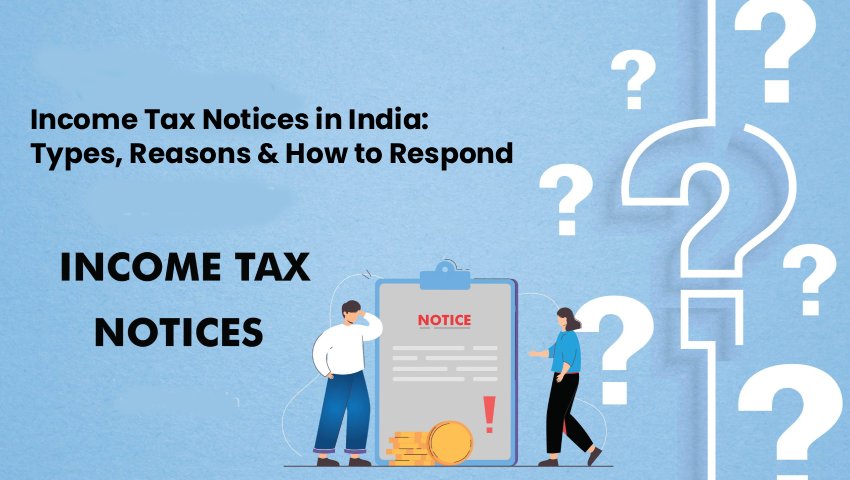
Income Tax Notices in India: Types, Reasons & How to Respond
Paying taxes on time is a duty for every Indian citizen and business owner. But sometimes, even after filing your Income Tax Return (ITR), you may receive a notice from the Income Tax Department. These notices can often cause stress, but in reality, they serve as a means for the department to communicate with you about discrepancies, pending issues, or clarifications. In this detailed guide by My Finance Gyan, we will cover everything about Income Tax Notices in India in 2025 – their types, reasons, legal provisions, response timelines, penalties for non-compliance, and how you can handle them confidently.
Introduction to Income Tax Notices in India:
Many taxpayers think that receiving an income tax notice means they have done something wrong. But that’s not always true. The Income Tax Department issues notices for multiple reasons – sometimes just to seek clarification, to inform you of a mismatch in your tax details, or to remind you of compliance. Understanding these notices is important because:
- They help you correct errors in your ITR.
- They allow you to provide proof of transactions.
- They ensure transparency between you and the tax department.
With the new updates in 2025, My Finance Gyan ensures you stay ahead by explaining every notice clearly so you don’t panic when one lands in your inbox.
What is an Income Tax Notice?
An Income Tax Notice is an official communication sent by the Income Tax Department of India to a taxpayer. It may be sent via email, SMS, or post, and is also available in your e-filing portal account.
For example:
- If you filed your ITR late, you may receive a notice under Section 234F.
- If your TDS mismatch shows in Form 26AS, you might get an intimation under Section 143(1).
Simply put, an Income Tax Notice in India is a request for additional details, clarification, or rectification of errors.
Why Do You Get an Income Tax Notice?
You may receive a notice for several reasons. Some are serious, while others are routine checks. The most common situations include:
- Mismatch in income reported in ITR vs. Form 26AS or AIS.
- Claiming higher deductions without proper proof.
- Not filing ITR despite having taxable income.
- Suspicious high-value transactions (e.g., property purchase above ₹30 lakh).
- Delay in filing the return.
- Random scrutiny under Section 143(2).
Top Reasons for Receiving an Income Tax Notice:
Here are the detailed reasons that commonly trigger an income tax notice in India:
- Mismatch in Tax Credit (Form 26AS/AIS): If your employer deducted TDS but you did not report the same in your ITR, the system automatically flags it.
- Undisclosed Income: Any unreported bank interest, property rental income, or capital gains may attract notice.
- High-Value Cash Transactions: Depositing more than ₹10 lakh in savings accounts, or ₹50 lakh in current accounts.
- Property Transactions: Buying or selling property above ₹30 lakh without proper disclosure.
- Foreign Income and Assets: Non-disclosure of overseas accounts or foreign assets.
- Claiming Wrong Deductions: Incorrect claims under Sections 80C, 80D, or HRA.
- Non-Filing of Returns: If you fall under the taxable limit but fail to file, the ITD issues a notice.
- Random Scrutiny: Sometimes, returns are picked up randomly for scrutiny as part of the compliance system.
Legal Provisions Related to Income Tax Notices:
Every income tax notice is issued under a specific section of the Income Tax Act, 1961. Some common ones are:
- Section 143(1): Intimation notice after filing Income tax Return (for mismatches or tax payable/refund).
- Section 143(2): Scrutiny notice, where your return is selected for detailed examination.
- Section 148: Notice for income escaping assessment (undisclosed income).
- Section 139(9): Defective return notice, asking you to correct errors.
- Section 245: Adjustment of refund against tax demand.
- Section 156: Demand notice to pay outstanding tax.
Knowing these provisions helps you understand the seriousness of each notice.
Different Types of Income Tax Notices & Intimations:
Here are the major types of income tax notices in India, explained simply:
- Intimation under Section 143(1): Issued after filing ITR; highlights mismatches or confirms tax/refund.
- Notice under Section 143(2): Sent for scrutiny to check the correctness of the return.
- Notice under Section 148: If the department suspects you have hidden income.
- Notice under Section 139(9): For defective returns (like missing annexures, wrong details).
- Notice under Section 245: If your refund is being adjusted against previous dues.
- Notice under Section 156: Demand notice for pending tax liabilities.
- Notice under Section 131: Summons for investigation of undisclosed income.
These notices differ in purpose, but each one requires a timely and accurate response.
Documents Required to Reply to an Income Tax Notice:
To respond properly, you must keep certain documents ready. These include:
- PAN card and Aadhaar card.
- Form 16 or salary slips.
- Form 26AS and AIS statement.
- Bank statements.
- Proof of investments (LIC, ELSS, PPF, etc.).
- Property sale/purchase documents.
- Loan statements (home loan, education loan).
- Other proofs depend on the type of notice.
Time Limit for Responding to an Income Tax Notice:
Generally, you get 15 to 30 days to respond to an income tax notice. The exact timeline is mentioned in the notice itself. If you fail to respond:
- The department may finalise the assessment without your input.
- Penalties and interest may be levied.
Always respond within the specified timeline.
How to Reply to an Income Tax Notice Online:
Thanks to digitalisation, you can now reply to income tax notices online through the e-filing portal. Here’s the step-by-step process:
- Log in to the Income Tax e-filing portal.
- Go to Pending Actions → e-Proceedings.
- Select the notice you received.
- Read the details carefully.
- Upload the required documents in PDF format.
- Submit your response and keep an acknowledgement copy.
This process ensures faster resolution and avoids unnecessary visits to the tax office.
Steps to Take After Receiving an Income Tax Notice:
Here are the best practices you should follow:
- Don’t Panic: Most notices are routine, not punishment.
- Read Carefully: Check the section under which it is issued.
- Match with Records: Compare the notice with your ITR, Form 26AS, and bank statements.
- Collect Documents: Keep proofs ready.
- Respond on Time: Never delay beyond the given deadline.
- Take Professional Help: Consult a CA or tax expert for complex issues.
Penalties for Ignoring an Income Tax Notice:
If you ignore a notice, the consequences can be serious:
- Penalty up to 200% of the tax amount in case of concealment.
- Interest under Section 234A/B/C for delayed payment.
- Prosecution under Section 276CC, in extreme cases of willful evasion.
- Freezing of bank accounts or attachment of assets in rare situations.
This makes it clear – never ignore an income tax notice.
Professional Help: Why Consult a CA or Tax Expert?
Handling income tax notices can be tricky, especially when legal provisions are involved. A Chartered Accountant (CA) or tax professional can:
- Analyse the notice and its implications.
- Prepare a proper response with supporting documents.
- Represent you before the department if needed.
- Save you from penalties and interest.
Professional guidance ensures peace of mind and compliance.
Conclusion: Stay Compliant and Respond on Time
Receiving an Income Tax Notice in India in 2025 is not something to fear. It is simply a communication from the Income Tax Department to ensure your tax records are accurate and transparent. To summarise:
- Understand the type of notice and its section.
- Gather documents and cross-check details.
- Respond online within the given deadline.
- Consult a CA or tax expert for complex issues.
At My Finance Gyan, we bring you the latest updates and practical guides on taxation, personal finance, and compliance, so you never miss important changes. For legal help in responding to income tax notices, you can also consult professionals at Startup Portal, who specialise in tax compliance and business services.