- 04/04/2026
- MyFinanceGyan
- 30 Views
- 5 Likes
- Company Law
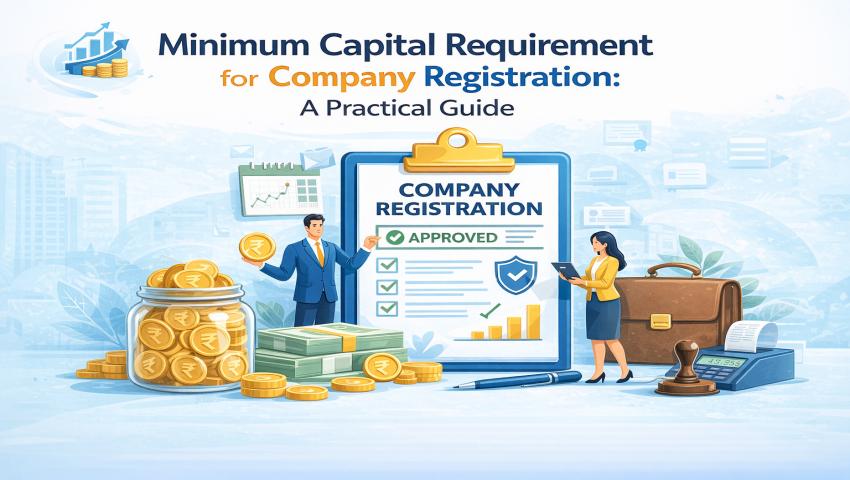
Minimum Capital Requirement for Company Registration: A Practical Guide
Starting a company is a major milestone for any entrepreneur. While ideas and execution drive success, building a strong legal and financial foundation is equally important. One of the most frequently asked questions during incorporation is about the minimum capital requirement for company registration.
In recent years, India’s corporate laws have evolved to simplify business formation. The removal of strict minimum capital requirements has made it easier for startups and small businesses to formalize their operations. However, many entrepreneurs still remain confused about how much capital is actually needed.
This guide explains the concept of share capital, current legal provisions, and practical considerations for choosing the right capital structure with expert insights from My Finance Gyan.
What Is Capital in Company Registration?
Capital refers to the money invested by shareholders in a company at the time of incorporation. This amount is recorded as share capital in the company’s financial statements.
Share capital represents:
- Ownership in the company
- Financial commitment of shareholders
- The base for business operations
It is divided into shares, each having a fixed nominal value. Capital is not just a legal formality—it also influences how your business is perceived by banks, investors, and clients.
What Is the Minimum Capital Requirement?
The minimum capital requirement refers to the lowest amount of paid-up share capital needed to legally incorporate a company.
Earlier, Indian company law prescribed fixed minimum capital limits. However, this requirement has now been removed, making company registration more flexible and accessible.
Legal Position Under the Companies Act, 2013:
With the introduction of the Companies (Amendment) Act, 2015, the concept of mandatory minimum paid-up capital was eliminated.
Current Legal Status:
- No minimum paid-up capital for Private Limited Companies
- No minimum paid-up capital for Public Limited Companies
- No minimum capital requirement for One Person Companies (OPCs)
This reform was aimed at improving the ease of doing business in India.
However, companies are still required to:
- Declare authorized share capital
- Subscribe to shares during incorporation
Minimum Capital for Different Types of Companies:
1. Private Limited Company:
A private limited company is the most preferred structure for startups and growing businesses.
Capital Requirement:
- No legally prescribed minimum
- Authorized capital can be as low as ₹1
- Paid-up capital depends on business needs
Practical Range:
Most companies start with ₹10,000 to ₹1,00,000 or more.
2. Public Limited Company:
Public companies can raise funds from the general public and list on stock exchanges.
Capital Requirement:
- No fixed minimum under the Companies Act
- Higher capital is generally expected for credibility
- Additional regulations apply if listing is planned
In reality, public companies usually begin with a substantial capital base.
3. One Person Company (OPC):
OPCs are ideal for solo entrepreneurs.
Capital Requirement:
- No minimum paid-up capital
- Single shareholder invests capital
- Flexible structure for growth
This model is popular among freelancers, consultants, and small business owners.
Authorized Capital vs Paid-Up Capital:
Understanding these two terms is essential:
Authorized Capital:
- Maximum capital a company can issue
- Mentioned in the Memorandum of Association
Paid-Up Capital:
- Actual amount invested by shareholders
While there is no minimum paid-up capital requirement, authorized capital must be declared during registration. Government fees are also linked to authorized capital.
Practical Factors to Consider While Deciding Capital:
Even without legal restrictions, choosing the right capital is crucial.
- Nature of Business: Manufacturing or infrastructure businesses need higher capital compared to service-based businesses.
- Regulatory Requirements: Certain industries like NBFCs, insurance, and financial services have specific capital norms set by regulators.
- Funding and Banking Needs: Higher capital improves credibility with:
- Banks
- Investors
- Vendors
- Compliance Costs: Higher authorized capital leads to higher registration and compliance fees.
Is Starting with Very Low Capital Practical?
Although legally possible, extremely low capital may create challenges:
- Difficulty in opening bank accounts
- Reduced credibility with clients
- Limited operational capacity
- Concerns during audits or funding rounds
It is advisable to choose a realistic capital amount based on your business plan.
Capital Requirement for Foreign-Owned Companies:
For companies with foreign investment, additional rules may apply.
While the Companies Act does not mandate minimum capital, FDI policies and RBI guidelines may require specific capital levels depending on the sector.
Entrepreneurs should always verify sector-specific regulations before incorporation.
Increasing Capital After Registration:
Companies are not locked into their initial capital structure.
Capital can be increased by:
- Raising authorized capital
- Issuing new shares
- Bringing in new investors
This flexibility allows businesses to start small and scale gradually.
Common Myths About Minimum Capital:
Myth 1: ₹1 Lakh Capital Is Mandatory
This was true earlier but is no longer applicable.
Myth 2: Low Capital Means Non-Compliance
Compliance depends on proper filings, not capital amount.
Myth 3: Capital Must Be Deposited Before Registration
Capital is deposited after incorporation in the company’s bank account.
Why Capital Still Matters?
Even though there is no legal minimum, capital remains a key business decision. It impacts:
- Business credibility
- Financial stability
- Shareholding structure
- Future fundraising
A well-planned capital structure supports long-term growth.
Conclusion:
The removal of mandatory minimum capital has made company registration more accessible than ever. Entrepreneurs can now start businesses without significant financial barriers.
However, capital planning should not be ignored. Instead of focusing only on legal requirements, businesses should determine capital based on operational needs and long-term goals.
A thoughtful approach to capital ensures smoother operations, better credibility, and sustainable growth.
Disclaimer:
The views expressed in this article are personal and intended solely for educational and awareness purposes. They do not constitute professional or financial advice.