- 05/02/2026
- MyFinanceGyan
- 9 Views
- 0 Likes
- GST
Models of GST – Types Explained Simply
The introduction of Goods and Services Tax (GST) marked one of the most significant reforms in India’s indirect tax system. By replacing multiple indirect taxes with a unified framework, GST brought transparency and consistency across the country. However, GST is not a single flat tax. It functions through different models of GST, designed to suit India’s federal structure and ensure fair revenue sharing between the Central and State Governments.
For businesses, professionals, and taxpayers, understanding the various GST models is essential for correct compliance and smooth day-to-day operations. This blog explains the models and types of GST in a simple and easy-to-understand manner.
What Is GST and Why Are Different Models Needed?
GST is a destination-based tax levied on the supply of goods and services. Since India follows a federal system of governance, both the Centre and the States have the authority to levy and collect taxes. To balance these powers and avoid conflicts, multiple GST models are used.
These models clearly define:
- Who collects the tax
- How tax revenue is shared
- How intra-state and inter-state supplies are taxed
Main Models of GST:
Globally, GST can be implemented under different models. India follows a Dual GST model, but within this structure, different types of GST apply depending on the nature of the transaction.
Let us understand these models one by one.
1. Dual GST Model (Indian GST Model):
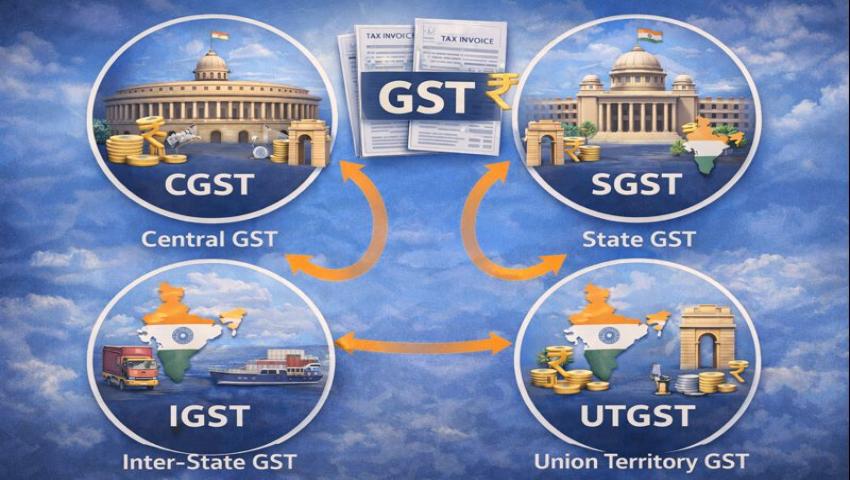
India follows the Dual GST model, where both the Central Government and the State Governments levy GST simultaneously on the same transaction.
Key Benefits of the Dual GST Model:
- Maintains fiscal autonomy of states
- Ensures fair distribution of tax revenue
- Creates a uniform indirect tax structure across India
Under this model, GST is divided into different components depending on whether the supply is intra-state or inter-state.
2. Central Goods and Services Tax (CGST):
CGST is levied by the Central Government on intra-state supplies of goods and services.
Key Features of CGST:
- Applicable when the supplier and recipient are in the same state
- Collected by the Central Government
- Governed by the CGST Act
Example: If a business located in Maharashtra sells goods within Maharashtra, CGST is applicable along with SGST.
3. State Goods and Services Tax (SGST):
SGST is levied by the State Government on intra-state supplies of goods and services.
Key Features of SGST:
- Collected by the respective State Government
- Levied along with CGST
- Revenue goes to the state where the supply occurs
In an intra-state transaction, CGST and SGST are charged simultaneously and shared between the Centre and the State.
4. Integrated Goods and Services Tax (IGST):
IGST is levied on inter-state supplies of goods and services, including imports.
Key Features of IGST:
- Collected by the Central Government
- Applicable when the supplier and recipient are in different states
- Revenue is later apportioned between the Centre and the destination state
IGST simplifies inter-state trade by enabling a seamless flow of input tax credit and avoiding multiple tax calculations.
5. Union Territory Goods and Services Tax (UTGST):
UTGST is applicable to supplies made within Union Territories without a legislature, such as:
- Chandigarh
- Andaman and Nicobar Islands
- Dadra and Nagar Haveli and Daman and Diu
Key Features of UTGST:
- Levied by the Central Government
- Applicable along with CGST
- Replaces SGST in Union Territories
UTGST ensures uniform GST implementation across all regions of India.
Other GST Models Followed Globally:
To better understand India’s GST system, it is useful to look at other GST models adopted worldwide.
6. Single GST Model:
Under the Single GST model, only one authority levies and collects GST.
Features:
- Centralised tax collection
- Simple compliance structure
- Limited autonomy for states
This model is usually followed by countries with a unitary system of governance. India did not adopt this model due to its federal structure.
7. Federal GST Model:
In the Federal GST model, both federal and state governments levy GST independently under separate laws.
Features:
- Greater autonomy for states
- Higher compliance complexity
- Less uniformity in taxation
India’s Dual GST model is a refined version of the federal GST model, designed to reduce complexity while maintaining state powers.
Why India Chose the Dual GST Model?
India adopted the Dual GST model to:
- Respect constitutional powers of states
- Prevent revenue loss for state governments
- Ensure uniform taxation across regions
- Simplify the movement of goods and services
This approach supports the concept of “One Nation, One Tax” while preserving the federal balance.
Importance of Understanding GST Models for Businesses:
Clear understanding of GST models helps businesses:
- Identify the correct tax type (CGST, SGST, IGST, UTGST)
- Issue accurate tax invoices
- Avoid incorrect tax payments
- Claim proper input tax credit
Incorrect classification can lead to penalties, interest, and compliance challenges.
Common Confusion Around GST Models:
Some common misconceptions include:
- Assuming GST is a single tax
- Confusing IGST with CGST and SGST
- Applying SGST instead of UTGST in Union Territories
Proper knowledge of GST models helps avoid such errors and ensures smooth compliance.
Conclusion:
The models of GST form the backbone of India’s indirect tax system. While GST appears as a single tax to consumers, it operates through multiple components such as CGST, SGST, IGST, and UTGST under the Dual GST framework.
Understanding these GST models is essential for businesses, professionals, and taxpayers to ensure accurate compliance, correct tax payment, and seamless input tax credit. With the right knowledge, GST becomes less complex and far more manageable.
Disclaimer: This article is for general informational purposes only and does not constitute legal, tax, or professional advice; readers are advised to consult a qualified tax professional for guidance specific to their situation.