- 03/04/2026
- MyFinanceGyan
- 30 Views
- 3 Likes
- Tax
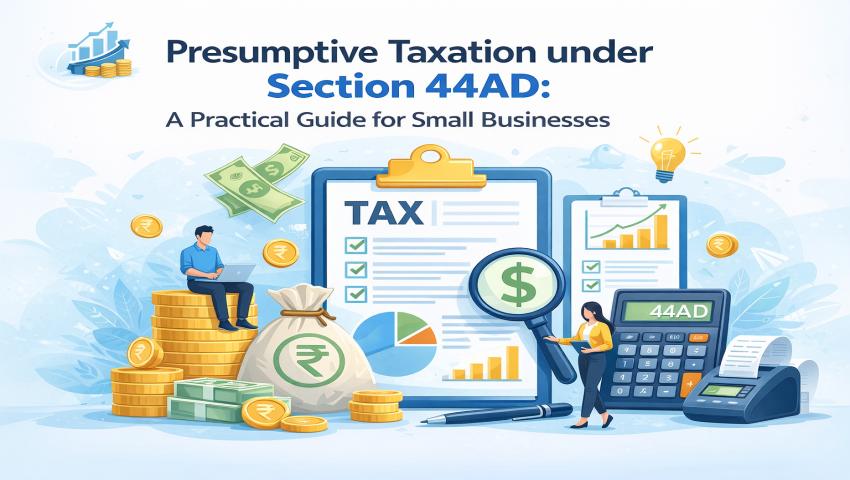
Presumptive Taxation under Section 44AD: A Practical Guide for Small Businesses
Managing taxes can be challenging for small businesses—especially when it involves maintaining detailed books of accounts, tracking every expense, and facing potential tax audits. To simplify compliance, the Income Tax Act introduced Presumptive Taxation under Section 44AD—a scheme designed specifically for small taxpayers engaged in business.
This guide explains how Section 44AD works, eligibility criteria, income calculation, benefits, limitations, and key compliance rules to help you decide whether it’s the right option for your business with expert insights from My Finance Gyan.
What is Presumptive Taxation under Section 44AD?
Section 44AD of the Income Tax Act, 1961 allows eligible businesses to declare income at a fixed percentage of turnover instead of calculating actual profits.
👉 In simple terms:
The government assumes a standard profit margin, eliminating the need for detailed bookkeeping and audits.
This scheme is ideal for:
- Small traders
- Shopkeepers
- Contractors
- Small business owners
Who is Eligible for Section 44AD?
1. Eligible Taxpayers:
Section 44AD can be opted by:
- Resident Individuals
- Hindu Undivided Families (HUFs)
- Resident Partnership Firms (excluding LLPs)
Not eligible:
- Non-residents
- Limited Liability Partnerships (LLPs)
2. Eligible Businesses:
Applicable to most businesses except:
- Transport businesses (covered under Section 44AE)
- Agency businesses
- Commission or brokerage income
- Professionals (covered under Section 44ADA)
👉 Primarily suited for trading, manufacturing, and small commercial businesses.
3. Turnover Limit:
- Maximum turnover allowed: ₹2 crore per financial year
- Exceeding this limit → mandatory shift to regular taxation
How Income is Calculated under Section 44AD?
The biggest advantage of Section 44AD is simplified income calculation.
Presumptive Rates:
- 8% of turnover (cash transactions)
- 6% of turnover (digital transactions)
Example:
- Total Turnover: ₹1 crore
- Digital Receipts: ₹70 lakh → 6% = ₹4.2 lakh
- Cash Receipts: ₹30 lakh → 8% = ₹2.4 lakh
👉 Total Taxable Income = ₹6.6 lakh
No further expense deductions allowed.
Expenses and Deductions:
Under Section 44AD: All business expenses are deemed to be allowed
No separate deduction for:
- Rent
- Salary
- Electricity
- Travel
- Depreciation
However, deductions under Chapter VI-A (like 80C, 80D) can still be claimed.
Depreciation Treatment:
- Depreciation is considered already included in presumptive income
- WDV of assets must still be reduced as per Income Tax rules
👉 Important for accurate asset valuation in future years.
Advance Tax under Section 44AD:
If tax liability exceeds ₹10,000:
- Entire advance tax can be paid by 15th March
- No need for quarterly installments
👉 Simplifies cash flow management.
Books of Accounts & Audit:
One of the biggest benefits:
- No requirement to maintain books (Section 44AA)
- No tax audit (Section 44AB)
👉 Significant reduction in compliance burden and costs.
Declaring Lower Income than Presumptive Rate:
You can declare lower income—but with consequences:
- Books of accounts become mandatory
- Tax audit may apply
- Lock-in rule applies
Lock-in Rule: If you opt out of Section 44AD → cannot opt again for 5 years
During this period:
- Audit mandatory if income exceeds exemption limit
👉 This makes it a strategic decision.
Advantages of Section 44AD:
1. Simplified Compliance:
No complex accounting or audit requirements
2. Cost Savings:
Lower professional and compliance costs
3. Predictable Taxation:
Fixed percentage makes planning easier
4. Promotes Digital Payments:
Lower 6% rate encourages digital transactions
Limitations of Section 44AD:
1. Not Ideal for Low-Margin Businesses:
Tax may be higher than actual profit
2. Turnover Cap:
Restricted to ₹2 crore
3. Lock-in Restriction
Opting out creates compliance burden for 5 years
4. Limited Eligibility:
Professionals, LLPs, and commission agents excluded
Section 44AD vs Regular Taxation:
Is Section 44AD Mandatory?
No. It is completely optional.
You can choose:
- Presumptive taxation (simplicity)
- Regular taxation (accuracy)
👉 Evaluate every year before opting.
Final Thoughts:
Presumptive Taxation under Section 44AD is a powerful tool for small businesses seeking simplicity, reduced compliance, and predictable tax liability.
However, it is not suitable for every business. If your margins are low or expenses are high, regular taxation may be more beneficial.
👉 The key is to evaluate:
- Profit margins
- Growth plans
- Compliance capacity
When used wisely, Section 44AD can help you manage taxes efficiently while focusing on business growth.
Disclaimer:
The views expressed in this article are personal and intended for educational and awareness purposes only. They do not constitute professional or financial advice and are not intended to recommend any specific product or service.