
- 02/04/2026
- MyFinanceGyan
- 7 Views
- 2 Likes
- Company Law
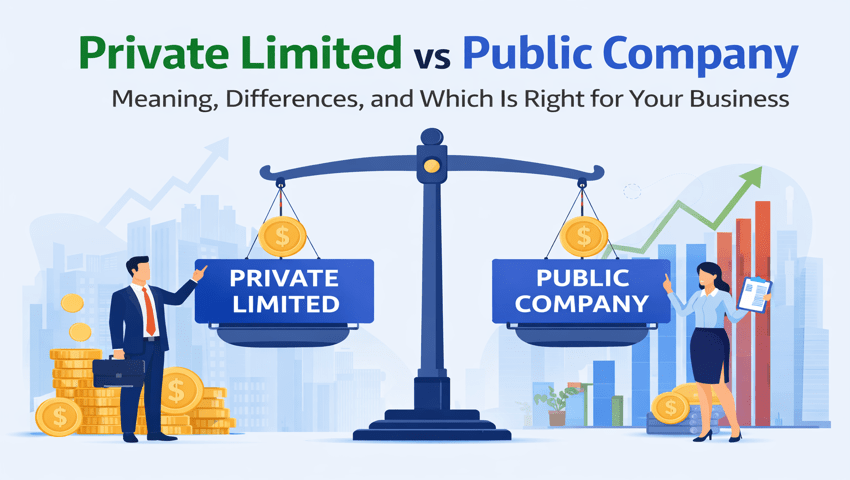
Private Limited vs Public Company: Meaning, Differences, and Which Is Right for Your Business
Choosing the right business structure is one of the most critical decisions for any entrepreneur. Among the various options available under Indian law, Private Limited Company and Public Company are the most widely used corporate structures.
While both offer the benefit of a separate legal identity and limited liability, they differ significantly in ownership, compliance, fundraising ability, and operational flexibility.
This guide explains the meaning, key differences, advantages, and practical considerations to help you choose the right structure for your business.
Meaning of a Private Limited Company:
A Private Limited Company is a company registered under the Companies Act, 2013 that:
- Restricts the transfer of shares
- Limits the number of shareholders (maximum 200)
- Does not allow public subscription of shares
👉 It is the most preferred structure for:
- Startups
- Small and medium businesses
- Family-owned enterprises
It offers a balance between corporate benefits and manageable compliance.
Meaning of a Public Company:
A Public Company is a company that:
- Allows free transfer of shares
- Can invite the public to subscribe to its shares
- Has no limit on the number of shareholders
Public companies can be:
- Listed (on stock exchanges)
- Unlisted (not listed but still public in nature)
👉 Typically suitable for large businesses with expansion and fundraising plans.
Legal Framework:
Both types of companies are governed by the Companies Act, 2013 and regulated by the Ministry of Corporate Affairs (MCA).
Additionally, public companies (especially listed ones) must comply with:
- SEBI regulations
- Stock exchange listing requirements
- Enhanced disclosure norms
Minimum Requirements for Incorporation:
Private Limited Company
- Minimum 2 shareholders
- Minimum 2 directors
- Maximum 200 shareholders
- At least 1 resident director
Public Company:
- Minimum 7 shareholders
- Minimum 3 directors
- No maximum limit on shareholders
- At least 1 resident director
Capital Requirements:
Legally, there is no minimum paid-up capital requirement for either structure.
However, in practice:
- Private companies start with lower capital
- Public companies require higher capital for scale and investor confidence
Ownership and Transfer of Shares:
Private Limited Company:
- Share transfer is restricted
- Requires approval of board/shareholders
- Ownership remains closely held
Public Company:
- Shares are freely transferable
- Listed shares can be traded on stock exchanges
- Ownership can be widely distributed
Fundraising and Capital Raising:
Private Limited Company
- Raises funds through:
- Promoters
- Angel investors
- Venture capital
- Cannot invite public investment
Public Company:
- Can raise funds through:
- Initial Public Offer (IPO)
- Public investors
- Access to large-scale capital
👉 This is the biggest advantage of a public company.
Compliance and Regulatory Burden:
Private Limited Company:
- Fewer board meetings
- Limited disclosures
- Simplified compliance
- Lower penalties (in some cases)
Public Company:
- Frequent board and committee meetings
- Mandatory governance structures
- Detailed disclosures
- Higher regulatory scrutiny
Management and Decision-Making:
Private Limited Company
- Faster decisions
- Promoter-driven control
- Flexible management
Public Company:
- Decisions involve multiple stakeholders
- Board independence required
- Greater accountability
Credibility and Market Perception:
- Public companies enjoy higher credibility due to transparency and regulations
- Listed companies gain visibility and investor trust
Private companies, however, can still build strong credibility—especially in niche industries and startups.
Risk and Liability:
Both structures offer:
- Limited liability protection
- Shareholders’ liability limited to their investment
👉 Personal assets are generally protected.
Key Differences at a Glance:
Which Is Better for Your Business?
Choose Private Limited Company if:
- You are starting or growing a business
- You want full control
- Compliance resources are limited
- Funding is from private investors
Choose Public Company if:
- You need large-scale funding
- You plan for IPO or listing
- Transparency and governance are priorities
- You aim for large-scale expansion
👉 Many businesses start as private companies and later convert into public companies.
Conversion from Private to Public Company:
The Companies Act allows conversion as your business grows.
Process Includes:
- Alteration of Articles of Association
- Passing shareholder resolutions
- Filing forms with ROC
👉 This flexibility supports long-term scalability.
Taxation Perspective:
- Both are taxed at corporate tax rates
- Dividend taxation rules apply similarly
👉 Taxation does not significantly impact the choice, but compliance cost does.
Final Thoughts:
Both Private Limited and Public Companies offer strong legal structures with limited liability and separate identity. However, they serve different business needs.
- Private Limited Company → Flexibility, control, ease of compliance
- Public Company → Scale, capital access, market credibility
The right choice depends on your:
- Business vision
- Funding strategy
- Growth plans
- Compliance capability
Choosing the right structure—or transitioning at the right time—can play a crucial role in long-term business success.
Disclaimer
The views expressed in this article are personal and intended for educational and awareness purposes only. They do not constitute professional or legal advice and are not intended to recommend any specific product or service.