- 28/01/2026
- MyFinanceGyan
- 204 Views
- 3 Likes
- GST
What Is GST Tax Exemption? Meaning, Rules, and Eligibility Explained
Navigating the complex landscape of the Goods and Services Tax (GST) in India can be a daunting task for entrepreneurs and small business owners. However, understanding goods and services tax exemptions is a game-changer for your financial planning. Whether you are a budding startup or an established trader, knowing which items are exempted from GST can help you reduce costs and simplify compliance.
My Finance Gyan brings you the latest updated information and simplified explanations to help you understand these legal provisions with clarity. In this comprehensive guide, we break down the meaning, rules, and eligibility criteria for GST tax exemption in 2026, so businesses can make informed financial decisions.
Since its inception, the GST regime has aimed to create a “One Nation, One Tax” system. However, to protect the interests of the common man and support small-scale industries, the government has provided certain exemptions from GST. These exemptions ensure that essential goods and services remain affordable and that micro-enterprises are not burdened by heavy compliance.
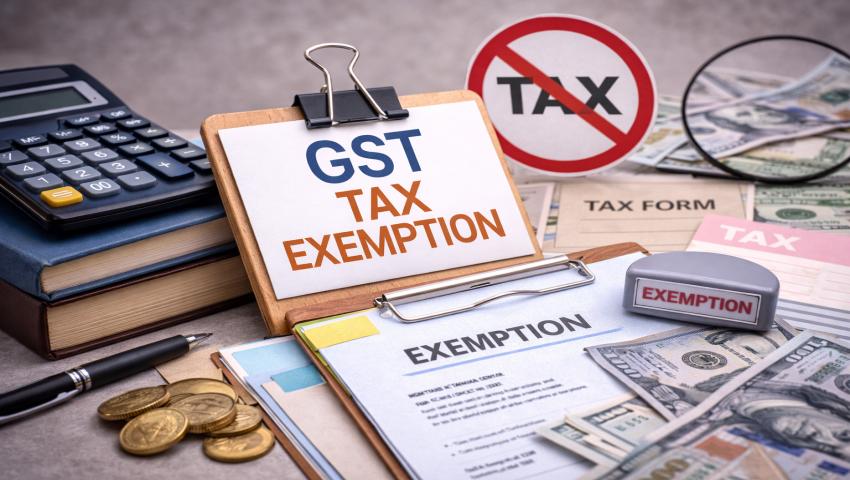
What Is GST Tax Exemption?
In simple terms, GST tax exemption refers to specific goods or services that do not attract any tax under the GST Act. When a supply is exempt from GST, the seller cannot charge GST from the buyer, and importantly, the seller cannot claim Input Tax Credit (ITC) on the raw materials used to produce those goods or services.
For a business, being gst exempt means:
- No tax is collected on the final sale.
- No tax is paid to the government for that specific supply.
- Reduced paperwork for those dealing exclusively in gst exempt items.
Legal Provisions for Exemption Under GST:
The power to grant exemption from GST lies with the government, based on the recommendations of the GST Council. Under Section 11 of the CGST Act and Section 6 of the IGST Act, the government can issue a GST exemption notification to exempt any goods or services from tax in the public interest.
My Finance Gyan advises business owners to stay informed about these notifications, as the GST exemption list is subject to periodic updates during GST Council meetings. With regularly updated insights and simplified explanations, My Finance Gyan helps you track important GST changes that may impact your business.
Categories of GST Exemptions:
Exemptions aren’t one-size-fits-all. They are broadly classified into three types:
- Absolute Exemption: Tax is not applicable regardless of who the supplier or receiver is (e.g., fresh milk or eggs).
- Conditional Exemption: Exemption is granted only if certain conditions are met (e.g., hotel rooms with a tariff below a specific limit).
- Partial Exemption: Only a portion of the supply is exempt under specific circumstances.
1] Exempted Goods Under GST:
The list of exempted goods under GST primarily includes unbranded and unprocessed items. The goal is to keep the “garib ki thali” (the poor man’s plate) affordable. Essential gst exemption products include fresh vegetables, fruits, and unbranded food grains.
2] Exempted Services Under GST :
Services exempted under GST usually include those that are vital for social welfare, such as public transport, basic banking (interest on loans), and specific government services.
List of Exempted Goods and Services Under GST:
- Top GST Exempt Items (Goods)
- Food Items: Fresh fruits, vegetables, milk, curd, lassi, unbranded honey, and salt.
- Grains: Rice, wheat, and pulses (when not pre-packaged or labeled).
- Daily Essentials: GST on eggs, bread, and fresh meat/fish.
- Cultural & Miscellaneous: Printed books, newspapers, the Indian National Flag, and clay pots.
- Popular Services Exempt from GST
- Healthcare: Medical services provided by doctors or clinics and ambulance services.
- Education: Tuition fees for schools and recognized degree courses.
- Agriculture: Cultivation, harvesting, and warehouse services for produce.
- Finance: Interest earned on deposits or loans.
Note: For a detailed breakdown, you can download a list of exempted goods under GST PDF from the official CBIC website or consult with experts at Startup Portal.
GST Exemption Limit (Turnover Based):
Not every business is required to register for GST immediately. GST registration depends on your annual aggregate turnover, and businesses below the prescribed GST exemption limit are not mandatorily required to register.
Supply of Goods:
- GST registration becomes mandatory if turnover exceeds ₹40 Lakhs in most states.
- For special category states, the limit is ₹20 Lakhs.
Supply of Services:
- The GST registration limit for services is ₹20 Lakhs in normal states and ₹10 Lakhs in special category states.
Difference Between Exempt Supply, Nil Rated & Zero-Rated Supply:
This is where most entrepreneurs get confused. My Finance Gyan breaks it down for you:
- Exempt Supply: No GST is charged, and you cannot claim ITC (e.g., Fresh Vegetables).
- Nil Rated Supply: These items have a 0% GST rate mentioned in the tariff schedule. Like exempt supplies, you cannot claim ITC.
- Zero-Rated Supply: This applies specifically to exports and supplies to SEZs. The tax rate is 0%, but the exporter can claim a refund of the ITC paid on inputs.
Non-GST and Excluded Supplies:
Some items are simply “out of scope” for GST. These are called non-GST items or non-taxable supply under GST.
- Alcohol for human consumption: Still taxed under State Excise and VAT.
- Petroleum Products: Crude oil, petrol, diesel, and natural gas are currently non-GST supplies.
GST Exemption for Education & Healthcare:
The Indian government prioritizes “Social Welfare.” Therefore, GST on education institutions is largely nil.
- Education: Core services like school/college fees and exams are exempt gst services. However, gst on coaching fee for private institutes remains at 18%.
- Healthcare: GST and medical services provided by clinical establishments are exempt. Recent reforms in 2025-26 have even seen the removal of GST on certain health insurance premiums for senior citizens.
GST Exemption Certificate & Documentation:
While many items are automatically exempt, certain organizations (like NGOs or research units) may require a GST exemption certificate to purchase goods without GST.
- Always maintain an exempted supply register.
- Issue a “Bill of Supply” instead of a “Tax Invoice” for gst 0 percent items.
- Properly mention the HSN code for gst exempt services in your records.
Common Mistakes Related to GST Exemptions:
- Claiming ITC on Exempt Supplies: This is a major compliance error. If your product is exempted from gst, you must reverse any ITC claimed on raw materials.
- Confusing “Nil Rated” with “Zero Rated”: Remember, only exports are zero rated supply under gst.
- Ignoring Thresholds: Thinking you are exempted gst because your product is tax-free, even though your total turnover (including taxable items) exceeds the limit.
Conclusion:
Understanding the list of goods exempted from gst is vital for any business to stay compliant and competitive. By leveraging these exemptions, startups can manage their cash flow better and offer more affordable prices to their customers.
At Startup Portal, we specialize in helping new businesses navigate these regulatory hurdles. Whether you need help with GST registration or understanding the negative list of gst, we are here to guide you every step of the way.
FAQs: GST Tax Exemption:
Zero rated supply under gst refers specifically to goods or services meant for exports or supplies made to Special Economic Zones (SEZ). The tax rate is 0%, but unlike exempt items, the business can claim a refund on the taxes paid for raw materials (Input Tax Credit).
There are four primary types of supplies under gst:
- Taxable Supply: Goods/services attracting standard rates like 5%, 12%, 18%, or 28%.
- Exempt Supply: Supplies that are exempt from gst (no tax is charged, but no ITC can be claimed).
- Nil Rated: Items listed with a 0% tax rate in the official schedule.
- Zero Rated: Exports and SEZ sales where tax is 0% and refunds are allowed.
GST not applicable applies to items or activities completely outside the scope of the GST law. This includes non-gst items like alcohol for human consumption, petroleum products (petrol, diesel), and certain services like salaries paid to employees.
Exclusive of gst means the quoted price does not include the tax amount. The buyer must pay the GST extra on top of the base price. For example, if a service is ₹1,000 “exclusive of GST” at 18%, the total payable amount is ₹1,180.
- Registration: Mandatory only if you exceed the gst exemption limit (usually ₹40 Lakhs for goods and ₹20 Lakhs for services).
- Documentation: For gst exempt items, you must issue a Bill of Supply instead of a Tax Invoice.
- ITC: You cannot claim Input Tax Credit on goods that are exempt under gst.