- 10/06/2026
- Govind S. Jethani
- 450 Views
- 2 Likes
- Company Law
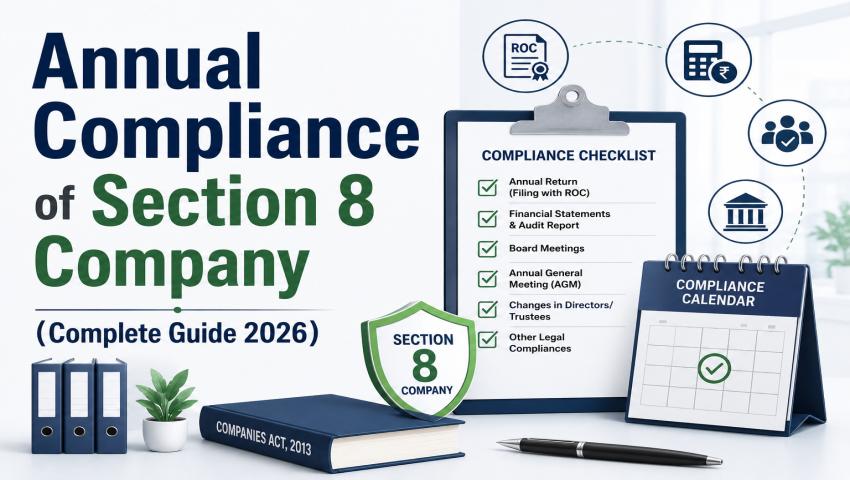
Annual Compliance of Section 8 Company: (Complete Guide 2026)
A Section 8 Company is established for charitable and non-profit objectives, but it must still comply with various legal and regulatory requirements under the Companies Act, 2013. Understanding the annual compliance of a Section 8 company is essential to maintain legal status, avoid penalties, and ensure smooth operations.
Even though these organizations work for social welfare and charitable causes, the government requires proper financial reporting, annual filings, and regular compliance procedures.
In this guide, My Finance Gyan explain the annual compliance requirements of a Section 8 company, important due dates, mandatory forms, penalties, and practical compliance tips.
What is a Section 8 Company?
A Section 8 Company is a non-profit organization registered under the Companies Act, 2013 for promoting charitable or socially beneficial objectives such as:
- Education
- Social welfare
- Charity
- Environment protection
- Art and culture
- Science and research
- Sports development
Unlike regular companies, profits earned by a Section 8 company are not distributed among members or directors. Instead, the income is utilized solely for achieving the organization’s objectives.
👉 In simple words, a Section 8 company is an NGO structure registered as a company for charitable purposes.
Why Annual Compliance is Important for Section 8 Companies?
- Legal Requirement: Compliance is compulsory under the Ministry of Corporate Affairs governed Companies Act, 2013.
- Maintain Section 8 License: Failure to comply may lead to cancellation of the Section 8 license and loss of legal status.
- Avoid Penalties and Legal Action: Late filing and non-compliance can result in penalties, additional fees, and legal consequences for directors.
- Transparency and Accountability: Proper compliance improves trust among:
- Donors
- Members
- Government authorities
- Stakeholders
Key Annual Compliance of Section 8 Company:
1. Conduct Board Meetings:
A Section 8 company must conduct:
- Minimum 4 board meetings every year
- Maximum gap between meetings should not exceed 120 days
Board meetings are conducted to discuss:
- Financial matters
- Operational activities
- Legal compliance
- Organizational decisions
2. Annual General Meeting (AGM):
The company must hold an AGM every year within 6 months from the end of the financial year.
👉 For most companies, AGM should generally be conducted by 30th September.
During the AGM:
- Financial statements are approved
- Annual reports are discussed
- Auditors are appointed or re-appointed
3. Filing of Financial Statements (AOC-4):
Section 8 companies must file Form AOC-4 with the Registrar of Companies (ROC).
Due Date:
Within 30 days from the date of AGM.
This form includes:
- Balance Sheet
- Profit & Loss Account
- Auditor’s Report
4. Filing of Annual Return (MGT-7):
Every Section 8 company must file annual return using:
- MGT-7 or MGT-7A (as applicable)
Due Date:
Within 60 days from AGM.
The annual return contains:
- Shareholding details
- Director information
- Company structure
- Compliance disclosures
5. Income Tax Return Filing (ITR-7):
Section 8 companies are required to file Income Tax Return in Form ITR-7.
Due Date:
Generally 31st October if audit is applicable.
Proper income tax filing is important for:
- Tax exemptions
- NGO credibility
- Regulatory compliance
6. Audit of Accounts:
Audit is mandatory for Section 8 companies.
The company’s financial statements must be audited by a qualified Chartered Accountant before filing annual returns.
The audit helps ensure:
- Financial transparency
- Accuracy of records
- Compliance with accounting standards
7. Director KYC (DIR-3 KYC):
Directors holding DIN (Director Identification Number) may need to complete annual KYC compliance through DIR-3 KYC.
Due Date:
Generally 30th September every year.
Failure to complete KYC may deactivate DIN.
Compliance Calendar for Section 8 Company:
Step-by-Step Compliance Process...
Step 1
Maintain Proper Books of Accounts:
The company should regularly maintain:
- Income records
- Expense records
- Asset and liability details
- Donation records
- Bank statements
Step 2
Conduct Board Meetings:
Hold board meetings periodically to review:
- Financial performance
- Compliance matters
- Operational activities
Step 3
Prepare Financial Statements:
Prepare important financial documents such as:
- Balance Sheet
- Income & Expenditure Statement
- Cash Flow Statement
Step 4
Conduct AGM:
Hold Annual General Meeting to:
- Approve financial statements
- Finalize annual decisions
- Discuss organizational activities
Step 5
File ROC Forms:
Step 6
File Income Tax Return:
File ITR-7 with all necessary financial documents and audit reports.
Common Mistakes to Avoid
Many Section 8 companies face compliance issues due to avoidable errors.
Avoid These Mistakes:
- Missing AGM deadlines
- Delayed ROC filing
- Poor bookkeeping practices
- Ignoring audit requirements
- Failure to update Director KYC
- Incorrect financial reporting
Tips for Smooth Compliance
- Maintain records throughout the year
- Track compliance due dates carefully
- Use professional assistance from CA or CS
- Complete filings before deadlines
- Regularly monitor MCA updates and notifications
Penalty for Non-Compliance:
Failure to comply with annual requirements may result in:
- Heavy additional filing fees
- Penalties on company and directors
- Legal notices
- Cancellation of Section 8 license
👉 Timely compliance is essential to avoid unnecessary legal complications.
Benefits of Proper Compliance:
Proper annual compliance provides several advantages:
- Legal protection
- Better organizational transparency
- Improved donor confidence
- Higher funding opportunities
- Strong governance structure
- Smooth operational management
How Compliance Helps NGO Growth?
A compliant Section 8 company gains:
- Better credibility
- Increased trust among donors
- Easier grant approvals
- Improved reputation
- Long-term operational stability
Proper compliance also helps organizations attract CSR funding and institutional support.
Frequently Asked Questions (FAQs):
It includes annual filings, meetings, audits, and legal requirements under the Companies Act, 2013.
Yes, every Section 8 company must conduct Annual General Meeting annually.
Important ROC forms include:
- AOC-4
- MGT-7 / MGT-7A
Yes, audit of accounts by a Chartered Accountant is mandatory.
Non-compliance may lead to penalties, late fees, legal action, and cancellation of the Section 8 license.
Conclusion:
Understanding the annual compliance of a Section 8 company is extremely important for maintaining legal status and ensuring smooth organizational functioning. Although these companies work for charitable purposes, compliance requirements under the Companies Act are strict and must be followed carefully.
By maintaining proper financial records, conducting meetings on time, completing audits, and filing returns before deadlines, Section 8 companies can avoid penalties and build long-term credibility.
Proper compliance not only protects the organization legally but also strengthens trust among donors, stakeholders, and government authorities.
Disclaimer: This article is for general informational purposes only and should not be considered legal, tax, or professional compliance advice.