- 17/07/2026
- Govind S. Jethani
- 367 Views
- 2 Likes
- Company Law
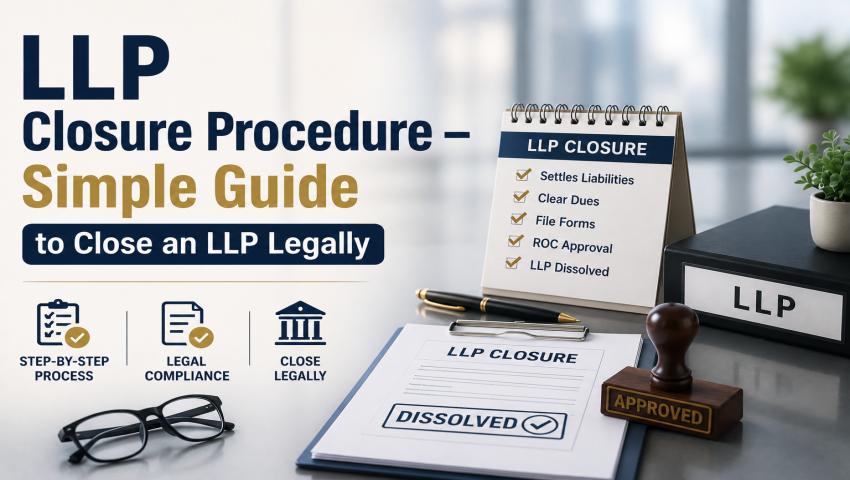
LLP Closure Procedure: Simple Guide to Close an LLP Legally
Starting an LLP (Limited Liability Partnership) is easy, but if the business is no longer running, it is important to close it properly.
Many people create an LLP (Limited Liability Partnership) for consulting, trading, services, startups, or professional work. Later, the business may stop, partners may shift to another company structure, or the LLP may never start operations.
In such cases, keeping the LLP active is not useful and can create unnecessary compliance costs. Follow this simple My Finance Gyan guide for LLP closure procedure to close your company legally, save on late fees, and clear your records easily.
What Is LLP Closure?
LLP closure means removing the LLP’s name from the records of the Registrar of Companies (ROC).
Once the LLP is struck off, it legally stops existing. It cannot do business, issue invoices, operate bank accounts, or enter into new transactions.
When Can an LLP Be Closed?
An LLP can be closed through Form 24 when:
- It has not carried on business for one year or more, or
- It was incorporated but never started business.
The LLP must have no assets and no liabilities.
This means there should be:
- No bank balance
- No loans
- No creditors
- No GST dues
- No income tax dues
- No pending payments
Why Is Closure Important?
Even if an LLP is inactive, annual MCA filings may still be required. If you do not file them, late fees keep increasing every year. In many cases, the penalty becomes much higher than the actual closure cost.
So if the LLP is not needed anymore, it is better to close it legally.
Step-by-Step LLP Closure Procedure
Step 1
Stop Business Activities:
Stop all business operations, including sales, services, purchases, and billing.
If the LLP never started business, mention that clearly in the declaration.
Step 2
Close the Bank Account:
If the LLP has a bank account, close it first and obtain a closure letter from the bank.
If no account was opened, mention this in the affidavit.
Step 3
Clear All Liabilities:
Pay all pending dues such as:
- Vendor payments
- Partner loans
- GST dues
- TDS dues
- Income tax demands
- Any other unpaid expenses
Step 4
Complete Pending MCA Filings:
File all overdue:
- Form 11 (Annual Return)
- Form 8 (Statement of Account and Solvency)
Many closure applications are delayed because these forms are pending.
Step 5
Prepare Nil Statement of Accounts:
A Chartered Accountant (CA) must certify a statement showing:
- Assets : Nil
- Liabilities : Nil
The statement should be less than 30 days old at the time of filing Form 24.
Step 6
Get Consent of All Partners:
All partners must agree to close the LLP and authorize one designated partner to file the application.
Step 7
Prepare Affidavit and Indemnity:
The designated partners usually declare that:
- The LLP has stopped business (or never started)
- There are no liabilities
- The bank account is closed or was never opened
- Income tax details are correctly disclosed
Step 8
Attach Latest ITR Acknowledgment:
If the LLP filed income tax returns, attach the latest acknowledgment.
If no business was conducted and no ITR was filed, mention that in the affidavit.
Step 9
File Form 24:
Upload Form 24 on the MCA portal with all supporting documents.
The form must be digitally signed by the authorized designated partner.
Step 10
Final Strike-Off:
After verification and public notice, the ROC/C-PACE will strike off the LLP’s name.
Once published in the Official Gazette, the LLP stands dissolved.
Documents Required:
- Partner consent letter
- Authority letter or resolution
- CA-certified nil statement of accounts
- Affidavit by designated partners
- Indemnity bond (if applicable)
- Bank account closure proof
- Latest ITR acknowledgment (if applicable)
- PAN of LLP
- Partner details
- Digital Signature Certificate (DSC)
Common Reasons for Rejection:
- Pending Form 8 or Form 11
- Bank account still active
- Statement of accounts older than 30 days
- Assets or liabilities showing in accounts
- Incorrect business cessation date
- Missing partner consent
- Missing ITR acknowledgment
- DSC or certification issues
What About GST?
If the LLP has GST registration, it must be cancelled separately.
Before closure, ensure that:
- All GST returns are filed
- GST dues are paid
- No GST notice is pending
What About Income Tax?
Check:
- Pending ITR filings
- Tax demands
- TDS defaults
- Bank interest income
If the LLP had business activity, file pending returns before closure.
How Long Does It Take?
There is no fixed timeline.
If documents are correct and there is no resubmission, closure may take a few weeks to a few months.
Final Thoughts:
If your LLP has no business, no assets, and no liabilities, closing it legally is better than keeping it inactive.
The process is simple:
- Stop business activities
- Close the bank account
- Clear all liabilities
- Complete pending MCA filings
- Prepare CA-certified nil accounts
- Get partner consent
- File Form 24 on the MCA portal
Ignoring an inactive LLP can lead to increasing compliance costs and penalties. If the business is closed, close the LLP properly through the legal process.
Please Note:
The views expressed in this article are personal and meant only for awareness and educational purposes. They are not intended as legal, tax, or financial recommendations.