
- 14/07/2026
- Govind S. Jethani
- 466 Views
- 4 Likes
- Tax
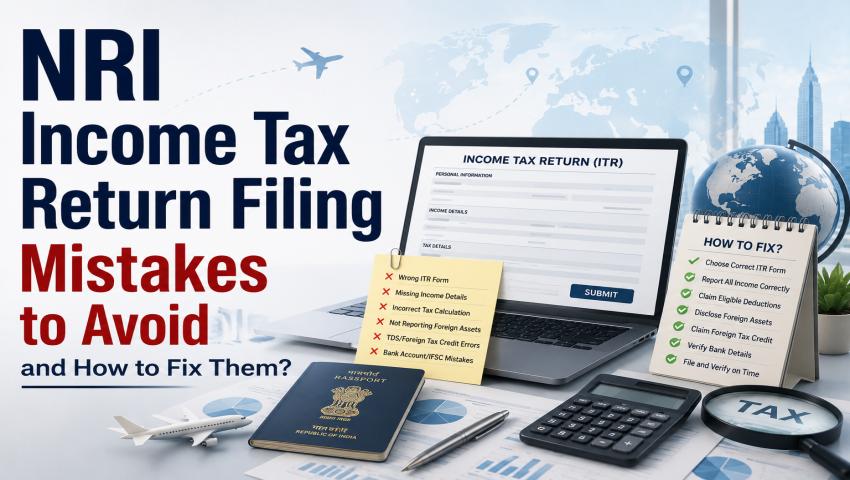
NRI Income Tax Return Filing Mistakes to Avoid and How to Fix Them?
If you are a Non-Resident Indian (NRI), filing your Income Tax Return (ITR) in India is often far more complicated than it looks. Between residential status rules, foreign income disclosures, DTAA benefits, and TDS on property sales, there are dozens of places where things can go wrong.
Many NRIs either file their returns using resident-focused tax software, or they copy what they did last year, without realising that even one small mistake can lead to notices, blocked refunds, or double taxation. In this My Finance Gyan guide, , we walk you through the most common NRI income tax return filing mistakes, and more importantly, how you can avoid them.
Whether you’re doing it yourself or looking for professional help with ITR filing in Pune, this guide will help you file your return correctly and stress-free.
Why NRI Tax Filing Is More Complex Than Resident Filing?
Resident Indians usually deal with one set of rules. NRIs, on the other hand, have to juggle:
- Indian tax laws
- Foreign country tax laws
- Double Taxation Avoidance Agreements (DTAA)
- Currency conversion and reporting requirements
- Special rules for NRE/NRO accounts, property sales, and capital gains
Get any of this wrong, and the consequences can be serious: penalties under the Income Tax Act, scrutiny notices, delayed or blocked refunds, and in worst cases, double taxation on the same income. Let’s look at the top mistakes NRIs make, one by one.
Mistake 1: Wrong Determination of Residential Status
This is, by far, the most common and most costly mistake.
The problem: Many NRIs assume that having an NRI immigration status (like a work visa, PR, or OCI) automatically makes them an “NRI” for tax purposes. That’s not how it works. Your residential status under the Income Tax Act is decided purely based on the number of days you spent in India during the financial year, not your passport or visa status.
Common errors:
- Not tracking the actual number of days spent in India accurately (the 182-day rule, and the additional 60-day rule in certain cases)
- Ignoring the “deemed residency” provision, which can apply to high-income individuals (Indian income above ₹15 lakh) who are not liable to pay tax in any other country
- Assuming that once you’re an NRI, you stay an NRI forever, without reassessing each financial year
How to fix it: Maintain a proper travel diary or use your passport stamps/flight tickets to calculate the exact number of days in India for the relevant financial year, before deciding your residential status.
Mistake 2: Not Reporting Global Income Correctly
The problem: NRIs often assume they only need to report income earned or received in India. This is true only if your residential status is genuinely “Non-Resident.” If your status accidentally shifts to “Resident” or “Resident but Not Ordinarily Resident (RNOR)” due to more days spent in India than expected, your global income may become taxable in India.
Common errors:
- Missing foreign salary, rental income, or investment income that becomes taxable due to a residency slip-up
- Confusion about what counts as “income accrued or arising in India” — for example, capital gains on Indian mutual funds, rental income from Indian property, or interest from Indian bank accounts
How to fix it: Always confirm your residential status first, then map out every source of income, Indian and foreign, before deciding what needs to be reported.
Mistake 3: Ignoring or Misapplying DTAA
India has Double Taxation Avoidance Agreements (DTAA) with over 90 countries, designed to prevent the same income from being taxed twice.
Common errors:
- Not claiming DTAA relief at all, resulting in the same income being taxed both in India and the country of residence
- Applying the wrong method — some treaties use the exemption method, others use the tax credit method, and using the wrong one can lead to incorrect tax computation
- Forgetting to file Form 67, which is mandatory if you want to claim foreign tax credit in India. Missing this form can lead to your credit claim being rejected, even if you’re otherwise eligible
How to fix it: Check the specific DTAA between India and your country of residence, and make sure Form 67 is filed before or along with your ITR, not after.
Mistake 4: Errors with NRE/NRO Account Reporting
NRIs typically maintain NRE (Non-Resident External) and NRO (Non-Resident Ordinary) accounts, and the tax treatment of each is very different.
Common errors:
- Assuming NRE account interest is always tax-exempt, without checking if it actually qualifies (exemption applies only while you genuinely hold NRI status)
- Forgetting that NRO account interest is fully taxable in India, regardless of residential status
- TDS mismatches — banks often deduct TDS at a flat rate on NRO interest, which may not match your actual tax liability, leading to either excess tax paid or a shortfall
How to fix it: Reconcile the interest certificates from your bank with what’s reflected in Form 26AS/AIS before filing, and claim a refund if excess TDS has been deducted.
Mistake 5: Missing Disclosure of Foreign Assets/Bank Accounts
The problem: The requirement to disclose foreign assets and bank accounts in the ITR (Schedule FA) is generally applicable to Resident and Ordinarily Resident (ROR) taxpayers, not NRIs. However, this becomes a serious issue if your residential status is wrongly classified.
Common errors:
- Filing as a Resident (correctly or by mistake) but forgetting to disclose foreign bank accounts, properties, or investments
- Underestimating the consequences under the Black Money (Undisclosed Foreign Income and Assets) Act, which carries steep penalties for non-disclosure
How to fix it: Double-check your residential status every year before filing, and if you do qualify as a Resident for that year, make sure Schedule FA is filled out completely and accurately.
Mistake 6: Overlooking TDS on Property Sale (Section 195)
Selling property in India as an NRI comes with its own set of TDS rules under Section 195, and this is where a lot of NRIs lose money unnecessarily.
Common errors:
- Buyers deducting TDS at the wrong rate (Section 195 rates are much higher than the standard 1% TDS applicable to resident sellers)
- Not applying for a Lower or Nil TDS certificate in advance, resulting in excess TDS being deducted, which then has to be claimed back as a refund (a slow process)
- Missing out on capital gains exemptions available under Section 54, 54EC, and 54F, which can significantly reduce your tax liability on the sale
How to fix it: If you’re planning to sell property in India, apply for a Lower/Nil TDS certificate well in advance, and explore capital gains exemptions before the sale, not after.
Mistake 7: Selecting the Wrong ITR Form
Common errors:
- Using ITR-1, which NRIs are generally not eligible to file at all, regardless of how simple their income sources are
- Choosing a form that doesn’t match your actual income profile — for example, using a form that doesn’t accommodate capital gains, foreign assets, or business income when applicable
How to fix it: NRIs typically need to file ITR-2 or ITR-3, depending on whether they have business income. Always verify eligibility before selecting the form.
Mistake 8: Not Reconciling Form 26AS / AIS / TIS
Common errors:
- Filing the return without checking Form 26AS, AIS (Annual Information Statement), and TIS (Taxpayer Information Summary) for mismatches
- Missing income that the tax department already has on record through AIS, such as interest income, mutual fund transactions, or property sale details
How to fix it: Always cross-verify your income and TDS figures with these statements before filing. A mismatch is one of the most common reasons for receiving a tax notice.
Mistake 9: Missing Filing Deadlines & Advance Tax
Common errors:
- Confusion over which due date applies to NRIs (it generally follows the same deadlines as resident taxpayers, unless a tax audit is applicable)
- Not paying advance tax where applicable, resulting in interest under Sections 234B and 234C
How to fix it: Mark your calendar for the applicable due date each year, and estimate your tax liability in advance if you have substantial income from capital gains, rent, or interest, so you can pay advance tax instalments on time.
Mistake 10: Not Consulting a Cross-Border Tax Expert
The problem: Many NRIs try to manage their India tax filing using generic tax software or advice meant for resident taxpayers. This often misses NRI-specific nuances entirely.
Common errors:
- Relying on tools that don’t account for DTAA, foreign tax credits, or NRI-specific exemptions
- Missing out on repatriation rules, currency conversion requirements, and treaty benefits that a generalist may not be aware of
How to fix it: Work with a professional who specifically handles NRI taxation and cross-border compliance. If you’re looking for reliable ITR e-filing in Pune with NRI expertise, it’s worth choosing a team that understands these nuances rather than a one-size-fits-all filing service.
Conclusion: Quick Recap Checklist
Before you file your next return, run through this checklist:
- Have you correctly determined your residential status for the year?
- Have you reported all applicable global and Indian income?
- Have you claimed DTAA relief and filed Form 67, if applicable?
- Have you correctly reported NRE/NRO interest income?
- Have you disclosed foreign assets, if your status requires it?
- Have you applied for a Lower/Nil TDS certificate before selling property?
- Are you using the correct ITR form?
- Have you reconciled Form 26AS, AIS, and TIS?
- Have you paid advance tax and filed within the deadline?
- Have you consulted an expert familiar with NRI taxation?
NRI tax filing doesn’t have to be stressful, but it does need to be done carefully, with attention to the details that resident tax filing simply doesn’t involve.
Need help filing your NRI income tax return correctly? If you’re looking for expert support with ITR e-filing in Pune, our ITR filing expert team at Startup Portal Business Services can help you navigate residential status, DTAA claims, TDS certificates, and everything in between.
Feel free to get in touch with Startup Portal for end-to-end, NRI-focused tax filing support — from the first consultation to the final acknowledgement.