- 29/06/2026
- Govind S. Jethani
- 1178 Views
- 3 Likes
- Tax
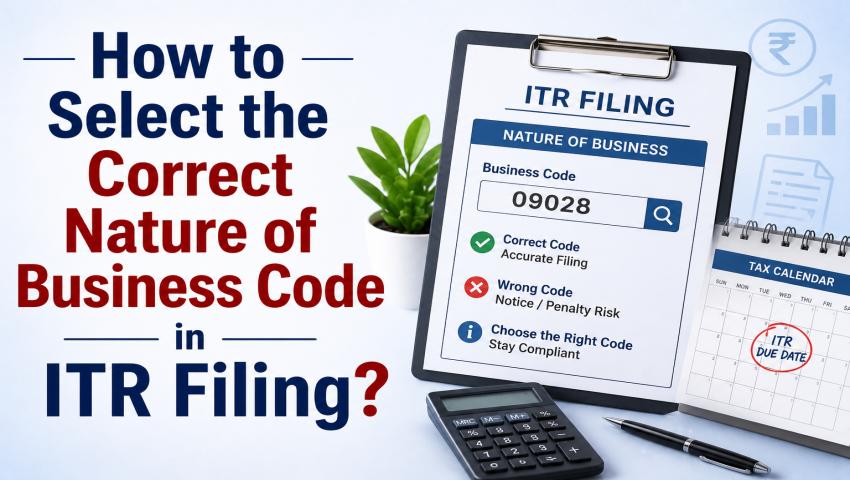
How to Select the Correct Nature of Business Code in ITR Filing?
When you sit down to file your ITR as a freelancer, consultant, or business owner, there is one field that almost everyone struggles with — the Nature of Business Code.
Most people either guess it, Google it randomly, or just copy it from last year without thinking. And that one small mistake can lead to tax notices, loss of tax benefits, or even a rejected return.
In this blog, My Finance Gyan will explain everything about income tax business codes — what they are, how to find the right one, and how to avoid costly mistakes.
What is the nature of Business Code in ITR?
A Nature of Business Code (also called Business Code or Profession Code) is a specific number assigned by the CBDT (Central Board of Direct Taxes) that describes what kind of business or profession you are in.
When you file ITR-3 or ITR-4, there is a section called “Nature of Business” where you need to enter this code. It tells the Income Tax Department:
- What type of work you do?
- Whether your income is from a business or a profession
- Which tax provisions apply to you (like presumptive taxation)?
Think of it as your business identity code in the eyes of the tax department.
And no — it is not just a formality. The department uses this code to classify your income, assess your eligibility for certain tax schemes, and flag any inconsistencies in your filing.
Business Code vs Nature of Employment — Don't Confuse the Two:
This is a very common confusion. These are two completely different fields in ITR:
If you are self-employed or running a business, you need to fill both — your nature of employment (self-employed) AND your business code. Missing either one can cause processing issues.
Which ITR Forms Use Business Codes?
Not every ITR form requires a business code. Here is a quick guide:
- ITR-1 (Sahaj) — No business code needed. Only for salaried individuals.
- ITR-2 — No business code. For those with capital gains or multiple properties.
- ITR-3 — Business code required. For individuals/HUFs with business or professional income with full books of accounts.
- ITR-4 (Sugam) — Business code required. For those opting for presumptive taxation under Section 44AD, 44ADA, or 44AE.
- ITR-5 / ITR-6 — For firms and companies (business code applicable).
Important for salaried people with side income: If you have freelance income or run a small business alongside your job, you cannot file ITR-1. You need ITR-3 or ITR-4 — and yes, you will need to select a business code for that extra income.
Types of Business Codes — Understanding the Categories:
The CBDT income tax business code list is divided into broad categories. Here is a simple overview:
- Category 1 — Manufacturing & Production Covers food processing, textiles, chemicals, electronics manufacturing, printing, and more. If you make or produce something physical, this is your category.
- Category 2 — Trading Wholesale trading, retail trading, import-export. If you buy and sell goods — whether in a shop, online, or in bulk — this is your category.
- Category 3 — Service Sector Transport, hotels, restaurants, IT services, finance, real estate, and other service businesses. A broad category covering most modern businesses.
- Category 4 — Specified Professions Doctors, lawyers, chartered accountants, architects, engineers, film artists, company secretaries. These have dedicated codes because they fall under special tax provisions.
- Category 5 — Other Professions Freelancers, consultants, digital marketers, content creators, IT professionals, coaches, and others who provide services using personal skill but do not fall under a specific listed profession. Business code 09028 is the most commonly used here.
- Category 6 — Agriculture-related Businesses For those involved in farming support services, agri-trading, or related activities.
Business Codes for Common Professions and Businesses:
Here is a handy reference table for some of the most commonly used income tax business codes:
Note: Always verify these codes with the latest ITR utility on the Income Tax portal — the CBDT updates the list periodically and codes can change.
Step-by-Step: How to Select the Right Business Code?
Step 1
Identify Your Nature of Work:
Ask yourself: What do I actually do to earn this income?
- Do I manufacture or produce something? → Manufacturing category
- Do I buy and sell goods? → Trading category
- Do I provide a service or use my skills? → Service or Profession category
Step 2
Decide: Business or Profession?
This is the most important step — and the most commonly confused one.
In Indian tax law:
- Profession = income earned by using personal skill, knowledge, or expertise (doctors, lawyers, IT consultants, designers, coaches)
- Business = income from commercial activity like buying/selling, running an operation, or trading
Why does this matter? Because:
- Professions are eligible for Section 44ADA (50% presumptive taxation — up to ₹75 lakh gross receipts)
- Businesses are eligible for Section 44AD (8% or 6% presumptive taxation — up to ₹3 crore turnover)
Choosing the wrong category means you could apply the wrong tax scheme — and lose a significant tax benefit.
Step 3
Check the Official CBDT Business Code List:
Go to www.incometax.gov.in → Download the latest ITR utility (ITR-3 or ITR-4) → Open the form and look for the “Nature of Business” dropdown or refer to the instructions PDF that comes with the utility.
The list is categorised by industry and profession — read through it carefully and find the description that best matches your work.
Step 4
Match Your Work to the Closest Code:
Sometimes your exact profession is not listed. In that case:
- Read the description of nearby codes carefully
- Choose the one that is the closest match to your actual work
- If nothing fits, use 09028 (Other Professionals) for profession-type income or the relevant “Others” code for business income
- Never leave the field blank or enter a random number
Step 5
Cross-Check with Your GST Registration:
If you are registered under GST, your NIC/SAC code in GST should match the nature of work you describe in your ITR business code.
A mismatch between your GST category and ITR business code can:
- Trigger a notice from the tax department
- Create issues during GST audits
- Complicate future loan or credit applications
If there is a genuine mismatch (your business has changed), update your GST registration details first, then file ITR accordingly.
Step 6
Review Last Year's Code Before Copying:
Many people copy the business code from last year’s ITR without a second thought. This is fine only if your nature of work has not changed.
But if you have:
- Started a new business or profession
- Changed the type of work you do
- Added a new income source
then your business code needs to be reviewed and possibly updated.
Common Mistakes People Make:
- Picking a random or generic code — Selecting “Others” without checking if a specific code applies. This attracts unnecessary scrutiny.
- Confusing profession with business — Applying a trading or business code when you are actually a professional. This affects your presumptive tax eligibility.
- Not updating the code — Your profession changed but you never updated the code. The department may flag inconsistency.
- GST vs ITR mismatch — Different categories in GST and ITR for the same work.
- Using outdated codes — The CBDT revises the list. A code valid 3 years ago may be discontinued today.
- Ignoring the field — Leaving it blank or entering 00000. This will result in a defective return.
What Happens if You Choose the Wrong Business Code?
The consequences are real and can be serious:
- Scrutiny notice from the Income Tax Department asking you to justify your code
- Loss of 44AD or 44ADA benefit — wrong classification means wrong scheme, which means more tax
- Defective return — if the code is blank or invalid, your ITR gets rejected
- GST mismatch notices — if your codes don’t align across filings
- Loan and visa problems — banks and embassies verify ITR details; inconsistencies raise red flags
Special Cases — What to Do When You Are Unsure?
- Multiple businesses: If you run two different types of businesses, select the code for your primary or main source of income. Disclose both in the ITR.
- Changed profession mid-year: Use the code that applies to the income earned during that year. If both apply, show them separately.
- New business with no clear category: Read the CBDT list carefully. If truly nothing fits, use the closest “Others” code — but note the description clearly.
- Side income from a different profession: Report it under the correct business code for that specific income, separately from your main income.
When in doubt — do not guess. Always consult a tax professional.
Conclusion:
The Nature of Business Code in ITR is a small field — but it carries big weight. It tells the Income Tax Department who you are, what you do, and which tax rules apply to you.
Getting it right means smoother filing, correct tax computation, and zero notices. Getting it wrong means scrutiny, lost benefits, and avoidable stress.
The simple rule is: do not guess, do not copy blindly, and do not leave it blank. Take five minutes to identify your correct code .
Or let a professional do it for you. Contact Startup Portal Business Services today — and file your ITR with confidence, knowing every detail is handled correctly.
Disclaimer: This blog is for general informational purposes only. Tax laws are subject to change. Please consult a qualified tax professional for advice specific to your situation.
FAQs:
It is a 5-digit code from the CBDT list that identifies your type of business or profession in the Income Tax Return.
Download the latest ITR utility from www.incometax.gov.in — the business code list is included in the form instructions.
Yes — if your nature of work has not changed. If your profession or business has changed, always review and update your code.
Nature of employment describes your relationship with an employer (govt, private, self-employed). Business code describes the type of business or profession you run. Both are separate fields.
It is the code for “Other Professionals” — used by IT consultants, freelancers, digital marketers, content creators, and other skill-based professionals who do not have a dedicated code.
Most freelancers should use 09028 (Other Professionals) under ITR-4, provided their gross receipts are within the 44ADA limit.
Yes — by filing a revised ITR before the due date. After the due date, a rectification request is required.