
- 16/06/2026
- Govind S. Jethani
- 560 Views
- 1 Likes
- Tax
How to Respond to an Income Tax Notice?
Finding an official email from the tax department in your inbox can make anyone nervous. Your mind instantly races to thoughts of penalties, legal trouble, or complex calculations. But here is some reassuring news: receiving an income tax notice is a very common part of the modern tax process. It does not mean you have broken the law or that you are in deep trouble.
Most it notices are simply sent because of automated system checks. The system might have spotted a minor mathematical error, a data mismatch, or it might just need a routine verification of a document you submitted. The key to handling an itr notice smoothly is to avoid panicking, understand what the department is asking for, and reply accurately before the deadline. In this comprehensive guide, My Finance Gyan is your guide for this blog to break down the exact, hassle-free steps to handle any notice from income tax department with complete confidence.
What Is an Income Tax Notice?
1. Meaning of Income Tax Notice:
In simple words, an income tax notice is a formal communication sent by the tax authorities to a taxpayer. It is an official request for clarification. Today, the entire process is digital. The department no longer sends physical letters through regular mail for standard cases. Instead, every tax notice is issued online directly through the secure e-filing portal and a notification is sent to your registered email ID and mobile number.
2.Common Reasons for Receiving a Notice:
The department’s automated system triggers a notice of income tax when your filed return doesn’t align with its backend records. The most frequent triggers include:
- Mismatch in income details: The income you declared in your return is lower than the amount reported by your bank or employer.
- Incorrect deduction claims: Claiming tax exemptions (like HRA or medical insurance deductions) without keeping valid structural proof.
- High-value transactions: Making large property deals, massive credit card payments, or heavy cash deposits that look disproportionate to your reported salary or business revenue.
- Non-filing or delayed filing of ITR: Skipping your tax filing entirely even though your bank history shows you earned taxable income.
- TDS mismatch: Claiming a tax credit that does not match the actual Tax Deducted at Source (TDS) visible in your government records.
- Defective return filing: Submitting an incomplete ITR form or using the wrong form type for your income sources.
Types of Income Tax Notices in India:
- Notice Under Section 139(9) – Defective Return: This is sent when the system finds structural errors in your filing. Common mistakes include uploading an incorrect ITR form, omitting mandatory balance sheet details for businesses, or forgetting to pay self-assessment tax before hitting submit.
- Notice Under Section 143(1) – Intimation Notice: This is an automated communication that every taxpayer receives after their return is processed. It is basically a comparative balance sheet showing what you filed versus what the department’s system computed. It can result in three outcomes: an affirmation of zero tax due, an approved tax refund, or an income tax demand notice if the system calculates that you owe additional tax.
- Notice Under Section 143(2) – Scrutiny Assessment: This is a more serious communication indicating your return has been selected for a detailed official review. This happens if the system detects high-risk anomalies or complex financial indicators that require manual checking by an assessing officer.
- Notice Under Section 148 – Income Escaping Assessment: This notice is issued when the department has solid structural reasons to believe you hidden or left out specific income in previous financial years. Reassessment cases require deep historical verification.
- Notice Under Section 156 – Demand Notice: This is an official income tax demand notice ordering you to pay an outstanding tax amount, along with accumulated interest or penalties, within a strict 30-day timeline.
- Notice for High-Value Transactions: This specific inquiry asks you to explain the exact financial source behind massive investments, such as:
- Large physical cash deposits into savings or current accounts.
- Substantial stock market, mutual fund, or cryptocurrency investments.
- High-value residential or commercial property purchases.
- Significant foreign exchange transactions or international trips.
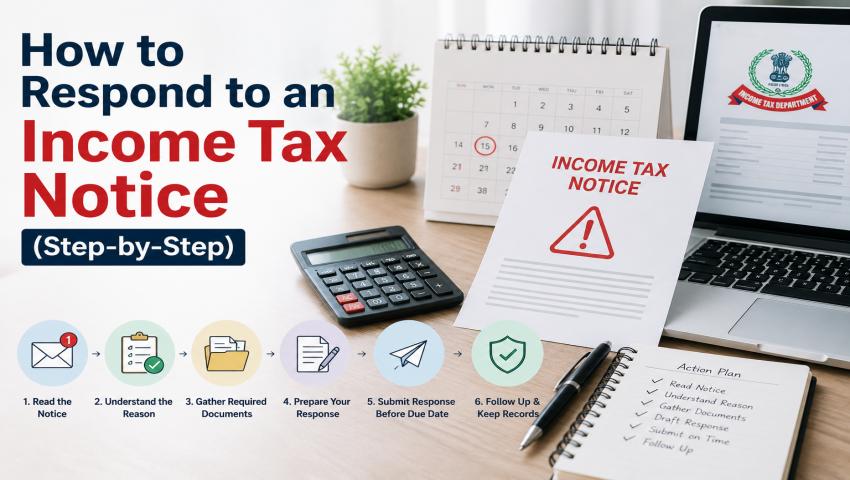
Step-by-Step Process to Respond to an Income Tax Notice...
Step 1
Read the Notice Carefully:
Open the document and identify the specific section it was issued under, the relevant Assessment Year (AY), and the exact issue raised by the system. Note down the official deadline given for your response.
Step 2
Verify Authenticity via DIN:
To protect yourself from phishing scams, copy the unique Document Identification Number (DIN) from the letter. Go to the official portal to verify that it is an authentic, legally issued notice.
Step 3
Collect Your Supporting Documents:
Gather your copy of the filed ITR, Form 16, Form 26AS, your updated Annual Information Statement (AIS), complete bank statements, investment proofs, and any relevant business bills or GST logs.
Step 4
Compare Information and Spot Errors:
Compare the department’s claims against your internal financial records. Look for data variations, data entry errors, or missed income streams to see if the department’s query is correct or mistaken.
Step 5
Prepare Your Response Draft:
Open the document and identify the specific section it was issued under, the relevant Assessment Year (AY), and the exact issue raised by the system. Note down the official deadline given for your response.
Step 6
Submit Your Response Online:
Log in to the official e-filing portal, navigate to the ‘Pending Actions’ tab, and click on ‘E-Proceedings’. Select your active notice, type out your response summary, upload your PDF supporting proofs, and hit submit.
Step 7
Monitor Your Online Submission:
Open the document and identify the specific section it was issued under, the relevant Assessment Year (AY), and the exact issue raised by the system. Note down the official deadline given for your response.
How to Respond to Different Types of Income Tax Notices?
Your income tax department notice handling approach must change depending on the specific type of letter you receive.
1. Responding to Defective Return Notice [Sec 139(9)]:
If your return is marked as defective, you are given a 15-day window to fix it. You don’t need to file a brand-new return from scratch. Instead, log into the e-filing portal, select the option to respond to the notice under Section 139(9), choose ‘Agree’, and file a corrected or revised return using the right offline utility or online form to fix the original errors.
2. Income Tax Demand Notice Response Procedure [Sec 156]:
If You Agree with the Demand:
- Log into your e-filing account.
- Click on ‘Response to Outstanding Tax Demand’.
- Select the ‘Demand is Correct’ option.
- Pay the tax amount instantly online via the integrated portal.
- Enter the payment challan details to close the case.
If You Disagree with the Demand:
- Select the ‘Disagree with Demand (Either Fully or Partially)’ option.
- Click on ‘Add Reasons’ to explain why the calculation is wrong.
- Provide precise reasons (e.g., TDS not credited, double counting).
- Upload supporting files like old challans or a rectified Form 16.
3. Responding to Scrutiny Notice [Sec 143(2)]:
Scrutiny notices cannot be solved with basic answers. You need to provide solid, verifiable evidence. You will need to upload clean digital copies of your bank accounts, complete itemized expense ledgers, and original tax invoices. Ensure every single number mentioned in your written explanation aligns perfectly with your attached balance sheet documents.
4. Responding to Reassessment Notice [Sec 148]:
Reassessment cases look at past financial data and carry high legal weight. You will be required to file a fresh tax return for that specific past year and explain long-term financial transactions. Because these proceedings are legally complex, it is highly recommended to seek professional help from a Chartered Accountant.
Common Mistakes to Avoid While Replying to a Tax Notice:
A poorly handled response can easily turn a simple query into a complicated legal issue. Avoid these common mistakes:
- Ignoring the Notice: Thinking that a minor error will simply go away on its own is a big mistake. The automated system will automatically freeze your tax refunds and fast-track penalties if you ignore it.
- Missing the Deadline: Most notices come with a strict 15 to 30-day response window. If you miss this deadline, you lose the chance to present your side of the story online.
- Providing Incorrect Information: Submitting guessed figures or false explanations to cover up an error will trigger severe anti-evasion penalties.
- Uploading Incomplete Documents: Uploading incomplete bank statements or blurry smartphone photos of receipts will cause the system to reject your submission. Always use clean, clearly named PDF documents.
- Responding Without Understanding the Issue: Never hit the submit button out of fear without reading the text carefully. Take the time to understand exactly why the system flagged your account before writing your reply.
What Happens If You Do Not Respond to an Income Tax Notice?
If you choose to ignore an official communication from the tax department, the system will escalate the case through a structured legal process:
The Penalty Burden: Under Section 271F or modern penalty codes, the department can impose fixed financial fines simply for failing to respond to a legal notice. Additionally, interest at 1% per month will continue to accumulate on any unpaid tax amounts.
If you don’t provide your financial details, the assessing officer can initiate a Best Judgment Assessment (Section 144). This means the officer will estimate your total income and calculate your tax liability based on the data available in their system (like your AIS or bank records), without giving you any say in the matter. This almost always results in a much higher tax demand, and severe non-compliance can even lead to prosecution in extreme cases.
Tips to Avoid Income Tax Notices in the Future:
The easiest way to deal with a tax notice is to prevent it from being generated in the first place. Build these simple habits into your financial routine:
- File Your ITR on Time: Always submit your return before the July 31 deadline to prevent late-filing tracking flags.
- Learn How to Check Income Tax Notice Status: Make it a habit to log into the e-filing portal once every quarter. Check the ‘E-Proceedings’ or ‘Response to Outstanding Demand’ tabs to catch any electronic alerts early.
- Cross-Check Your Records with the AIS: Before you file your ITR, download your latest Annual Information Statement (AIS) and Form 26AS. Ensure every rupee of savings bank interest, fixed deposit interest, and stock dividend listed in those forms matches your return exactly.
- Report Every Source of Income: Always declare side income, freelance earnings, or capital gains from casual stock sales.
- Avoid Fake or Inflated Deduction Claims: Never use inflated rent receipts or unsupported investment claims to artificially increase your tax refund.
Latest Income Tax Notice Trends in India:
The Income Tax Department has fully upgraded its compliance infrastructure. The department now runs on advanced AI models designed for real-time transaction tracking.
The system continuously matches information between different government databases, such as GST filings, banking channels, property registries, and stock market exchanges. Because of this integration, discrepancies are flagged via automated notices almost immediately after you submit your ITR. The department is paying extra attention to digital transactions, freelance income streams, startup funding rounds, and e-commerce transactions. Keeping organized digital financial records is now essential for every taxpayer.
When Should You Consult a CA or Tax Expert?
While you can easily handle straightforward notices (like fixing a defective return or accepting a small calculation error) on your own, you should definitely consult a qualified Chartered Accountant or tax professional in the following situations:
- Complex Scrutiny Notices: If your profile is selected for a detailed review under Section 143(2).
- Large Tax Demands: If you receive an outstanding demand for a substantial amount that requires detailed legal corrections.
- Reassessment Cases: When dealing with historical tracking inquiries under Section 148.
- Business and GST Variations: If you receive a notice regarding a mismatch between your annual business turnover and your GST returns.
Conclusion:
Receiving an income tax notice is simply an administrative query, not a legal emergency. By staying calm, logging into the e-filing portal to check the exact details, and preparing an accurate, step-by-step response, you can easily resolve most tax issues online.
The key is to take action quickly, double-check your numbers against your AIS statement, and submit your response well before the official deadline. If you want to keep your finances stress-free and avoid unexpected notices in the future, focus on maintaining clean financial records, filing your returns on time, and seeking expert professional guidance whenever you handle complex transactions.