- 12/06/2026
- Govind S. Jethani
- 537 Views
- 2 Likes
- Company Law
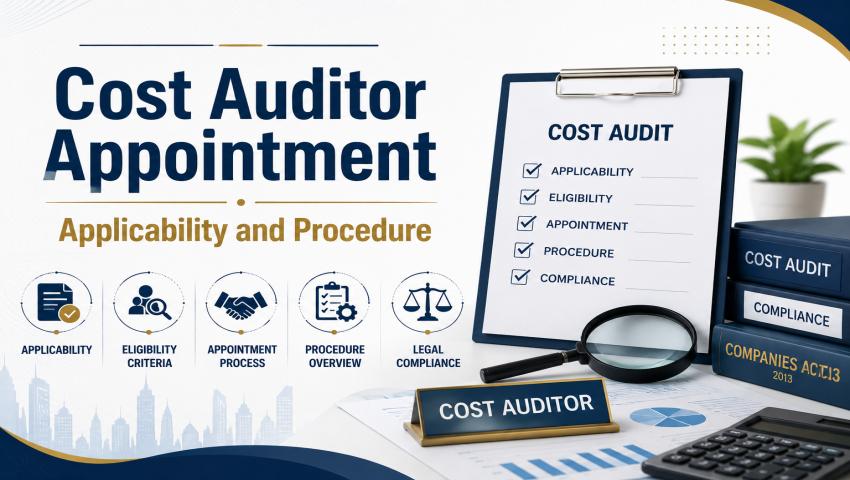
Cost Auditor Appointment – Applicability and Procedure
Cost audit is an important compliance mechanism that helps companies maintain transparency in cost records, improve operational efficiency, and ensure adherence to statutory requirements. For companies operating in specified industries, the appointment of a Cost Auditor is not optional but a mandatory legal requirement under the Companies Act, 2013.
Understanding the applicability of cost auditor appointment and the procedure involved is essential for companies engaged in manufacturing, production, mining, utilities, and other notified sectors. Proper compliance helps businesses avoid penalties while also improving cost management and financial discipline.
This article By My Finance Gyan explains the meaning of cost audit, legal provisions, applicability criteria, appointment procedure, reporting requirements, and practical benefits in a clear and simplified manner.
What is a Cost Audit?
A cost audit refers to the verification and examination of a company’s cost records and cost accounting system to ensure:
- Accuracy of cost data
- Compliance with cost accounting standards
- Proper maintenance of records
- Efficient utilization of resources
The primary objective of cost audit is not limited to statutory compliance. It also helps management in:
- Cost control
- Pricing decisions
- Operational efficiency
- Financial planning
Under Indian law, cost audit is governed by:
- Section 148 of the Companies Act, 2013
- Companies (Cost Records and Audit) Rules, 2014
👉 In simple words, cost audit checks whether a company is properly recording and managing its production and operational costs.
Legal Framework Governing Cost Auditor Appointment:
The appointment and conduct of Cost Auditors are regulated under:
- Section 148 of the Companies Act, 2013
- Companies (Cost Records and Audit) Rules, 2014
- Cost Accounting Standards issued by the Institute of Cost Accountants of India
These provisions specify:
- Applicability of cost audit
- Maintenance of cost records
- Eligibility of Cost Auditors
- Appointment procedures
- Reporting and filing requirements
The rules are administered under the supervision of the Ministry of Corporate Affairs (MCA).
Applicability of Cost Auditor Appointment:
The requirement to appoint a Cost Auditor applies to companies operating in specified sectors and meeting prescribed turnover limits.
The applicability is broadly divided into two categories.
1. Companies Required to Maintain Cost Records:
Certain companies engaged in regulated and non-regulated sectors must maintain cost records if they exceed prescribed turnover thresholds.
These sectors include:
- Manufacturing
- Mining
- Power generation
- Telecommunications
- Pharmaceuticals
- Petroleum
- Engineering industries
- Infrastructure sectors
Maintenance of cost records is the first stage of compliance.
2. Companies Required to Appoint Cost Auditor:
A company must appoint a Cost Auditor if:
- It is required to maintain cost records, and
- Its turnover exceeds the prescribed limits under Cost Audit Rules
👉 Applicability is determined based on the turnover of the immediately preceding financial year.
Industries Commonly Covered Under Cost Audit:
Cost audit is commonly applicable in sectors such as:
- Cement
- Steel
- Fertilizers
- Pharmaceuticals
- Electricity and power
- Petroleum and natural gas
- Sugar industry
- Telecommunications
- Textiles
- Mining and minerals
The Central Government may notify additional industries from time to time.
Who Can Be Appointed as a Cost Auditor?
Only a qualified Cost Accountant in practice can be appointed as a Cost Auditor.
The person must:
- Hold a valid Certificate of Practice
- Be a member of the Institute of Cost Accountants of India
Persons Not Eligible for Appointment:
The following persons cannot be appointed as Cost Auditor:
- Internal auditor of the company
- Person disqualified under Section 141 of the Companies Act
- Cost Accountant not in full-time practice
The company must verify eligibility before appointment.
Time Limit for Appointment of Cost Auditor:
The Cost Auditor must be appointed:
👉 Within 180 days from the commencement of the financial year.
Failure to appoint within the prescribed timeline may result in non-compliance and penalties.
Step-by-Step Procedure for Appointment of Cost Auditor:
Step 1
Determine Applicability:
The company should first assess:
- Industry classification
- Turnover limits
- Requirement to maintain cost records
This determines whether cost audit provisions apply.
Step 2
Obtain Consent and Eligibility Certificate:
Before appointment, the proposed Cost Auditor must provide:
- Written consent
- Eligibility certificate
The certificate confirms:
- Compliance with Companies Act provisions
- No disqualification
- Eligibility to act as Cost Auditor
- Compliance with audit limits
Step 3
Conduct Board Meeting:
The Board of Directors must hold a Board Meeting to:
- Approve the appointment of Cost Auditor
- Approve remuneration
👉 The appointment is made by the Board, subject to shareholder ratification of remuneration.
Step 4
File Form CRA-2:
The company must file Form CRA-2 with the Registrar of Companies (ROC).
Due Date:
- Within 30 days of Board Resolution, or
- Within 180 days from the start of the financial year,
- whichever is earlier.
Form CRA-2 contains:
- Auditor details
- Applicable industry
- Product/service details
- Auditor remuneration
Step 5
Shareholder Ratification of Remuneration:
The remuneration of the Cost Auditor must be ratified by shareholders:
- In General Meeting, or
- Through postal ballot, where applicable
Step 6
Conduct of Cost Audit:
The appointed Cost Auditor examines:
- Cost records
- Cost statements
- Compliance with Cost Accounting Standards
The Cost Audit Report is prepared in Form CRA-3.
Step 7
Filing of Cost Audit Report (CRA-4):
After completion of the audit, the company must file Form CRA-4 with ROC.
Due Date:
Within 30 days from receipt of the Cost Audit Report.
Timely filing is mandatory to avoid penalties.
Importance of Cost Audit Report:
The Cost Audit Report provides valuable information regarding:
- Cost efficiency
- Resource utilization
- Production cost analysis
- Cost variances
- Operational inefficiencies
It helps management improve:
- Pricing strategies
- Budgeting
- Internal controls
- Financial planning
Penalties for Non-Compliance:
Failure to comply with cost audit provisions may lead to:
- Penalties on the company
- Penalties on officers in default
- Additional fees for delayed filings
- Regulatory scrutiny
Repeated non-compliance may result in stricter legal action under the Companies Act.
Practical Benefits of Cost Auditor Appointment:
Although statutory in nature, cost audit offers several business advantages.
Key Benefits Include:
- Better cost transparency
- Improved operational efficiency
- Stronger internal financial controls
- Better pricing and budgeting decisions
- Increased investor confidence
- Enhanced regulatory compliance
Companies that properly implement cost audit systems often achieve better financial discipline and long-term efficiency.
Common Mistakes to Avoid:
Many companies face compliance issues due to avoidable errors.
Avoid These Mistakes:
- Delayed appointment of Cost Auditor
- Incorrect applicability assessment
- Failure to maintain proper cost records
- Delay in filing CRA forms
- Incomplete documentation
Frequently Asked Questions (FAQs):
Cost audit is the examination and verification of cost records and cost accounting systems maintained by a company.
The Board of Directors appoints the Cost Auditor subject to shareholder ratification of remuneration.
Form CRA-2 is filed with the Registrar of Companies for appointment of Cost Auditor.
The appointment must be made within 180 days from the beginning of the financial year.
No, Cost Audit is applicable only to companies operating in specified sectors and crossing prescribed turnover limits.
Conclusion:
The appointment of a Cost Auditor is an important statutory compliance requirement under the Companies Act, 2013 for companies operating in specified industries. Businesses must carefully evaluate their applicability based on sector classification and turnover criteria.
Timely appointment of a qualified Cost Auditor, proper maintenance of cost records, and accurate filing of statutory forms ensure smooth legal compliance and help companies strengthen financial governance.
Beyond compliance, cost audit serves as a valuable management tool that improves cost efficiency, operational control, and long-term business planning.
Disclaimer: This article is for general informational purposes only and should not be considered legal, financial, or professional advice