- 09/07/2026
- Govind S. Jethani
- 497 Views
- 2 Likes
- ETF
How Indians Can Invest in Global ETFs?
Many Indian investors are now looking beyond Indian stocks and mutual funds.
The reason is simple. Some of the world’s biggest companies, technology firms, healthcare businesses, and global brands are listed outside India. Investing internationally helps you access these opportunities and diversify your portfolio.
One of the easiest ways to invest in international markets is through Global ETFs. However, cross-border investing comes with its own unique set of rules, tax implications, hidden costs, and currency risks.
In this comprehensive My Finance Gyan guide, we will break down everything you need to know about How Indians Can Invest in Global ETFs in simple, easy-to-understand words.
What Is a Global ETF?
ETF stands for Exchange Traded Fund. A Global ETF is an investment fund that invests in companies, stock markets, bonds, or sectors outside India.
For example, a Global ETF may invest in:
- US stock markets
- Global technology companies
- Healthcare companies
- Semiconductor companies
- Developed or emerging markets
Instead of buying shares of many foreign companies separately, you can invest in one ETF that holds a basket of investments. This makes investing easier and helps diversify your portfolio.
Can Indians Invest in Global ETFs?
Yes.
Indian residents can invest in Global ETFs under the Liberalised Remittance Scheme (LRS) introduced by the Reserve Bank of India (RBI).
Under LRS, an individual can send money abroad for approved purposes, including investments. Currently, the maximum amount allowed is USD 250,000 per financial year per person.
How Indians Can Invest in Global ETFs: Top 2 Ways to Invest
1. Direct Overseas Investment
In this method, you open an account with an international broker or investment platform. After completing KYC and other formalities, you transfer money from your Indian bank account under the LRS scheme.
Once the money reaches your overseas account, you can buy Global ETFs listed on international stock exchanges. This option gives you more investment choices but also comes with additional responsibilities such as tax reporting and record keeping.
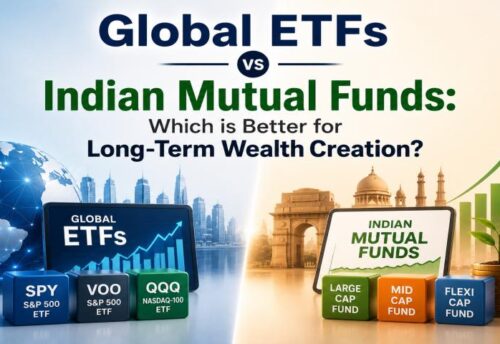
2. Through Indian Mutual Funds
Some Indian mutual funds invest in Global ETFs or international funds. In this method, you invest in Indian Rupees, and the mutual fund company manages the overseas investment on your behalf.
This option is easier for beginners because you don’t need a foreign brokerage account.
However, sometimes these funds may temporarily stop accepting fresh investments due to overseas investment limits. Always check whether the fund is accepting new investments before investing.
Documents Required:
If you choose direct overseas investing, you may need:
- PAN Card
- Aadhaar Card
- Passport (if required)
- Bank account details
- Address proof
- KYC documents
- Tax residency details
- LRS declaration
- Bank remittance forms
- Overseas brokerage account details
Your bank may also ask the purpose of the money transfer.
What Is TCS?
When you send money abroad under LRS, Tax Collected at Source (TCS) may apply. Currently, TCS generally applies at 20% on the amount exceeding ₹10 lakh in a financial year for investment-related remittances.
For example:
- If you send ₹8 lakh abroad, TCS may not apply.
- If you send ₹15 lakh, TCS may apply only on ₹5 lakh.
Remember, TCS is not an extra tax. You can usually claim it while filing your Income Tax Return, subject to tax rules.
Tax on Global ETFs:
Taxation is an important part of international investing. If you invest directly in Global ETFs, you may have to pay tax on:
- Capital gains
- Dividend income
- Foreign tax deductions
- Foreign asset reporting
Dividends received from foreign ETFs are taxable in India. In some countries, tax may already be deducted before the dividend reaches you.
You should keep proper records of:
- Purchase price
- Sale price
- Dividends received
- Tax deducted
- Exchange rates
These records are helpful while filing your Income Tax Return.
Schedule FA Reporting:
If you are an Indian resident holding foreign investments, you may need to report these assets in Schedule FA while filing your Income Tax Return.
This may include:
- Foreign brokerage accounts
- Global ETFs
- Foreign dividends
Ignoring this requirement can create compliance issues. Always file your Income Tax Return carefully if you own foreign assets.
Currency Risk:
Global ETFs are usually linked to foreign currencies such as the US Dollar.
Your returns depend on:
- The performance of the ETF.
- The movement of the exchange rate.
If the ETF performs well and the Rupee weakens against the Dollar, your returns in Rupees may increase. If the Rupee strengthens or the ETF performs poorly, your returns may reduce.
So, currency movements can either increase or decrease your returns.
Costs Involved:
Investing internationally involves several charges.
These may include:
- Currency conversion charges
- Bank remittance charges
- Brokerage charges
- Platform fees
- ETF expense ratio
- Withdrawal charges
- Tax filing costs
Even if an ETF has a low expense ratio, these additional charges can increase your overall investment cost. Always calculate the total cost before investing.
Benefits of Global ETFs:
Global ETFs offer several advantages.
They help you:
- Diversify your investments internationally.
- Invest in industries that are not well represented in India.
- Get exposure to global companies through one investment.
- Reduce dependence on a single country’s economy.
- Build wealth over the long term.
They can also be useful if you have future goals like overseas education or relocation.
Risks of Global ETFs:
Like every investment, Global ETFs also carry risks.
Some common risks include:
- Market risk
- Currency risk
- Changes in tax rules
- TCS impact on cash flow
- Foreign asset reporting requirements
- Platform and operational risks
Always understand the ETF before investing. Do not invest simply because it has performed well in the past.
How Much Should Beginners Invest?
Beginners should start with a small investment. Instead of putting a large portion of your money into Global ETFs, begin with around 5% to 15% of your long-term equity portfolio.
Before investing internationally, make sure you have:
- Emergency savings
- Health insurance
- Life insurance (if needed)
- Debt under control
- Regular investments in India
Global ETFs should be a part of your portfolio—not your entire portfolio.
How to Choose a Global ETF?
Before investing, check:
- Which index does it follow?
- Which country or sector does it invest in?
- What is the expense ratio?
- Is the ETF large and liquid?
- What is its tracking error?
- Does it pay dividends or reinvest them?
- Is it suitable for your financial goals?
Don’t invest only because the ETF has delivered high returns in the past. Past performance does not guarantee future returns.
Common Mistakes to Avoid:
Many beginners make these mistakes:
- Investing without understanding LRS rules.
- Ignoring TCS.
- Forgetting foreign asset reporting.
- Buying random Global ETFs.
- Investing only in one country or sector.
- Ignoring investment costs.
- Ignoring currency risk.
- Investing money meant for short-term needs.
- Not maintaining proper records.
Avoid these mistakes to make your investment journey smoother.
Final Thoughts:
Global ETFs allow Indian investors to invest in international markets and diversify their portfolios. You can invest directly through overseas investment platforms or indirectly through Indian mutual funds that invest internationally.
Direct investing offers more choices but also involves additional tax reporting and compliance. Mutual fund routes are easier for beginners but may have fewer investment options.
Before investing, understand the LRS rules, taxes, TCS, currency risk, reporting requirements, and investment costs. Start with a small amount, invest for the long term, keep proper records, and review your portfolio regularly.
Global investing can be a valuable part of your financial plan—but only when done with proper knowledge and discipline.
Disclaimer:
The information shared in this article is for educational and awareness purposes only. It should not be considered financial, tax, or investment advice, nor should it be treated as a recommendation to invest in any specific product.