- 31/01/2026
- MyFinanceGyan
- 240 Views
- 7 Likes
- Tax
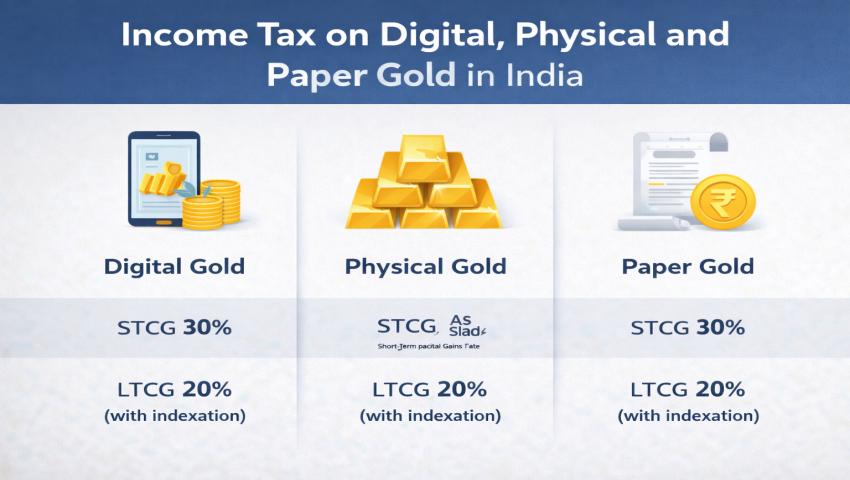
Income Tax on Digital, Physical and Paper Gold in India
Gold has traditionally been one of the most preferred investment avenues in India. Today, investors can choose from multiple formats such as physical gold, digital gold, Gold ETFs, Gold Mutual Funds, Sovereign Gold Bonds, and gold derivatives. While the form of investment may differ, the income tax treatment largely depends on the holding period and the nature of the asset. Financial awareness platforms like My Finance Gyan regularly share the latest updates and simplified guidance to help investors understand these changing tax rules better.
As per current income tax provisions, long-term capital gains (LTCG) on gold are taxed at 12.5% (without indexation), while short-term capital gains (STCG) are taxed as per the individual’s applicable income tax slab rate, making proper tax planning essential for maximising post-tax returns.
What Is Digital Gold?
Digital gold represents ownership of physical gold purchased online. The gold is stored securely in insured vaults by the issuing entity on behalf of the investor. The value of digital gold closely tracks the price of physical gold.
However, unlike other regulated financial instruments, digital gold is not regulated by RBI or SEBI, which investors should keep in mind while evaluating risks.
Income Tax on Digital Gold in India:
The taxation of digital gold is the same as that of physical and paper gold.
- Holding period of 24 months or more: Gains are treated as long-term capital gains and taxed at 5% plus applicable cess.
- Holding period of less than 24 months: Gains are considered short-term capital gains and taxed according to the investor’s income tax slab.
Tax liability arises only at the time of sale or redemption of digital gold.
Taxes on Physical Gold:
Physical gold includes gold jewellery, coins, bars, biscuits, and ornaments. It continues to be a popular investment choice among Indian households.
- Long-term capital gains (holding period ≥ 24 months) are taxed at 5% without indexation benefit.
- Short-term capital gains (holding period < 24 months) are added to total income and taxed as per the applicable slab rate.
Capital gains tax becomes applicable only when physical gold is sold.
Income Tax on Paper Gold in India:
Paper gold refers to gold investments that do not involve physical possession. These include:
- Gold Exchange Traded Funds (ETFs)
- Gold Mutual Funds
- Sovereign Gold Bonds (SGBs)
Taxation rules are as follows:
- Long-term capital gains (after 24 months) are taxed at 5%.
- Short-term capital gains (before 24 months) are taxed as per the individual’s income tax slab.
In the case of Sovereign Gold Bonds, while interest income is taxable, capital gains on redemption at maturity may be exempt under specific conditions as notified by the government.
Income Tax on Gold Derivatives:
Gold derivatives are traded in the commodities market, with gold as the underlying asset. These transactions are treated differently from investments in physical or paper gold.
- Profits from gold derivative trading are classified as business income (non-speculative).
- Such income is taxed at applicable slab rates.
- Investors can deduct eligible business expenses and maintain a Profit & Loss account to compute taxable income.
Proper maintenance of books of accounts is required, especially if one intends to explore presumptive taxation benefits under Section 44AD, subject to applicability.
Income Tax on Gift or Inheritance of Gold:
Gold is commonly gifted or inherited in Indian families, especially during weddings and festivals.
- Gold received as a gift or inheritance from specified relatives (parents, spouse, children, etc.) is fully exempt from income tax under Section 56(2) of the Income Tax Act.
- Gold received on the occasion of a wedding is also exempt from tax.
- If gold is received from a non-relative and its value exceeds ₹50,000, it becomes taxable under the head “Income from Other Sources.”
When such gifted or inherited gold is sold later, capital gains tax applies based on the original holding period.
Income Tax Rules on Gold for NRIs:
Non-Resident Indians (NRIs) are permitted to invest in physical gold, digital gold, Gold ETFs, and Gold Mutual Funds in India.
- NRIs cannot invest in Sovereign Gold Bonds, as per RBI and FEMA regulations.
- The tax rates on capital gains from gold sales are the same for NRIs and resident Indians.
Read also – Digital Gold Vs Physical Gold
How to Save Tax on Long-Term Capital Gains from Gold?
Investors can reduce or eliminate LTCG tax on gold by claiming exemptions under the following sections:
Section 54F :
- Exemption is available if long-term capital gains are reinvested in a residential house property, subject to conditions.
Section 54EC :
- Exemption can be claimed by investing LTCG in specified bonds such as NHAI or REC bonds.
- The maximum investment limit under this section is ₹50 lakh.
Conclusion:
Gold continues to be a favored investment choice in India due to its cultural significance and ability to hedge against inflation. However, like any financial asset, gold investments are subject to market fluctuations and income tax implications.
Understanding the tax treatment of different forms of gold—digital, physical, paper, and derivatives—helps investors make informed decisions and plan their taxes efficiently. With proper tax planning using provisions such as Sections 54F and 54EC, investors can significantly reduce their tax burden on long-term capital gains from gold investments.
A well-informed approach ensures that gold remains a valuable and tax-efficient component of a diversified investment portfolio.
Disclaimer: This article is for general informational purposes only and does not constitute legal, tax, or professional advice; readers are advised to consult a qualified tax professional for guidance specific to their situation.