
- 15/09/2026
- Govind S. Jethani
- 33 Views
- 2 Likes
- Finance
50/30/20 Budget Rule Explained: Is It Right for You?
Managing money can be difficult when you have rent, groceries, bills, debt payments and other expenses competing for your income. A budgeting method can make it easier to understand where your money is going and how much you can save.
One popular approach is the 50/30/20 budget rule. It divides your after-tax income into three broad categories: needs, wants and savings or debt repayment.
But is the 50/30/20 rule suitable for everyone? Not necessarily. Understanding how it works and how you can adjust it to your circumstances can help you decide whether it fits your financial goals.
What Is the 50/30/20 Budget Rule?
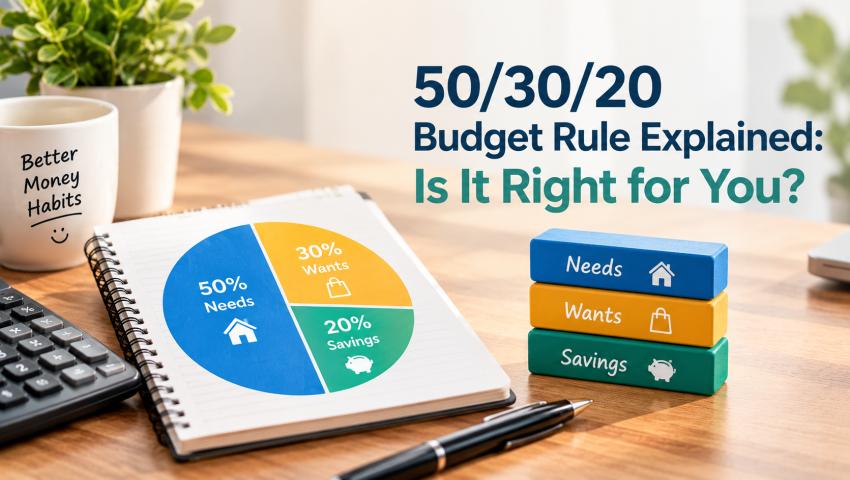
The 50/30/20 rule is a simple budgeting framework that divides your after-tax income into three categories:
- 50% for needs
- 30% for wants
- 20% for savings and debt repayment
The idea is to create a balance between meeting essential expenses, enjoying your money and preparing for the future.
For example, if your monthly take-home income is $5,000, the guideline would look like this:
- $2,500 → Needs
- $1,500 → Wants
- $1,000 → Savings and debt repayment
These percentages are guidelines rather than strict financial requirements. Your actual budget may look different depending on your income, location, family size and financial goals.
50%: Spend on Your Needs
The first category covers expenses that are essential for daily life.
Common needs may include:
- Rent or mortgage payments
- Utilities
- Groceries
- Health insurance
- Transportation
- Basic clothing
- Minimum debt payments
- Essential household expenses
The goal is to keep these necessary expenses around 50% of your after-tax income.
However, housing costs can make this difficult, especially in expensive U.S. cities. If your rent or mortgage alone takes up a large percentage of your income, forcing your entire budget to fit exactly into the 50% category may not be realistic.
Instead, use the rule as a starting point to identify where you may be able to reduce unnecessary spending.
30%: Spend on Your Wants
The second category is for things you enjoy but do not necessarily need to live.
Examples include:
- Restaurant meals
- Entertainment
- Streaming subscriptions
- Vacations
- Hobbies
- Shopping
- Upgraded electronics
- Non-essential memberships
This category allows room for enjoying your income.
A budget does not have to mean eliminating everything you enjoy. Giving yourself a reasonable amount for discretionary spending can make a budget easier to maintain over the long term.
However, if you have significant debt or an important savings goal, you may choose to reduce the amount allocated to wants.
20%: Save and Pay Down Debt
The final 20% is focused on your financial future.
This money can potentially be used for:
- Emergency savings
- Retirement contributions
- Long-term investments
- Additional debt payments
- Other financial goals
For example, you might use part of this amount to build an emergency fund and contribute the rest toward a retirement account.
If you have high-interest debt, directing additional money toward repayment can also be an important financial priority.
Example of the 50/30/20 Rule:
Imagine you earn $4,000 per month after taxes.
Using the 50/30/20 framework:
- Needs: 50% = $2,000
This could cover rent, groceries, utilities, transportation and insurance. - Wants: 30% = $1,200
This could include dining out, entertainment, shopping and hobbies. - Savings and debt repayment: 20% = $800
This could go toward an emergency fund, retirement savings or paying down debt.
This example is only a framework. Your actual numbers may be different.
Benefits of the 50/30/20 Rule:
One of the biggest advantages of this budgeting method is simplicity. You do not necessarily need to track every single expense category. Instead, you can focus on three broad areas.
The rule can also encourage people to save regularly while still leaving room for discretionary spending.
Another advantage is flexibility. You can adjust the percentages based on your financial circumstances.
For example, someone with significant debt might temporarily use a 50/20/30 approach, where more money goes toward debt repayment and savings.
Someone with a low income and high housing costs may need to spend more than 50% on essential expenses.
Is the 50/30/20 Rule Right for You?
The answer depends on your financial situation.
The rule may work well if you have relatively stable income, manageable debt and enough flexibility in your monthly expenses.
However, it may be difficult to follow if you have very high housing costs, substantial debt, irregular income or expensive family responsibilities.
Instead of treating 50/30/20 as a strict formula, consider using it as a budgeting benchmark.
If your needs currently consume 65% of your income, for example, that does not mean your budget has failed. It may simply show that your essential expenses are high and that you need to adjust your financial priorities.
How to Start Using the Rule?
Start by calculating your monthly after-tax income.
Next, review your spending from the previous month and separate your expenses into needs, wants and savings/debt repayment.
Compare your actual spending with the 50/30/20 guideline.
If you are spending significantly more on wants, look for expenses you can reduce. If you are saving less than 20%, consider setting up automatic transfers after receiving your paycheck.
Most importantly, choose targets that are realistic enough to maintain consistently.
Final Thoughts:
The 50/30/20 budget rule is not a one-size-fits-all financial plan. It is a simple framework that can help you organize your money and think about your spending priorities.
If the traditional percentages work for your situation, they can provide a useful structure. If they do not, adjust them.
The best budget is not necessarily the one that follows a perfect formula. It is the one that helps you pay your essential expenses, enjoy your money responsibly, reduce financial stress and make steady progress toward your goals.