- 12/08/2026
- Govind S. Jethani
- 324 Views
- 4 Likes
- Tax, Finance
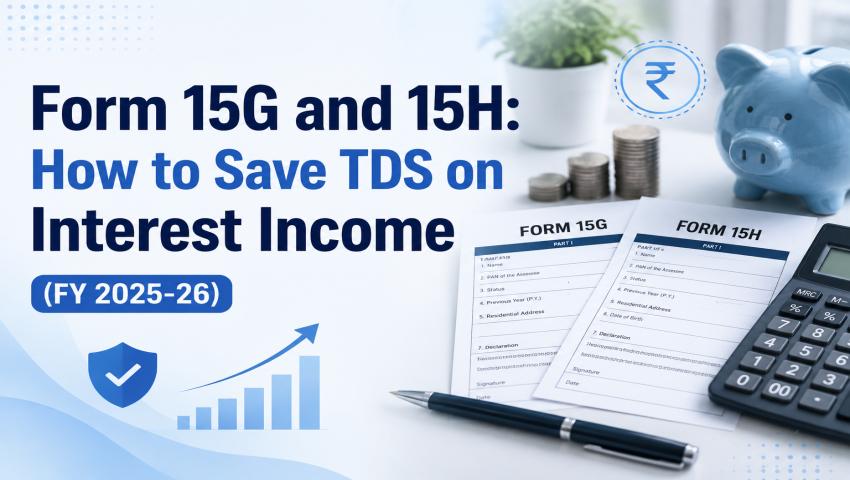
Form 15G and 15H: How to Save TDS on Interest Income?
If you have a fixed deposit or a recurring deposit and your bank has started cutting TDS from your interest earnings, chances are you missed submitting form 15g and 15h on time. These two forms are among the most searched income tax forms every financial year, and for good reason. They allow eligible taxpayers to stop banks and other institutions from deducting tax at source when their actual tax liability is nil. In this guide by My Finance Gyan, we will break down everything about form 15g and 15h, their eligibility, differences, and how to fill them correctly, along with an important update on the newly introduced Form 121.
Whether you are a salaried individual, a homemaker with FD income, or a senior citizen depending on interest income, understanding what is form 15g and 15h can genuinely save you a good amount of money that would otherwise get blocked as TDS and refunded only after you file your ITR.
What Are Form 15G and Form 15H?
Form 15g and form 15h are self-declaration forms under the Income Tax Act that let you inform banks, post offices, and other financial institutions that your total income for the year is below the taxable limit. Once submitted, these institutions will not deduct TDS on your interest income, insurance commission, EPF withdrawal, or other specified payments.
Both the 15g income tax form and the 15h form of income tax are valid for a single financial year only. This means you cannot submit them once and forget about it. You need to file them fresh at the start of every financial year, ideally in April, so that no TDS gets deducted right from the first interest credit.
It is important to remember that submitting these forms does not make your interest income tax free. It simply tells the deductor not to cut TDS because your estimated total income will not attract any tax. You are still required to report this interest income while filing your ITR and pay tax if your total income actually crosses the exemption limit later in the year.
Form 121: The New Combined Form (Applicable from FY 2026-27)
Here is something taxpayers should keep an eye on. With the Income Tax Act, 2025 coming into effect, a new form called Form 121 has been introduced. This form is set to combine the functions of both form 15g and 15h into a single declaration, applicable from FY 2026-27 onward.
Form 121 is filed by resident individuals, HUFs, and other eligible assessees to request nil TDS deduction when their estimated income is not chargeable to tax. It essentially replaces the older 15 g and h forms under Section 393 of the new Act, simplifying the process so that taxpayers do not have to remember which form applies to them based on age.
For FY 2025-26, however, you will still continue to use the existing form 15g and 15h as usual. The shift to Form 121 becomes relevant only from the next financial year, so this guide will focus on the current applicable forms while giving you a heads-up about what is coming.
Who Can File Form 15G and Form 15H?
Not everyone can submit these forms randomly. There are specific eligibility conditions attached to each one.
Form 15G eligibility:
- Any resident individual below 60 years of age, HUF, trust, or any person other than a company or a firm
- Interest income should be below the basic exemption limit, that is Rs 2.5 lakh under the old regime or Rs 4 lakh under the new regime
- Final tax liability for the year should be nil
- Must hold a valid PAN
Form 15H eligibility:
- Applicable only to resident senior citizens, meaning individuals aged 60 years or above
- Can be used even if interest income exceeds the basic exemption limit, as long as final tax liability is nil
- Must have a valid PAN
So essentially, if someone asks what is form 15g and 15h in simple terms, form 15g is for younger taxpayers whose income is genuinely low, while form 15h for senior citizens has a bit more flexibility since it focuses purely on whether the final tax payable is zero.
Why Do You Need These Forms?
Banks and other financial institutions are required by law to deduct TDS once your interest income crosses a specified threshold, generally Rs 50,000 for regular taxpayers and Rs 1,00,000 for senior citizens in a financial year. Many people assume that FD interest gets taxed only at maturity, but that is a myth. TDS actually gets deducted periodically, and it shows up in your Form 26AS.
If your total income does not attract any tax, this deduction becomes an unnecessary hassle because you would need to claim it back as a refund while filing your return. Submitting the 15g and 15h form at the right time avoids this entire cycle and keeps your money in your account instead of sitting with the tax department until refund processing.
Form 15G and 15H Difference: A Quick Comparison
Understanding With Examples:
Let us say a 45-year-old individual earns Rs 2 lakh salary and Rs 60,000 interest income, with total deductions bringing taxable income to nil. This person is eligible for form 15g since they are under 60 and both income and tax liability conditions are met.
Now consider a 65-year-old with Rs 1 lakh pension income and Rs 2.8 lakh interest income. Even though the interest income exceeds the general exemption limit, since this person is a senior citizen and final tax liability works out to nil after deductions, form 15h for senior citizens applies here, not form 15g.
This distinction is exactly why so many people search terms like 15h and 15g or form 15g and 15h together, hoping to figure out which one fits their specific income situation.
Where Can You Use Form 15G or Form 15H?
These forms are not limited to bank FD interest alone. You can submit form 15g or form 15h for the following types of income:
- Interest income from banks, including 15g form for FD
- Premature EPF withdrawals above Rs 50,000 within five years of account opening
- Rental income exceeding Rs 6 lakh annually where TDS applies
- Insurance commission above Rs 15,000
- Interest income from corporate bonds exceeding Rs 5,000
- Post office deposits, where form 15h for post office is commonly used by senior citizens
- Dividend income above Rs 5,000
- Life insurance policy proceeds not covered under Section 10(10D), exceeding Rs 1 lakh
How to Fill Form 15G?
If you are wondering how to fill the 15g form, here is a simplified step-by-step approach:
- Download the form from your bank’s website, the EPFO portal, or the income tax department’s official site
- Fill in your personal details accurately, including your full name, PAN, address, and contact information
- Mention your estimated total income for the year along with the specific income for which the declaration is being made
- Declare your residential status and previous year details
- Sign the form, ideally in front of a witness where required
- Attach a self-attested copy of your PAN card
- Submit the form to the relevant bank branch, EPFO office, or institution before your interest gets credited
Always keep a copy of the submitted form 15g income tax declaration for your personal records, along with the acknowledgment number if provided.
How to Fill Form 15H for Senior Citizen?
For those searching how to fill form 15h for senior citizen, the process is quite similar but includes a couple of additional fields:
- Fill in your name and PAN exactly as per your PAN card
- Mention your status, that is individual, since HUFs cannot use this form
- Enter the correct previous year, meaning the financial year for which the declaration applies
- Confirm your residential status as an Indian resident
- Provide your date of birth, which is a mandatory field unique to this form since only those 60 and above can file it
- Fill in contact details including address, email, and phone number
- Declare whether you were assessed to tax in any of the past six years, and if yes, mention the latest assessment year
- Enter the estimated income for which the declaration is made, along with your estimated total income for the year
- Provide details of any other forms 15H filed earlier during the same year, along with the aggregate income declared
- Fill in specific details of the investment or account, such as your FD account number or deposit details
- Sign the declaration form
Whether you are looking to download form 15h for senior citizen or wondering how to fill form 15 h correctly, most banks now provide a pre-filled digital version through net banking, which reduces manual errors significantly.
How to Submit Form 15G and 15H Online?
Most major banks allow form 15h online submission through their net banking portal or mobile application. The general steps are:
- Log in to your bank’s internet banking or mobile app
- Navigate to the tax center or service request section
- Select form 15G or 15H as applicable
- Fill in the required details and select the relevant FD or deposit accounts
- Submit the request and download the acknowledgment for your records
If you prefer offline submission, you can also visit your bank branch physically, fill the paper form, and submit it along with your PAN copy.
What If You Forget to Submit the Form?
If TDS has already been deducted because you missed the deadline, do not panic. Here is what you should do:
- File your income tax return to claim a refund of the excess TDS deducted
- Submit the form immediately to prevent further deductions for the remaining part of the financial year
- Keep all supporting documents, including TDS certificates and the acknowledgment of the form submitted
- Consult a tax professional if you find the refund process confusing
Penalty for Wrong Declaration:
Filing a false declaration under these forms is a serious matter. If the tax sought to be evaded exceeds Rs 25 lakh, imprisonment can range from six months to seven years along with a fine. In other cases, the imprisonment term ranges from three months to two years with a fine, under Section 277 of the Income Tax Act. So always be careful and file only when you genuinely meet the eligibility conditions.
If you are still facing any issue regarding form 15g and 15h, TDS deduction, or refund processing, you can consult Startup Portal for expert assistance.
Frequently Asked Questions:
Form 15g and 15h difference mainly lies in the age criteria. Form 15G is for individuals below 60 years and requires interest income to stay within the basic exemption limit. Form 15H is exclusively for resident senior citizens aged 60 and above, and it can be used even if interest income exceeds the exemption limit, as long as final tax liability is nil.
No, NRIs are not eligible to submit either of these forms. These declarations are meant only for resident taxpayers.
If you do not submit form 15g income tax declaration on time, the bank or deductor will continue deducting TDS on your interest income even if your actual tax liability is nil. You will then need to file your ITR to claim the excess TDS as a refund.
Yes, form 15h for post office deposits works the same way as it does for bank FDs. Senior citizens earning interest income from post office schemes can submit this declaration to avoid TDS, provided their final tax liability is nil.
Yes, starting FY 2026-27, Form 121 under the Income Tax Act, 2025 will replace both form 15g and 15h with a single combined declaration form. However, for FY 2025-26, taxpayers should continue using the existing 15g and 15h forms as applicable.
Final Thoughts:
Understanding form 15g and 15h is not complicated once you know the basic eligibility rules tied to age and income. The key takeaway is to submit the relevant form at the very start of the financial year to every bank or institution where you earn taxable interest, rather than waiting until TDS has already been deducted. And with Form 121 on the horizon from next year, it is worth staying updated so you are not caught off guard when the transition happens. At My Finance Gyan, we always recommend reviewing your income estimates carefully before signing any declaration, since a wrong submission can invite penalties under the law.