- 24/09/2026
- Govind S. Jethani
- 75 Views
- 2 Likes
- Finance
High-Yield Savings Account: What Is It and How Does It Work?
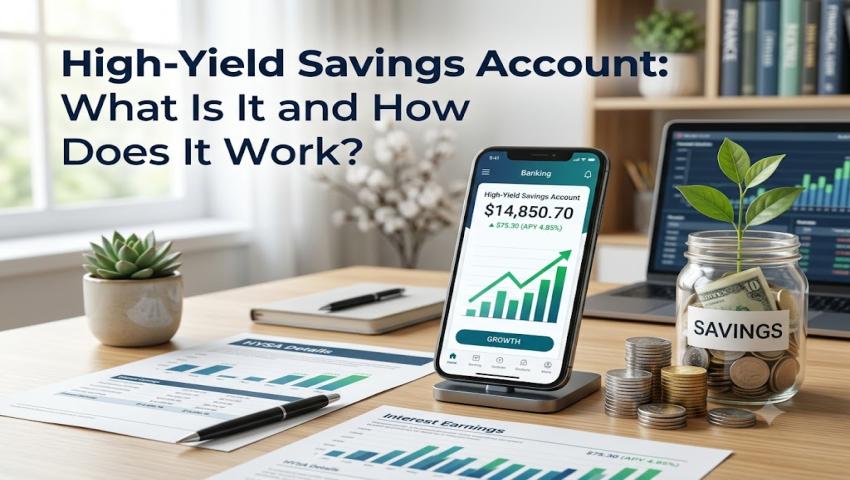
A high-yield savings account, commonly called an HYSA, is a savings account that generally pays a higher interest rate than a standard savings account.
In this guide by My Finance Gyan, a high-yield savings account can be useful for people who want to keep money relatively safe and accessible while earning interest. High-yield savings accounts are often used for emergency funds, short-term goals, travel savings, home down payments, or other planned expenses.
What Is a High-Yield Savings Account?
A high-yield savings account works much like a regular savings account. You deposit money with a bank or credit union, and the institution pays interest on your balance.
The main difference is that an HYSA generally offers a more competitive Annual Percentage Yield, or APY. Many high-yield accounts are offered by online banks because they may have lower operating costs than traditional banks with large branch networks.
However, rates can change, so the APY offered today may not remain the same in the future.
What Does APY Mean?
APY stands for Annual Percentage Yield. It shows approximately how much your money can earn over one year, including the effect of compounding.
For example, if you deposit money into a savings account and leave both your original deposit and the interest in the account, future interest may be calculated on the larger balance.
That is how compounding helps savings grow. When comparing accounts, APY is important, but it should not be the only factor.
Also check:
- Monthly fees
- Minimum balance requirements
- Transfer limits
- Withdrawal policies
- Minimum opening deposit
- Promotional-rate conditions
High-Yield Savings Account vs Regular Savings Account:
Both accounts are designed to hold cash.
However, a high-yield savings account generally offers a higher interest rate.
A traditional savings account may provide advantages such as local branches, easier cash deposits, and direct integration with your checking account.
An online HYSA may offer a stronger APY but less access to physical branches. The better option depends on your banking habits and financial goals.
Are High-Yield Savings Accounts Safe?
If the account is held at an FDIC-insured bank, eligible deposits are generally protected within applicable federal insurance limits. The standard FDIC insurance amount is generally up to $250,000 per depositor, per insured bank, for each ownership category.
Credit unions may have similar federal protection through the National Credit Union Administration when applicable. Always verify that the financial institution is properly insured.
Deposit insurance does not cover investment losses in stocks, mutual funds, ETFs, cryptocurrency, or other market investments.
What Should You Use an HYSA For?
A high-yield savings account can be useful for money you may need within the next few years.
Common uses include:
- Emergency fund
- Home down payment
- Wedding expenses
- Vacation fund
- Home repairs
- Insurance premiums
- Car purchase
- Short-term financial goals
Money needed soon may not be suitable for volatile investments because market values can decline at the wrong time. An HYSA can provide greater stability and accessibility.
Is an HYSA an Investment?
Not in the traditional sense.
An HYSA is a bank deposit product rather than a stock-market investment. Its main purpose is usually capital preservation, liquidity, and interest income.
Stocks and investment funds may offer greater long-term growth potential, but they also involve greater risk.
Therefore, an HYSA and a long-term investment account serve different purposes.
High-Yield Savings Account vs CD:
High-Yield Savings Account
- A CD generally requires you to keep money deposited for a specified period. Early withdrawals may result in penalties.
- A CD may make sense if you know you will not need the money during the term.
CD
- An HYSA usually provides easier access to funds.
- An HYSA may be better when flexibility is important.
Can HYSA Rates Change?
Yes.
Most high-yield savings accounts have variable interest rates. Banks may raise or lower rates depending on economic conditions and business decisions.
Do not assume that an advertised APY will remain permanent. It is a good idea to r view your savings account periodically and compare it with other available options.
Is HYSA Interest Taxable?
Generally, interest earned from a savings account is taxable income for federal income-tax purposes.
Your financial institution may provide a tax form showing reportable interest. State tax rules may also apply.
How Much Money Should You Keep in an HYSA?
There is no single correct amount.
For emergency savings, consider your monthly expenses, job stability, family responsibilities, insurance coverage, and potential unexpected costs. For short-term goals, keep enough to meet the expected expense.
However, keeping too much long-term money in cash can also have disadvantages because savings accounts generally offer lower long-term growth potential than investments.
Can You Lose Money in an HYSA?
Eligible deposits within insurance limits at an insured institution generally have strong protection against bank failure.
However, inflation can still reduce purchasing power.
For example, if your savings earns 3% while prices rise faster than that, your balance may increase while the real value of your money grows more slowly.
This is one reason savings accounts are usually better for short-term security than long-term wealth creation.
Frequently Asked Questions:
It may be if it offers a higher APY with reasonable fees and suitable access.
Most HYSAs provide relatively easy access, although bank-specific transfer and withdrawal rules may apply.
Generally, yes. Interest earned is usually taxable income.
Usually not for long-term goals. Savings and investments serve different purposes.
Final Thoughts:
A high-yield savings account can be a useful place for emergency savings and short-term financial goals.
It allows your money to earn interest while remaining relatively accessible. Before opening an account, compare APY, fees, minimum balance requirements, transfer options, and deposit-insurance protection.
Choose the account based on your financial goal rather than the advertised interest rate alone.