
- 19/09/2026
- Govind S. Jethani
- 36 Views
- 2 Likes
- Investment
Best Investment Options in the USA for Beginners
Starting to invest can feel overwhelming.
Stocks, ETFs, mutual funds, bonds, 401(k)s, IRAs, Treasury securities and other investment choices can make it difficult for a beginner to know where to start.
The good news is that investing does not need to be complicated. The best investment option for you depends on your financial goal, time horizon, risk tolerance, income and how quickly you may need access to the money.
Instead of searching for one investment that is “best” for everyone, beginners should understand the advantages and risks of the major investment options available in the USA.
Here are some of the most common choices.
1. 401(k) Retirement Plan:
If your employer provides a 401(k), it may be one of the first investment accounts worth understanding. A 401(k) allows eligible employees to contribute part of their compensation toward retirement.
Many employers also offer a matching contribution.
For example, an employer might contribute additional money when an employee contributes to the plan, subject to the employer’s specific matching formula.
That can make employer matching an important workplace benefit.
For 2026, the IRS employee-contribution limit for most 401(k), 403(b) and governmental 457 plans is $24,500. The general catch-up contribution limit for participants age 50 and older is $8,000, with special rules applying in some circumstances.
Why Beginners May Consider a 401(k)?
- Convenient payroll contributions
- Potential employer matching
- Tax advantages
- Designed for long-term retirement saving
- Access to professionally managed investment options
One limitation is that the investment menu is generally selected by the employer’s plan provider, so choices may be more limited than in an individual brokerage account.
2. Individual Retirement Account — IRA:
An IRA is another common retirement account in the USA. Unlike a 401(k), an IRA is generally opened by an individual rather than an employer.
Two common forms are:
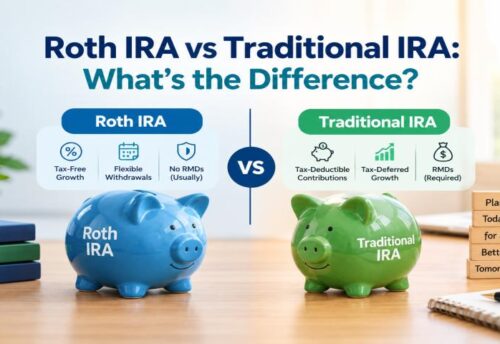
- Traditional IRA: Contributions may be deductible depending on income, filing status and workplace retirement-plan coverage. Taxes are generally deferred until withdrawals, subject to applicable rules.
- Roth IRA: Roth IRA contributions are generally made with after-tax money. Qualified withdrawals can generally be tax-free.
For 2026, the combined annual contribution limit for traditional and Roth IRAs is $7,500, with an additional $1,100 catch-up contribution generally available for people age 50 and older. Eligibility and deductibility rules can depend on income and other circumstances.
IRAs can also provide access to a wider range of investments than some workplace plans.
3. Broad-Market Index Funds:
Index funds are popular with many long-term investors because they provide a relatively simple way to own many investments at once. Instead of attempting to select individual companies, an index fund follows a specific market index or investment benchmark.
For example, a broad U.S. stock-market index fund might own shares in hundreds or even thousands of companies.
This can help provide diversification.
The SEC notes that diversification involves spreading investments across and within different asset categories, while mutual funds and ETFs can make it easier for investors to own portions of many investments.
Potential Advantages:
- Broad diversification
- Simple investment approach
- Often relatively low management costs
- Less dependence on the performance of one company
- Suitable for long-term investment strategies
However, index funds are still exposed to market risk. If the overall market falls, the value of the fund can fall as well.
4. Exchange-Traded Funds — ETFs:
An ETF pools investors’ money into a portfolio that can contain stocks, bonds or other assets. ETF shares are generally bought and sold on stock exchanges during trading hours.
Some ETFs track:
- The broad U.S. stock market
- The S&P 500
- International stocks
- Bonds
- Specific industries
- Dividend-paying stocks
- Other investment strategies
For beginners, broad diversified ETFs may be easier to understand than attempting to pick individual stocks.
However, not every ETF is diversified.
An ETF focused only on one industry, theme or small group of companies can still carry significant risk. Investor.gov specifically notes that narrowly focused funds may not provide the diversification an investor expects.
5. Mutual Funds:
Mutual funds pool money from multiple investors and invest it according to a defined investment strategy.
A mutual fund might invest in:
- S. stocks
- International stocks
- Government bonds
- Corporate bonds
- A combination of different assets
Both actively managed and index-based mutual funds are available. Mutual funds can be useful for beginners who want diversification without buying many individual securities.
Before investing, compare:
- Expense ratios
- Management fees
- Minimum investments
- Fund strategy
- Risk level
- Historical volatility
- Any sales charges
Fees matter because even relatively small annual expenses can reduce long-term returns.
6. U.S. Treasury Securities:
U.S. Treasury securities are debt obligations issued by the federal government.
Common types include:
- Treasury bills
- Treasury notes
- Treasury bonds
- Treasury Inflation-Protected Securities, or TIPS
Treasury securities can be useful for investors seeking relatively lower credit risk than stocks. They may be more appropriate for certain short- or medium-term goals or for the lower-risk portion of a diversified portfolio.
However, lower risk generally comes with lower long-term return potential compared with riskier assets such as stocks.
Bond prices can also change when interest rates move.
7. Bonds and Bond Funds:
A bond represents money lent to a government, municipality or company. In return, the issuer generally agrees to pay interest and return principal according to the bond’s terms, subject to the issuer’s ability to meet its obligations.
Compared with stocks, high-quality bonds generally experience lower price volatility, although risks remain. The SEC notes that bonds have historically tended to be less volatile than stocks but generally offer more modest return potential.
Beginners can gain bond exposure through:
- Individual bonds
- Bond mutual funds
- Bond ETFs
Risks can include:
- Interest-rate risk
- Credit/default risk
- Inflation risk
- Market-price fluctuations
Not all bonds are low risk. High-yield corporate bonds, for example, can carry significantly greater credit risk.
8. Target-Date Funds:
A target-date fund is designed around an approximate future year, often a retirement date.
For example, someone expecting to retire around 2060 might consider learning about a fund with a target date near that period.
Target-date funds generally hold a mix of investments such as:
- Stocks
- Bonds
- Other diversified funds
As the target date approaches, the fund typically adjusts its asset allocation toward a more conservative mix according to its predefined strategy. This can make target-date funds convenient for investors who prefer a more automated approach.
However, funds with the same target year can have different:
- Fees
- Asset allocations
- Risk levels
- Glide paths
Investors should understand what the fund actually owns rather than choosing solely based on the year in its name.
9. Certificates of Deposit — CDs:
A Certificate of Deposit is a deposit product available from many banks and credit unions. You generally agree to keep money deposited for a specified period in exchange for an agreed interest rate.
Depending on the institution and account type, eligible deposits may receive federal deposit-insurance protection within applicable limits. CDs may be useful for money that has a defined short- or medium-term purpose and does not need the growth potential of stocks.
However, withdrawing funds before maturity may result in penalties.
Inflation can also reduce the purchasing power of returns.
10. High-Yield Savings Accounts:
A high-yield savings account is technically a savings product rather than a market investment, but it can play an important role in a beginner’s financial plan.
It may be suitable for:
- Emergency funds
- Short-term goals
- Money needed within the next few years
- Cash that should not be exposed to major market fluctuations
One of the biggest mistakes beginners can make is investing emergency money in volatile assets and then being forced to sell during a market decline. Building an adequate cash reserve before taking significant investment risk can create a stronger financial foundation.
11. Individual Stocks:
Buying a stock means purchasing an ownership interest in an individual company. Individual stocks can offer substantial growth potential, but they also involve substantial risk.
If you put a large percentage of your savings into one company and that business performs poorly, your portfolio can suffer significant losses.
For beginners interested in individual stocks, it is important to understand:
- The company’s business model
- Revenue and profitability
- Debt
- Competition
- Valuation
- Industry risks
- Financial statements
Individual stocks should not be treated as guaranteed opportunities simply because a company is popular or trending on social media.
12. Real Estate Investment Trusts — REITs:
Investing directly in real estate can require substantial capital. Real Estate Investment Trusts, or REITs, provide another way to obtain exposure to real-estate-related assets without necessarily purchasing physical property yourself. Publicly traded REITs can be bought and sold through brokerage accounts.
They may own assets such as:
- Apartments
- Office buildings
- Warehouses
- Shopping centers
- Hotels
- Data centers
- Healthcare properties
REITs can provide diversification and income potential, but they also carry market, property-sector and interest-rate risks.
Which Investment Is Best for a Beginner?
There is no single best investment for every beginner. Different financial goals call for different approaches.
For example:
- Emergency money: Cash or other highly liquid, lower-risk options may be more appropriate.
- Short-term goal: Investors may prefer relatively stable options rather than putting all the money into stocks.
- Long-term retirement: Diversified stock and bond investments held through retirement accounts may be considered depending on age, goals and risk tolerance.
- Employer retirement benefits: A 401(k) with an employer match deserves particular attention because the employer may contribute additional money under the plan’s rules.
The important principle is to match your investment with your goal and time horizon.
How Should a Beginner Start Investing?
Step 1
Build an Emergency Fund:
Keep accessible money available for unexpected expenses.
Step 2
Pay Attention to High-Interest Debt:
High-interest credit-card debt can significantly affect your finances. Consider your debt situation before taking substantial investment risk.
Step 3
Define Your Goal:
Ask why you are investing.
Is it for:
- Retirement?
- A home?
- Education?
- Long-term wealth?
- Another future goal?
Step 4
Determine Your Time Horizon:
Money needed next year should generally be treated differently from money intended for retirement decades from now.
Step 5
Understand Your Risk Tolerance:
All investments involve risk.
Higher potential returns generally come with greater uncertainty and greater potential for loss.
Step 6
Choose the Appropriate Account:
You might invest through:
- A 401(k)
- Traditional IRA
- Roth IRA
- Taxable brokerage account
- Another suitable account
The account can affect taxes and withdrawal rules.
Step 7
Diversify:
Avoid relying entirely on one stock, sector or asset.
Step 8
Invest Consistently:
Regular contributions can help build a long-term investing habit.
Step 9
Review Fees:
Understand expense ratios, management fees, trading costs and account charges before investing.
Step 10
Think Long Term:
Short-term market movements are normal.
A financial plan should generally be based on your goals rather than daily headlines or social-media predictions.
Common Investing Mistakes Beginners Should Avoid:
Beginners should be particularly careful about:
- Trying to get rich quickly
- Investing emergency savings
- Following social-media tips blindly
- Putting everything into one stock
- Using borrowed money without understanding the risks
- Ignoring investment fees
- Panic-selling during normal market volatility
- Investing in products they do not understand
- Frequently buying and selling based on emotions
- Assuming past performance guarantees future returns
Investing is generally more sustainable when based on discipline rather than speculation.
Frequently Asked Questions:
There is no universal minimum. Some brokerage platforms and investment funds allow people to begin with relatively small amounts.
Broad diversified ETFs can provide a convenient way to own many securities through one investment, although investors should understand the fund’s holdings, fees and risks.
Stocks involve market risk and can lose value. A diversified portfolio can reduce company-specific risk but cannot eliminate investment losses.
The answer depends on your employer benefits, tax situation, investment choices and financial goals. An available employer match can be an important factor to consider.
Yes. Having access to a 401(k) does not automatically prevent you from contributing to an IRA, although IRA tax deductions and Roth IRA eligibility can depend on income and other rules.
Final Thoughts:
The best investment options in the USA for beginners are not necessarily the ones promising the highest return. A strong starting approach is to understand your financial position, establish clear goals, choose suitable accounts, diversify your investments and invest consistently over time.
401(k)s and IRAs can help with retirement planning, while diversified ETFs, index funds, mutual funds and bonds can provide different combinations of growth and risk. Cash savings, CDs and Treasury securities can also play important roles for shorter-term or lower-risk goals. Most importantly, never invest simply because an investment is popular.
Understand where your money is going, what risks you are taking and how the investment fits into your overall financial plan.