- 17/09/2026
- Govind S. Jethani
- 48 Views
- 2 Likes
- Investment, Tax
Roth IRA vs Traditional IRA: What’s the Difference?
Saving for retirement is one of the most important financial decisions you can make. In the United States, two of the most popular retirement accounts are the Roth IRA and the Traditional IRA.
Both accounts can help your retirement savings grow with valuable tax advantages. However, the way you receive those tax benefits is very different.
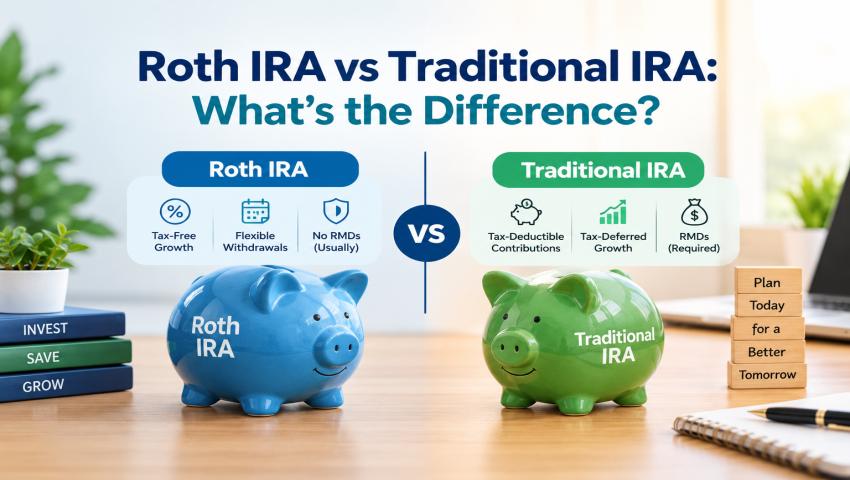
With a Traditional IRA, you may receive a tax benefit today and pay taxes when you withdraw the money in retirement. With a Roth IRA, you generally pay taxes today, but qualified withdrawals in retirement can be tax-free.
So, which one should you choose?
Let us understand the difference between a Roth IRA and Traditional IRA in simple terms.
What Is an IRA?
IRA stands for Individual Retirement Arrangement, commonly called an Individual Retirement Account.
It is a retirement account that individuals can open separately from an employer-sponsored retirement plan such as a 401(k).
An IRA itself is not an investment. It is an account in which you can generally hold investments such as:
- Stocks
- Bonds
- Mutual funds
- Exchange-traded funds (ETFs)
- CDs and certain other eligible investments
The two commonly used types are Traditional IRAs and Roth IRAs.
What Is a Traditional IRA?
A Traditional IRA allows eligible individuals to contribute money toward retirement and potentially claim a tax deduction for their contribution. Your investments can grow tax-deferred inside the account.
This means you generally do not pay income tax on investment earnings every year while the money remains in the IRA.
However, taxable withdrawals from a Traditional IRA are generally included in your income when you take the money out.
What Is a Roth IRA?
A Roth IRA works differently. You contribute money that has already been taxed, so Roth IRA contributions are not tax-deductible.
However, your money can grow without current taxation inside the account, and qualified withdrawals in retirement can be received tax-free.
This can make a Roth IRA attractive to people who believe their tax rate may be higher in the future.
Roth IRA vs Traditional IRA: Quick Comparison
IRA Contribution Limit for 2026:
For 2026, the combined contribution limit across your Traditional and Roth IRAs is generally:
- $7,500 if you are under age 50
- $8,600 if you are age 50 or older
You cannot contribute $7,500 separately to a Roth IRA and another $7,500 to a Traditional IRA. The limit applies to your total contributions across the two types.
Your contribution also generally cannot exceed your taxable compensation for the year.
Example:
Suppose you are 35 years old.
You contribute:
- $4,500 to a Roth IRA
- $3,000 to a Traditional IRA
Your total IRA contribution is $7,500, which reaches the 2026 annual limit.
Roth IRA Income Limits for 2026:
Your ability to contribute directly to a Roth IRA depends on your modified adjusted gross income, or MAGI.
For 2026, the Roth IRA contribution phase-out range is:
- Single or Head of Household: $153,000 to $168,000
- Married Filing Jointly: $242,000 to $252,000
- Married Filing Separately when living with your spouse: generally $0 to $10,000
Once your income reaches the upper end of the applicable range, you generally cannot make a direct Roth IRA contribution for that year.
Traditional IRA Deduction Limits:
Unlike a Roth IRA, there is generally no income ceiling that prevents you from contributing to a Traditional IRA if you otherwise qualify.
However, your ability to deduct the contribution may be restricted when you or your spouse participate in a workplace retirement plan.
For 2026, if you are covered by a retirement plan at work, the Traditional IRA deduction phase-out range is:
- Single or Head of Household: $81,000 to $91,000
- Married Filing Jointly, contributing spouse covered at work: $129,000 to $149,000
If you are not covered by a workplace plan but your spouse is, the joint-filer phase-out range is $242,000 to $252,000.
How Are Withdrawals Taxed?
1. Traditional IRA:
Deductible contributions and investment earnings are generally taxed as ordinary income when withdrawn. If you take a taxable distribution before age 59½, an additional 10% federal tax may apply unless you qualify for an exception.
2. Roth IRA:
Qualified Roth IRA distributions are generally tax-free.Rules surrounding Roth withdrawals depend on factors including your age, how long the Roth IRA has been open and whether the distribution meets the requirements for qualified treatment.
This makes Roth IRAs particularly attractive for long-term retirement planning.
Required Minimum Distributions:
Traditional IRAs generally require the account owner to begin taking Required Minimum Distributions, or RMDs, at age 73 under current rules.
Roth IRA owners generally do not have to take RMDs during their lifetime. Beneficiaries may be subject to separate distribution rules.
When Could a Roth IRA Be Better?
A Roth IRA may be worth considering if:
- You are currently in a relatively low tax bracket.
- You expect your income to increase in the future.
- You expect to face higher tax rates during retirement.
- You value tax-free qualified retirement withdrawals.
- You do not want lifetime RMDs from the account.
- You have many years available for investment growth.
For example, a young professional early in their career may currently pay a relatively low tax rate but expect substantially higher earnings later.
Paying tax before making a Roth contribution could potentially make sense in that situation.
When Could a Traditional IRA Be Better?
A Traditional IRA may be attractive if:
- You qualify for a tax deduction today.
- Your current tax rate is relatively high.
- You expect to be in a lower tax bracket after retirement.
- Reducing current taxable income is an important goal.
However, remember that getting a deduction today means eligible taxable withdrawals generally become income later.
Can You Have Both a Roth and Traditional IRA?
Yes. You can maintain both types of IRA.
However, your annual contribution limit applies to your combined contributions.
Some people use both accounts to create tax diversification in retirement. They may eventually have some retirement assets that generate taxable withdrawals and others that may generate tax-free qualified withdrawals.
Roth IRA vs Traditional IRA: Which Is Better?
There is no single answer for everyone.
The central question is:
Would you rather potentially receive a tax benefit today or potentially receive tax-free qualified income during retirement?
A Roth IRA may be attractive when you expect future tax rates to be higher.
A Traditional IRA may be attractive when receiving a current tax deduction is more valuable.
Your income, workplace retirement coverage, filing status, age and long-term financial plans should all be considered.
Frequently Asked Questions:
Contributions are made using after-tax money. Investment earnings can grow without annual current taxation, and qualified distributions can generally be withdrawn tax-free.
Generally, yes. Participation in an employer-sponsored 401(k) does not itself prevent you from contributing to a Roth IRA, although Roth IRA income limits still apply.
Yes. However, the annual IRA contribution limit applies to your combined contributions.
There is generally no maximum age for making Traditional or Roth IRA contributions, provided applicable compensation and eligibility requirements are met.
Conclusion:
Both Roth IRAs and Traditional IRAs can be powerful retirement-saving tools. The biggest difference is when you pay taxes.
With a Traditional IRA, you may receive a deduction today and generally pay tax when taxable money is withdrawn.
With a Roth IRA, there is no current contribution deduction, but qualified retirement withdrawals can be tax-free.
Rather than simply asking which IRA is “best,” consider which tax treatment is more suitable for your current and expected future financial situation.