- 08/09/2026
- Govind S. Jethani
- 344 Views
- 2 Likes
- Tax
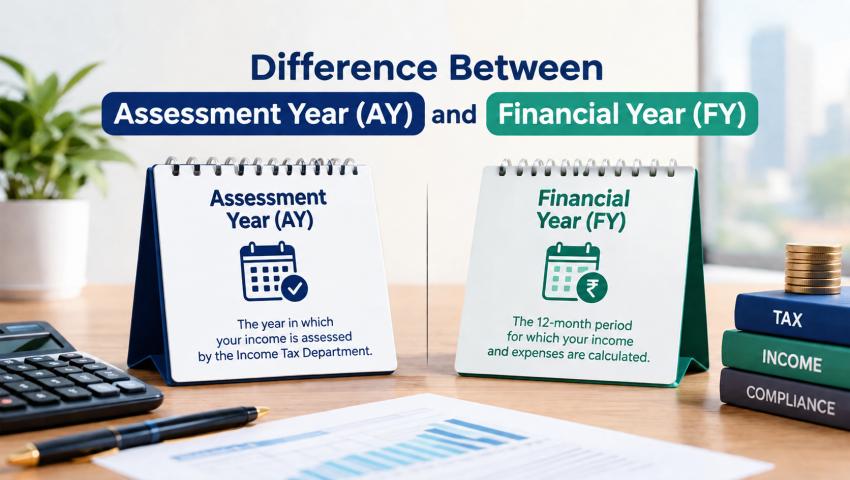
Difference Between Assessment Year (AY) and Financial Year (FY)Assessment Year (AY) vs Financial Year (FY)
If you have ever tried filing your Income Tax Return (ITR), you must have come across two terms that confuse almost every taxpayer at least once — Assessment Year (AY) and Financial Year (FY). Especially for first-time ITR filers, these two terms look almost identical, and it’s very common to mix them up while filling the ITR form.
But here’s the thing — understanding assessment year and financial year correctly is not just for exam purposes. Every single time you file your taxes in India, you need to know exactly which FY your income belongs to, and which AY you should select on the income tax portal. Get this wrong, and you could end up filing your return under the wrong year altogether.
In this guide by My Finance Gyan, we’ll break down what is assessment year and financial year in India, how they are different, and why both are equally important for every taxpayer. By the end, you’ll never confuse FY and AY again.
What is a Financial Year (FY)?
Let’s start with the basics. A financial year in India is simply the 12-month period during which you earn your income. It starts from 1st April of one calendar year and ends on 31st March of the next calendar year.
So, when someone asks “financial year starts from which month?” — the answer is always April. This is true whether you’re a salaried employee, a business owner, or a freelancer. The financial year date is fixed by law and doesn’t change based on your profession or type of income.
How to Read FY Notation?
The full form of FY is Financial Year, and it is usually written in a shorthand format. For example:
- Financial Year 2025 26 (written as FY 2025-26) means the period from 1st April 2025 to 31st March 2026.
- If someone says “fy 25 26 means” — it simply refers to this same period.
- Similarly, “fy 26 meaning” would generally refer to FY 2026-27, i.e., April 2026 to March 2027 — though people often use it loosely, so always check the exact years being referred to.
FY is Also Called the "Previous Year":
Here’s something many people don’t know — under the Income Tax Act, the Financial Year is also officially referred to as the “Previous Year.” So if you ever come across the term previous year meaning in a tax form or document, know that it means the same thing as FY — the year in which the income was actually earned.
This brings us to an important point: previous year and assessment year are not the same thing. The previous year (or FY) is when you earn money, while the assessment year is when that income gets evaluated. We’ll get into this in detail in the next section.
Special Cases for Financial Year:
While the financial year start and end date is generally fixed at 1st April to 31st March, there are a couple of exceptions:
- New businesses: If a business is set up partway through the year, its first financial year starts from the date of establishment and ends on the following 31st March.
- New income sources: If a new source of income arises during the year (say, you start receiving rental income from July), the financial year for that income begins from the date the income arises.
What is an Assessment Year (AY)?
Now let’s talk about the term that confuses most people — what is assessment year in income tax?
Simply put, the Assessment Year (AY) is the year immediately following the Financial Year, during which the income earned in the FY is evaluated, tax is calculated, and the ITR is filed. So, assessment year begins from 1st April right after the FY ends, and it also runs for 12 months, ending on 31st March of the following year.
How to Read AY Notation?
Just like FY, the AY is also written in a shorthand format. For example:
- If your current fy is 2025-26 (1st April 2025 to 31st March 2026), then the corresponding Assessment Year 2025 26… wait, let’s get this right — income earned in FY 2025-26 will be assessed in AY 2026-27.
- So, “what is the current assessment year” for FY 2025-26 income? It’s AY 2026-27.
Why Tax Can't Be Assessed Before Income is Earned?
This is where the logic of AY really makes sense. You simply cannot calculate tax on income before that income has actually been earned. Your salary, business profits, capital gains, or any other income needs to be finalised first — which happens over the full financial year. Only after the FY ends can the income tax department (and you) sit down and assess how much tax is payable. That assessment process happens in the AY.
This is also why, when people ask “what do you mean by assessment year” or want a simple definition of assessment year, the easiest way to explain it is: AY is the “checking year” for the income earned in the previous FY.
FY vs AY: Side-by-Side Comparison Table
Let’s make this crystal clear with a simple assessment year vs financial year comparison table:
A Quick Worked Example:
Suppose you earned income between 1st April 2025 and 31st March 2026. This period is your Financial Year 2025-26. Now, when you sit down to file your ITR for this income, you will select Assessment Year 2026-27 on the income tax portal — because that’s the year in which this income is being assessed and taxed.
This single example answers most of the confusion around “what is financial year and assessment year” — remember, FY comes first (earning), AY comes second (filing/assessing).
Quick Reference Chart: FY-AY Mapping for Recent Years
Here’s a handy chart to check the assessment year and financial year difference for recent years, so you never have to guess again:
So, if someone asks about the current financial year in India, it is FY 2025-26, and the current AY applicable to this FY is AY 2026-27. Bookmark this table — it’s useful every single tax year.
Why ITR Forms Ask for Assessment Year, Not Financial Year?
Ever noticed that when you log in to file your ITR, the portal asks you to select the Assessment Year, not the Financial Year? There’s a solid reason behind this.
Since income tax is calculated on income that has already been earned, the ITR form is essentially a “look-back” document. It records and reports the income you earned in the previous FY, and calculates the tax payable on it. This entire process — filing, verification, and assessment — happens in the AY. That’s why the form asks for AY and not FY.
A Common Mistake Taxpayers Make:
One of the most frequent errors people make while filing returns is selecting the wrong Assessment Year on the portal. For instance, someone trying to file returns for income earned in FY 2024-25 might mistakenly select AY 2024-25 instead of the correct AY 2025-26. This can lead to your return being filed for the wrong period, causing unnecessary notices or rejections.
Tip: Always remember — the AY is always one year ahead of the FY in which you earned the income.
Note on the New "Tax Year" Concept (Income Tax Bill 2025/2026 Update):
As part of ongoing efforts to simplify India’s tax laws, the government has proposed a new, simplified concept called the “Tax Year” under the Income Tax Bill. The idea is to eventually do away with the dual FY-AY system and replace it with a single, unified tax year in India — making compliance easier and less confusing for the average taxpayer.
At present, the FY and AY system continues to apply as usual, and this article reflects the rules currently in force. However, it’s worth keeping an eye on official updates from the Income Tax Department, since taxation year in India terminology may evolve going forward. We’ll keep this blog updated as and when there’s an official rollout.
Practical Tips for Taxpayers:
Here are a few simple, practical tips to help you stay on top of your FY and AY game every year:
- Keep FY and AY straight while filing: Always double-check — the AY is the year after the FY in which you earned your income.
- Maintain records aligned with the correct FY: Keep your salary slips, Form 16, investment proofs, and other documents organised by financial year — this makes filing much smoother.
- Note ITR filing deadlines: The due date for individual taxpayers is usually 31st July of the Assessment Year, though this may be extended by the government from time to time. Always check the latest deadline before filing.
- Double-check AY selection on the tax portal: Before hitting submit, verify that you’ve selected the correct Assessment Year corresponding to the financial year you’re reporting income for.
Conclusion:
To sum it all up in one line: FY is the year you earn your income, and AY is the year you file your return and get that income assessed.
Understanding the difference between assessment year and financial year isn’t just a technical detail — it directly affects how correctly and smoothly you file your taxes every year. So, the next time you sit down to file your ITR, double-check your FY and AY before hitting submit.
Frequently Asked Questions About Assessment Year (AY) and Financial Year (FY):
The full form of AY is Assessment Year, and the full form of FY is Financial Year.
Yes. For income tax purposes, Financial Year and Previous Year mean exactly the same thing — the year in which income is earned.
For Financial Year 2025-26, the applicable Assessment Year is 2026-27.
In certain cases, yes — through updated or belated returns, subject to the timelines and conditions set by the Income Tax Department. It’s best to check current provisions or consult a tax expert for your specific situation.
Selecting the wrong Assessment Year can lead to your return being processed for the wrong period, which may cause discrepancies, notices, or the need to file a revised return. Always verify the AY before submitting your ITR.