- 21/08/2026
- Govind S. Jethani
- 400 Views
- 3 Likes
- Tax
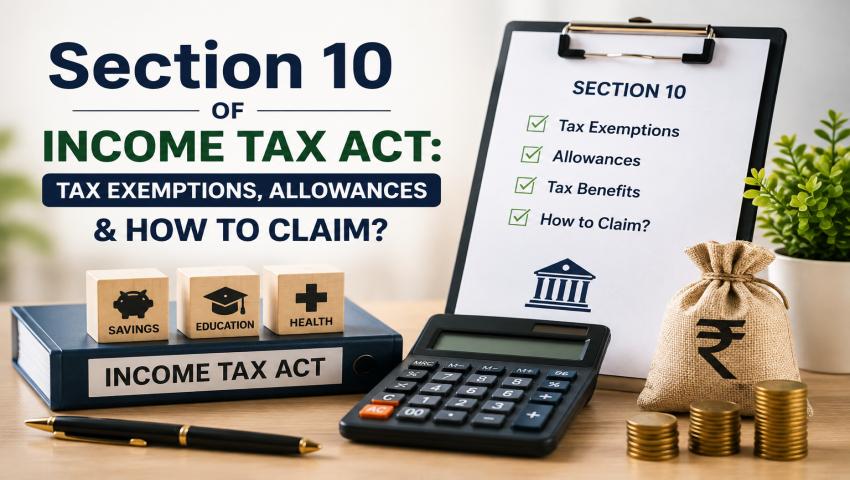
Section 10 of the Income Tax Act: Tax Exemptions, Allowances & How to Claim?
Every salaried person has, at some point, looked at their payslip and wondered why the “total salary” figure never matches what actually gets credited to their bank account — and why tax is not deducted on the full amount. Most of this gap is explained by Section 10 of the Income Tax Act, the section that lists incomes and allowances the government has chosen to keep out of your taxable income.
At My Finance Gyan, our goal is to make tax rules simple enough that you don’t need a finance degree to understand your own salary slip. In this guide, we’ll break down what Section 10 covers, which allowances are tax exempt, how much you can claim, and how tax exemption under Section 10 actually works while filing your ITR.
What is Section 10 of the Income Tax Act?
In simple terms, Section 10 income tax exemption refers to certain types of income that are excluded — fully or partly — while calculating your total taxable income. If an income falls under Section 10 of income tax, it either doesn’t get taxed at all, or only the amount above a specified limit gets taxed.
This is different from your regular salary, business profit, or capital gains, which are taxable unless a specific provision says otherwise. Section 10 is that “specific provision” for a long list of incomes — from salary allowances to agricultural income to retirement benefits.
Why are certain incomes and allowances exempt from tax?
The idea behind tax exempt allowances is simple: some payments are meant to cover actual expenses (like rent or travel), not to add to your personal wealth. Other exemptions exist to support specific groups — farmers, retirees, residents of certain states — or to encourage savings and long-term financial planning. So the law carves these out separately instead of taxing them like regular income.
Difference between tax exemption, deduction and rebate:
People often use “exemption,” “deduction,” and “rebate” interchangeably, but they work differently:
Understanding this tax exemption meaning matters because exemptions reduce your income before tax is calculated, while deductions and rebates apply at later stages of the computation. Mixing these up while filing your income tax return can lead to incorrect tax calculations.
Who can claim Section 10 exemptions?
Salaried employees, pensioners, partners in firms, farmers, and even certain SEZ businesses can claim relevant exemptions — as long as they meet the eligibility conditions for that specific clause. Not everyone qualifies for every exemption; each provision has its own criteria.
Importance of checking eligibility and applicable tax regime:
Before you claim any allowance under Section 10, check two things: whether you actually meet the conditions, and whether the exemption is available under the tax regime you’ve chosen. As we’ll see later, several common exemptions are not available if you opt for the new tax regime.
What is Section 10 of the Income Tax Act? (A Closer Look):
Exempt income means income that the law says should not be added to your total taxable income at all, or should be added only after excluding a certain portion. Section 10 works by reducing your gross income, so your final tax liability is calculated on a smaller base.
Some exemptions are fully exempt (like a partner’s share of firm profit), while others are partially exempt — meaning only a portion, calculated as per prescribed rules, is tax-free, and the rest is taxable. HRA and LTA are good examples of partial exemptions.
Section 10 exemptions apply to salaried individuals (through allowances and retirement benefits) as well as other taxpayers (through agricultural income, partnership income, and specific investment income). Every exemption comes with its own conditions — a limit, a purpose test, or an eligibility criterion — so you cannot assume an entire allowance is automatically tax-free just because it’s listed under this section.
Section 10 Exemptions vs Tax Deductions:
This distinction matters while filing your ITR because exemptions and deductions are reported in different schedules of the income tax return. A tax deduction under Section 10 is actually a slight misnomer — Section 10 deals purely with exemptions, while deductions largely fall under Chapter VI-A (like 80C, 80D). Reporting an exemption as a deduction, or vice versa, can lead to mismatches with your Form 16 and trigger notices.
Major Section 10 Exemptions for Salaried Individuals:
1. Section 10(13A) – House Rent Allowance (HRA):
If you receive HRA as part of your salary and live in rented accommodation, you can claim HRA tax exemption under Section 10(13A). This is one of the most commonly used allowances exempt under Section 10.
Conditions to claim HRA:
- You must be a salaried employee receiving HRA as part of your CTC
- You must actually be paying rent for a residential accommodation
- HRA exemption is not available if you live in your own house
How HRA exemption is calculated — the exempt amount is the least of:
- Actual HRA received
- 50% of (Basic + DA) if living in a metro city, or 40% for non-metro cities
- Actual rent paid minus 10% of (Basic + DA)
Documents required: Rent receipts, rent agreement, and landlord’s PAN (mandatory if annual rent exceeds Rs. 1 lakh).
What if you don’t pay rent? Then no HRA exemption can be claimed — the entire HRA becomes taxable, even if it’s shown separately in your salary structure.
2. Section 10(5) – Leave Travel Allowance (LTA):
Section 10(5), popularly searched as section 10/5 or section 10 5, covers Leave Travel Allowance. LTA exemption is available only for domestic travel expenses like airfare, train, or bus fare for you and your family.
- Only travel fare is covered — hotel stay, food, local sightseeing and conveyance are not eligible
- Travel must be within India
- The exemption is limited to the actual LTA amount provided in your CTC, and only for the amount actually spent on eligible travel
For example, if your LTA is Rs. 30,000 but you spend only Rs. 20,000 on eligible travel, the remaining Rs. 10,000 becomes taxable income.
3. Section 10(14) – Special Allowances:
Section 10(14) is a broad category covering exempted allowances for both official duties and certain personal expenses, subject to actual expenditure.
Some commonly applicable allowances under this clause:
- Meal allowance exemption — food coupons/meal vouchers provided by employers can be exempt up to prescribed limits, assuming a defined number of meals and working days
- Fuel allowance exemption — conveyance or fuel reimbursement for official travel, exempt to the extent it’s actually spent for work purposes
- Internet and telephone reimbursement
- Research, academic, or training allowance connected to your role
The key condition here is that these are allowance tax exemption provisions only to the extent the amount is genuinely spent for the stated purpose — they’re not a blanket tax-free component.
10(14)(ii) – Children’s Education and Hostel Allowance:
Under 10 14 ii, a specific sub-clause deals with allowances for children’s education and hostel expenses:
- 100 per month per child for education allowance (up to 2 children)
- 300 per month per child for hostel expenditure allowance (up to 2 children)
- A blind, deaf, or otherwise handicapped employee receiving transport allowance can claim a higher exemption, subject to prescribed limits
4. Section 10(10) – Gratuity:
Gratuity received by government employees is fully exempt. For private-sector employees, the exemption depends on whether the employer is covered under the Payment of Gratuity Act, and is subject to a maximum limit prescribed under law.
5. Section 10(10AA) – Leave Encashment:
Leave encashment received during the service period is fully taxable. However, leave encashment received at the time of retirement or resignation qualifies for exemption:
- Fully exempt for government employees
- For non-government employees, exempt up to the lowest of: a specified monetary cap, leave salary actually received, average salary of the last 10 months, or the cash equivalent of unavailed leave
6. Section 10(10A) – Commuted Pension:
Commuted pension (a lump sum taken in lieu of periodic pension) is fully exempt for government employees. Non-government employees get partial exemption depending on whether they also receive gratuity.
7. Section 10(10B) – Retrenchment Compensation:
Compensation received on retrenchment (job loss due to closure/restructuring) is exempt up to the lowest of: the amount actually received, a specified monetary ceiling, or 15 days’ average pay for each completed year of service.
8. Section 10(10C) – Voluntary Retirement Compensation:
Amount received under a Voluntary Retirement Scheme (VRS) is exempt up to the lowest of: compensation received, a prescribed monetary ceiling, three months’ salary multiplied by completed years of service, or last drawn salary multiplied by remaining months of service.
9. Section 10(10D) – Life Insurance Policy Proceeds:
Maturity or death benefit proceeds from a life insurance policy are generally exempt. However, exemption is not available for:
- Policies where the premium exceeds prescribed limits relative to the sum assured
- Keyman insurance policies
Certain policies taken for specially-abled dependents (which are governed by separate rules)
10. Section 10(11) – Provident Fund and Sukanya Samriddhi Account:
Interest earned on recognised Provident Fund balances and Sukanya Samriddhi Account is exempt, subject to conditions. Note that interest on employee PF contributions exceeding Rs. 2.5 lakh in a financial year is taxable from FY 2021-22 onwards.
Section 10 Exemptions on Other Types of Income:
- Section 10(1) – Agricultural Income: Section 10 1 of Income Tax Act exempts agricultural income, including income from the sale of agricultural produce, rent or revenue from agricultural land, and income from farm buildings used for agricultural purposes. While fully exempt, agricultural income is still considered while determining the tax rate on your other (non-agricultural) income if it crosses a specified threshold.
- Section 10(2A) – Partner’s Share of Profit: A partner’s share of profit from a partnership firm or LLP is fully exempt in their individual hands, since the firm itself has already paid tax on its profits.
- Section 10(15) – Interest on Specified Investments: Interest income from post office savings accounts and certain notified bonds/securities is exempt up to specified limits — commonly Rs. 3,500 for individual accounts and Rs. 7,000 for joint accounts.
- Section 10(23C) – Educational and Medical Institutions: Educational or medical institutions with annual receipts below a prescribed threshold are eligible for exemption under this clause, subject to conditions relating to their non-profit character.
- Section 10(26) and 10(26AAA): These clauses exempt income earned by members of Scheduled Tribes residing in specified North-Eastern states, and by Sikkimese individuals earning income from specified sources within Sikkim.
- Section 10AA – SEZ Units: Businesses operating from units in Special Economic Zones (set up within the prescribed window) can claim a phased deduction — typically 100% of export profits for the first five years, 50% for the next five, followed by a further conditional deduction for five more years.
Section 10 Exemptions That Are No Longer Generally Available:
This is an important section, because outdated information about Section 10 circulates widely online. The following provisions applied only to specific historical periods and should not be treated as currently available exemptions:
- Section 10(34) – Dividend exemption (applicable only for dividends received up to 31 March 2020)
- Section 10(35) – Income from specified mutual funds (applicable only up to 31 March 2020)
- Section 10(37) – Capital gains on compulsory acquisition of certain urban agricultural land, subject to conditions of the relevant period
- Section 10(38) – Long-term capital gains on listed equity shares/equity mutual funds (applicable only for gains up to 31 March 2018)
If you come across an old article listing these as active exemptions, treat it as outdated — always cross-check the applicable assessment year before relying on it.
Section 10 Exemptions Under Old vs New Tax Regime:
Old Tax Regime allows most traditional exemptions, including:
- HRA exemption
- LTA exemption
- Most Section 10(14) allowances
- Other applicable Section 10 exemptions like leave encashment, gratuity, and retirement benefits
New Tax Regime restricts several common salary exemptions:
- HRA and LTA are generally not available
- Most Section 10(14) special allowances are also disallowed, though a few specific ones (like transport allowance for specially-abled employees) may still qualify
- Employer’s contribution to NPS under Section 80CCD(2) continues to be available as a benefit, along with the standard deduction
For AY 2026-27, ITR validation rules specifically flag and restrict claims for HRA, LTA, and certain Section 10(14) allowances if you’ve selected the new regime — so double-check your regime selection before entering these exemptions in your return.
How to Claim Section 10 Exemptions While Filing ITR?
- Identify which exemptions you’re eligible for based on your salary structure and income sources
- Check whether the exemption is permitted under your chosen tax regime
- Verify the exempt allowance amount shown in your Form 16
- Calculate the actual eligible exemption as per the relevant limit (not just the amount received)
- Enter the exemption under the appropriate schedule/field in your ITR form
- Retain all supporting documents (you generally don’t need to upload them, but keep them for verification)
- Review your full tax computation before submission
- Submit your return and complete e-verification within the due date
Your Form 16 typically separates exempt allowances from taxable salary, which makes cross-verification easier.
Documents Required to Claim Section 10 Exemptions:
- Form 16
- Salary slips
- Rent receipts
- Rent agreement (where applicable)
- Landlord’s PAN (for rent above Rs. 1 lakh/year)
- LTA travel tickets/boarding passes
- Employer-issued allowance breakup
- Gratuity or retirement settlement documents
- Life insurance policy documents
- PF/Sukanya Samriddhi account statements
Tip: Even when these documents aren’t uploaded with your ITR, keep them safely — they serve as proof if the tax department asks for verification later.
Common Mistakes While Claiming Section 10 Exemptions:
- Claiming an exemption without actually meeting the eligibility conditions
- Claiming the entire HRA received instead of the actual eligible (least-of) amount
- Claiming LTA for non-travel expenses like hotels or sightseeing
- Claiming old-regime-only exemptions while filing under the new regime
- Treating withdrawn provisions (like old Section 10(38)) as currently applicable
- Reporting a different exempt amount than what’s shown in Form 16, without verifying the reason
- Not retaining supporting documents
- Claiming the same benefit twice under different heads
Example: How Section 10 Exemption Reduces Taxable Salary?
Consider a salaried employee with the following components:
Under the old regime, this employee can claim HRA, LTA, and eligible allowances along with deductions like 80C, reducing taxable income further. Under the new regime, HRA and LTA exemptions would not apply, so only the standard deduction and employer’s NPS contribution (if any) would reduce taxable income — meaning the taxable salary figure would generally be higher, though tax rates under the new regime are also lower.
Section 10 Exemptions: Key Points to Remember
- Not every income listed under Section 10 is automatically tax-free
- Eligibility conditions must be genuinely satisfied
- Some exemptions are fully exempt, others are capped or partial
- Your tax regime choice directly affects which salary exemptions you can use
- Always keep supporting documents for every claim
- Check the applicable financial year/assessment year before relying on any exemption, especially for historical provisions
Conclusion:
Section 10 of the Income Tax Act covers a wide range of exempt incomes — from everyday salary allowances like HRA and LTA to retirement benefits, agricultural income, and special-category exemptions. But income exempted under Section 10 isn’t automatic; it depends on the nature of the income, specific eligibility conditions, prescribed limits, and the tax regime you choose while filing.
Before claiming any exemption, verify your Form 16, keep your supporting documents ready, and report the correct eligible amount in your ITR — not just the amount received. When in doubt, it’s always worth cross-checking with a tax professional, since eligibility conditions can be specific to your situation.
FAQs on Section 10 Exemptions:
It’s the section that lists incomes and allowances that are fully or partially exempt from tax, meaning they’re excluded from your total taxable income subject to specific conditions.
Salary allowances like HRA and LTA, retirement benefits like gratuity and leave encashment, agricultural income, a partner’s share of firm profit, and certain investment income, among others.
Yes, HRA exemption is available under Section 10(13A), calculated as the least of actual HRA received, a percentage of basic salary based on city type, and rent paid minus 10% of basic salary.
No, HRA exemption is generally not available if you opt for the new tax regime.
Yes, under Section 10(5), covering only domestic travel fare, and only for the amount actually spent on eligible travel.
It exempts maturity or death benefit proceeds from life insurance policies, subject to conditions on premium amount and policy type.
Yes, fully exempt for government employees; for private-sector employees, exemption depends on Payment of Gratuity Act coverage and prescribed limits.
Leave encashment during service is fully taxable. At retirement/resignation, it’s exempt up to specified limits (fully exempt for government employees).
By verifying eligibility, checking your tax regime, cross-checking Form 16, calculating the correct eligible amount, and reporting it under the relevant ITR schedule.
Form 16, salary slips, rent receipts/agreement, landlord PAN, travel documents, and other exemption-specific proofs.
No. Several common exemptions like HRA, LTA, and most Section 10(14) allowances are not available under the new tax regime, though some benefits like employer NPS contribution remain.
Section 10 excludes specific income from your taxable income altogether, while Section 80C reduces your taxable income through eligible investments/expenses after your gross income is computed.