
- 21/09/2026
- Govind S. Jethani
- 58 Views
- 1 Likes
- Tax
How Does Capital Gains Tax Work in the USA?
If you invest in stocks, real estate or other assets in the United States, you may eventually come across the term capital gains tax. Capital gains tax generally becomes relevant when you sell a capital asset for more than its adjusted basis.
However, the amount of tax you may owe depends on several factors, including how long you owned the asset, your taxable income, the type of asset and whether you have other capital gains or losses.
Here is a simple guide to understanding how capital gains tax works in the USA.
What Is a Capital Gain?
A capital gain generally occurs when you sell a capital asset for more than its adjusted basis.
Capital assets can include:
- Stocks
- Bonds
- Mutual funds
- ETFs
- Investment property
- Real estate
- Certain collectibles
- Other investment assets
The IRS explains that most property you own for personal or investment purposes is considered a capital asset.
A simplified calculation is:
Capital Gain = Amount Realized From Sale – Adjusted Basis
Your basis is often your original purchase cost, although adjustments and special rules can apply.
Simple Example:
Suppose you purchase shares for $10,000. Later, you sell them for $15,000. Ignoring other adjustments and transaction costs for simplicity:
$15,000 – $10,000 = $5,000 capital gain
You generally do not pay capital gains tax on the full $15,000 sale amount. The gain is based on the difference between the amount realized and your adjusted basis.
What Is a Capital Loss?
A capital loss occurs when you sell an investment for less than its adjusted basis.
For example:
- Purchase price: $10,000
- Sale price: $7,000
- Capital loss: $3,000
Capital losses can generally be used to offset capital gains, subject to applicable tax rules.
Short-Term vs Long-Term Capital Gains:
One of the most important factors is how long you held the asset.
The IRS generally classifies capital gains as either short-term or long-term.
1. Short-Term Capital Gain:
If you hold an asset for one year or less before selling it, the gain is generally considered short-term. Net short-term capital gains are generally taxed at ordinary income-tax rates.
2. Long-Term Capital Gain:
If you hold the asset for more than one year, the gain is generally considered long-term. Long-term capital gains may qualify for preferential federal tax rates.
For many investments, the main federal long-term capital-gains rates are:
- 0%
- 15%
- 20%
Which rate applies depends primarily on taxable income and filing status.
2026 Long-Term Capital Gains Tax Brackets:
For the 2026 tax year, the IRS published the following taxable-income thresholds for the main long-term capital-gains rates.
Capital gains above the applicable 15% ceiling may generally be subject to the 20% rate. These thresholds refer to taxable income, not simply the amount of your investment profit.
The calculation can also involve how ordinary income and capital gains stack together, so having a $50,000 capital gain does not automatically mean the entire gain is taxed at one rate.
Capital Gains Example:
Assume you purchased an investment for $20,000 and sold it two years later for $35,000.
Your simplified gain would be:
$35,000 – $20,000 = $15,000
Because you owned the asset for more than one year, the $15,000 would generally be considered a long-term capital gain.
The federal tax rate that applies would depend on your overall taxable income, filing status, other gains and losses, and any special tax rules that apply to the investment.
Do You Pay Capital Gains Tax If You Do Not Sell?
Generally, simply seeing an investment increase in market value does not create a taxable capital gain.
For example, suppose you bought stock for $5,000 and it is now worth $8,000.
You have an unrealized increase of $3,000.
If you continue holding the stock, you generally have not realized that capital gain merely because its market price increased.
A capital gain generally becomes relevant for tax purposes when you sell or otherwise dispose of the asset in a taxable transaction.
How Do Capital Losses Affect Capital Gains?
Capital losses can help offset capital gains.
For example:
- Capital gain from Investment A: $10,000
- Capital loss from Investment B: $4,000
- Simplified net capital gain: $6,000
If your allowable capital losses exceed your capital gains, individuals can generally deduct up to $3,000 of excess net capital loss against other income per year, or $1,500 if married filing separately. Additional allowable losses can generally be carried forward to future years.
The actual calculation can become more complicated because short-term and long-term gains and losses are netted under specific rules.
Are All Long-Term Capital Gains Taxed at 0%, 15% or 20%?
No. Special rates can apply to certain assets.
For example, the IRS notes that:
- Certain gains from collectibles can be subject to a maximum 28% capital-gains rate.
- Certain taxable gains involving qualified small-business stock can have special treatment.
- Certain unrecaptured Section 1250 gains involving depreciable real property can be subject to a maximum 25% rate.
Therefore, you should not assume that every long-term investment qualifies for the standard 0%, 15% or 20% framework.
What Is the Net Investment Income Tax?
Higher-income taxpayers may also need to consider the Net Investment Income Tax, or NIIT. The NIIT is a 3.8% tax that can apply to certain net investment income when income exceeds applicable thresholds.
For individuals, the relevant modified adjusted gross income thresholds include:
- $200,000 for single or head-of-household filers
- $250,000 for married couples filing jointly or qualifying surviving spouses
- $125,000 for married taxpayers filing separately
The tax is calculated on the lesser of net investment income or the amount by which modified adjusted gross income exceeds the applicable threshold.
Not every investor is subject to NIIT.
What About Capital Gains on a Home?
The sale of a primary residence has separate federal tax rules.
Depending on whether you meet applicable ownership and use requirements, some gain from selling a primary home may qualify for an exclusion from federal taxable income.
Because home-sale rules can involve important exceptions and eligibility requirements, homeowners should review current IRS guidance or consult a tax professional before assuming a gain is taxable or excluded.
How Are Stock and ETF Gains Taxed?
Suppose you purchase shares of a stock or ETF through a regular taxable brokerage account.
If you later sell the investment for a profit, the gain may generally be:
- Short-term if held for one year or less
- Long-term if held for more than one year
Your brokerage may provide tax documents showing information about transactions, but taxpayers are responsible for correctly reporting taxable activity.
Remember that dividends, interest and capital-gain distributions can have different tax treatment from gains created by selling an investment.
What About Retirement Accounts?
Tax-advantaged retirement accounts work differently from ordinary taxable brokerage accounts.
For example, buying and selling investments inside a qualified retirement account generally does not create the same immediate capital-gains tax treatment as transactions in an ordinary taxable brokerage account.
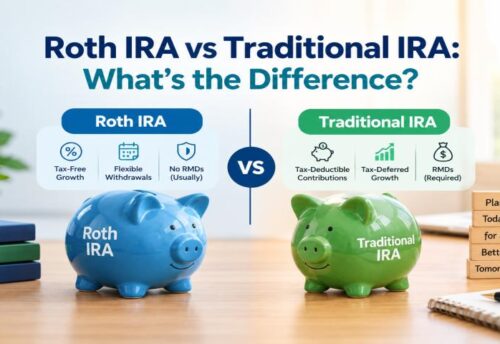
Traditional retirement accounts and Roth accounts have their own contribution, withdrawal and taxation rules.
This is one reason investors should understand not only what they invest in, but also which type of account holds the investment.
How Can Investors Manage Capital Gains Taxes?
- Understand Your Holding Period: Selling an investment after one year versus after more than one year can result in different federal tax treatment.
- Keep Accurate Cost-Basis Records: Your basis affects the calculation of your capital gain or loss.
- Review Capital Losses: Capital losses may be available to offset gains, subject to applicable tax rules.
- Understand Tax-Advantaged Accounts: Accounts such as 401(k)s and IRAs have different tax rules from ordinary brokerage accounts.
- Avoid Making Decisions Based Only on Taxes: Taxes are important, but investment quality, risk, diversification, liquidity and financial goals should also be considered. Selling or keeping an investment solely to avoid tax can sometimes create a worse financial outcome.
Frequently Asked Questions:
For many long-term capital gains, the main federal rates are 0%, 15% and 20%. The rate depends on taxable income and filing status. Short-term gains are generally taxed at ordinary income rates.
Generally, more than one year.
Generally, an increase in market value alone is an unrealized gain and does not create a taxable capital gain until a taxable sale or disposition occurs.
Capital losses can generally offset capital gains. If allowable losses exceed gains, up to $3,000 of excess net capital loss may generally be deductible against other income annually for most individual filers, with applicable carryforward rules.
No. State tax treatment varies. Some states may tax capital gains as part of state income while others have different rules.
Final Thoughts:
Capital gains tax is an important concept for anyone investing in the USA.
The key distinction is simple:
Short-term gains and long-term gains can receive different federal tax treatment. Your actual tax liability, however, depends on more than your investment profit. Filing status, taxable income, cost basis, holding period, capital losses, investment type and other taxes can all affect the result.
Understanding these rules before selling an investment can help you make better-informed financial decisions.