- 22/09/2026
- Govind S. Jethani
- 59 Views
- 1 Likes
- Company Law
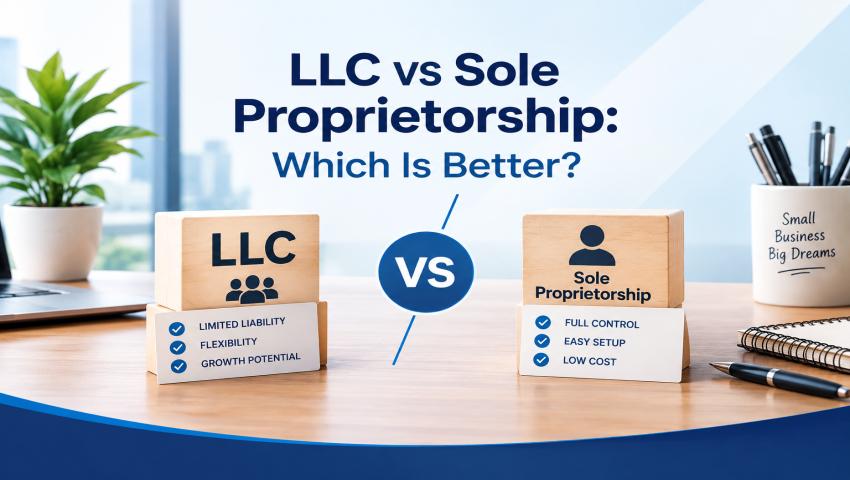
LLC vs Sole Proprietorship: Which Is Better?
Starting a business in the USA involves several important decisions. One of the first is choosing the right business structure.
For a solo entrepreneur, freelancer, consultant or small-business owner, two common options are a sole proprietorship and a Limited Liability Company, commonly known as an LLC.
At first glance, the two structures may seem similar, especially because a single-member LLC can be taxed like a sole proprietorship. However, there are important differences involving legal liability, formation costs, paperwork and business growth.
So, LLC vs sole proprietorship: which is better?
The answer depends on your type of business, level of risk, budget and long-term plans.
What Is a Sole Proprietorship?
A sole proprietorship is one of the simplest ways to operate a business in the United States.
If you start conducting business by yourself without creating another formal business entity, you may generally be considered a sole proprietor.
For example, you might operate as a:
- Freelancer
- Consultant
- Photographer
- Graphic designer
- Tutor
- Online seller
- Independent contractor
- Home-service provider
A sole proprietorship does not create a separate legal entity between the owner and the business. As a result, the business’s assets and liabilities are generally connected to the owner personally.
Advantages of a Sole Proprietorship:
One major advantage is simplicity.
There is usually less formation paperwork than with an LLC, although licenses, permits, DBA registrations and other requirements may still apply depending on the state and locality.
Other potential advantages include:
- Easy to start
- Lower initial costs
- Fewer ongoing formalities
- Full control over business decisions
- Straightforward federal tax reporting
Income and expenses from many sole proprietorships are generally reported on Schedule C with Form 1040.
Disadvantages of a Sole Proprietorship:
The biggest concern is personal liability.
Because there is generally no legal separation between the business and its owner, the owner can be personally responsible for business debts and obligations.
For example, depending on the circumstances, personal assets could potentially be exposed if the business has significant unpaid debts or faces a lawsuit.
A sole proprietorship may also become less convenient as a business grows, hires employees, takes on significant contracts or adds owners.
What Is an LLC?
LLC stands for Limited Liability Company.
An LLC is created under state law. Unlike a sole proprietorship, it generally creates a legal entity separate from its owners, who are known as members. One of the biggest reasons business owners form LLCs is liability protection.
The U.S. Small Business Administration notes that LLC owners generally are not personally liable for the company’s debts, although the exact protections and requirements depend on applicable law and circumstances.
An LLC can have:
- One owner – a single-member LLC
- Multiple owners – a multi-member LLC
How Is an LLC Taxed?
This is where many new business owners become confused. An LLC is a legal structure created under state law, but LLC is not one single federal tax classification. For federal income-tax purposes, the IRS generally treats a domestic single-member LLC as a disregarded entity unless it elects another tax classification.
That means an individual who owns a single-member LLC may report the business’s income and expenses in much the same way as a sole proprietor. A domestic LLC with two or more members is generally treated as a partnership for federal income-tax purposes unless it elects corporate treatment.
An eligible LLC may also elect to be taxed as a corporation, subject to applicable rules.
Therefore, forming an LLC does not automatically mean that your federal income taxes will be completely different from those of a sole proprietor.
LLC vs Sole Proprietorship: Key Differences
Are Taxes Lower With an LLC?
Not necessarily.
This is an important misconception. Simply forming a single-member LLC does not automatically reduce federal taxes. If the LLC is treated as a disregarded entity, its business income is generally reported on the owner’s federal tax return similarly to a sole proprietorship.
An individual owner operating a trade or business through a disregarded single-member LLC is generally subject to self-employment tax on net earnings in the same way as a sole proprietor.
Different tax treatment may become available if an eligible LLC makes a corporate tax election, but additional rules, payroll requirements and administrative responsibilities may apply.
Business owners should discuss such decisions with a qualified tax professional instead of forming an LLC solely because they expect an automatic tax saving.
Which Structure Is Easier to Start?
A sole proprietorship is generally easier.
You may not need to file formal formation documents with your state simply to exist as a sole proprietor, although you could still need:
- Business licenses
- Local permits
- DBA or fictitious-name registration
- Sales-tax registration
- Professional licenses
- An EIN in certain circumstances
An LLC generally requires filing formation documents with the state and paying the applicable filing fee. Some states also impose annual reports, franchise taxes or recurring fees.
Because requirements vary significantly across states, always check the rules where your business is formed and operates.
Which Offers Better Liability Protection?
This is one of the biggest differences between the structures. A sole proprietorship generally does not provide a legal separation between the owner and the business.
An LLC generally provides its owners protection from personal liability for many business debts and obligations.
However, an LLC does not create unlimited protection in every situation.
An owner may still potentially face personal responsibility for matters such as personal wrongdoing, certain personally guaranteed debts or other situations where applicable law permits liability. Maintaining proper business records and keeping business and personal finances separate can also be important.
When Might a Sole Proprietorship Make Sense?
A sole proprietorship may be worth considering when:
- You are testing a new business idea
- Your business has relatively low legal or financial risk
- You are operating on a very small scale
- You want minimal formation costs
- You do not currently need multiple owners
- You want a straightforward structure
The SBA identifies sole proprietorships as a possible option for low-risk businesses and owners who want to test a business idea before creating a more formal structure.
When Might an LLC Make Sense?
An LLC may be worth considering when:
- Your business has meaningful liability exposure
- You have personal assets you want to keep legally separate from the business
- You are signing larger contracts
- You expect the business to grow
- You want to add business partners
- You want a more formal business structure
- You want flexibility in federal tax classification
The decision should consider both legal protection and the additional costs and administrative responsibilities involved.
Can You Start as a Sole Proprietor and Form an LLC Later?
Yes.
Many entrepreneurs initially operate as sole proprietors and form an LLC as their business becomes larger or takes on greater risk.
However, changing your structure may involve:
- State registrations
- A new business bank account
- Tax changes
- Contract updates
- Licenses and permits
- Insurance changes
- Accounting changes
It is often easier to consider these issues before the business becomes complicated.
LLC vs Sole Proprietorship: Which Is Better?
There is no single answer for every business.
A sole proprietorship may be suitable for a small, low-risk business where simplicity and low startup costs are priorities. An LLC may be more appropriate when liability protection, business separation and long-term flexibility are important.
Also remember that choosing an LLC does not automatically change how a single-owner business is taxed at the federal level. Legal structure and tax classification are related, but they are not always the same thing.
Frequently Asked Questions:
No. An LLC offers advantages such as liability protection, but it can also involve additional formation costs, state fees and administrative requirements.
Not automatically. A single-member LLC may be taxed like a sole proprietorship unless another federal tax classification is elected.
No. Many businesses can operate as sole proprietorships. The appropriate structure depends on your circumstances and applicable state and local laws.
Yes. Most states allow single-member LLCs.
Yes, subject to applicable employer-registration, payroll-tax, insurance and labor-law requirements.
Final Thoughts:
Choosing between an LLC and sole proprietorship is an important part of starting a business in the USA. A sole proprietorship provides simplicity, while an LLC can provide greater separation between the business and its owner.
Before deciding, consider your business risk, personal assets, future plans, state fees, tax situation and administrative requirements.
Choosing the correct structure early can make it easier to manage your business as it grows.