- 01/09/2026
- Govind S. Jethani
- 268 Views
- 5 Likes
- Company Law
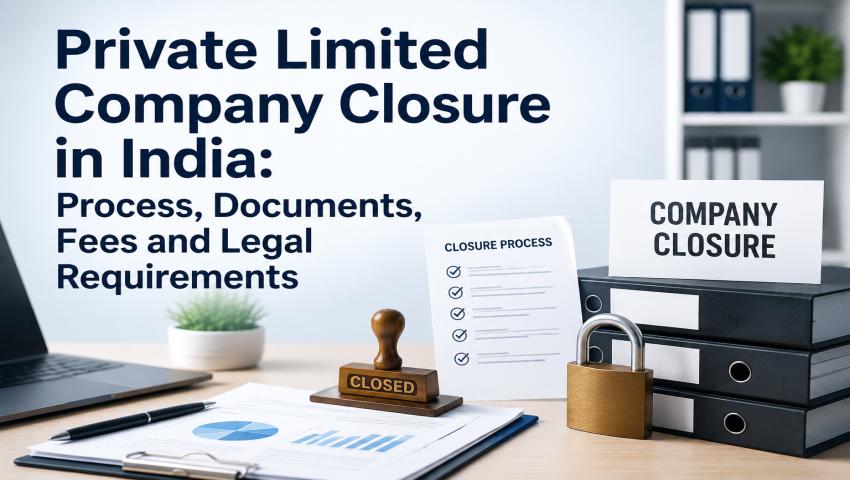
Private Limited Company Closure in India: Process, Documents, Fees and Legal Requirements
Starting a Private Limited Company in India is relatively simple. Closing one, however, requires proper planning and statutory compliance. In this comprehensive guide by My Finance Gyan, we break down everything you need to know about navigating Private Limited company closure legally and efficiently.
A company does not automatically cease to exist just because it has stopped doing business, closed its bank account, or has no active transactions. Until its name is removed from the Register of Companies (ROC) or the entity is dissolved through the appropriate legal process, it continues to accumulate statutory obligations and compliance duties.
For an inactive company with no outstanding liabilities, strike-off under Section 248 of the Companies Act, 2013 is generally the simpler option. Where the company has assets, creditors, liabilities, or more complex financial affairs, voluntary liquidation under the Insolvency and Bankruptcy Code, 2016 (IBC) may be more appropriate.
Choosing the correct closure process is critical because attempting Private Limited company closure while concealing liabilities can result in heavy penalties, legal action, and personal liability for the directors and officers responsible.
What Does Private Limited Company Closure Mean?
Closure means legally bringing the existence of a company to an end.
Simply stopping business activities does not close a company. Until the company is legally dissolved, it may continue to be responsible for applicable:
- ROC filings
- Income-tax compliance
- GST compliance, where applicable
- Statutory dues
- Regulatory requirements
- Other obligations applicable to the company
The two common voluntary routes for closing a company are:
- Removal of the company’s name through strike-off under Section 248
- Voluntary liquidation under Section 59 of the Insolvency and Bankruptcy Code, 2016
The appropriate option depends on the company’s financial position, assets, liabilities, creditors, disputes and ongoing obligations.
Closure Through Strike-Off Under Section 248:
Strike-off is generally suitable for a company that is inactive and has completed its financial and statutory affairs.
A company may apply for removal of its name where, among other prescribed conditions, it:
- Has not commenced business within one year of incorporation; or
- Has not carried on business or operations for two immediately preceding financial years and has not applied for dormant company status.
Before applying for strike-off, the company must ensure that its liabilities have been extinguished.
The application also requires a special resolution or consent of members representing at least 75% of the company’s paid-up share capital, as applicable.
When Is Strike-Off Not Suitable?
Strike-off should not be treated as a way to escape debts, taxes or other legal obligations.
Certain companies and circumstances are restricted from applying for voluntary strike-off. These include situations involving, among others:
- Listed companies
- Section 8 companies
- Companies with unsatisfied charges
- Companies having outstanding public deposits
- Companies facing certain pending prosecution, inspection or investigation proceedings
- Companies with pending compounding applications
- Certain delisted or vanishing companies
There are also restrictions where the company has recently undertaken certain activities, such as changing its name, shifting its registered office from one State to another, disposing of property outside the permitted framework, or having certain compromise or arrangement proceedings pending.
These restrictions help protect creditors, shareholders, employees and other stakeholders.
Preparations Before Filing Form STK-2:
Before submitting a strike-off application, the directors should review the company’s complete financial and compliance position.
This may include:
- Recovering outstanding receivables
- Settling vendor and employee dues
- Repaying loans
- Paying applicable taxes and government dues
- Cancelling GST and other registrations, where applicable
- Settling or satisfying registered charges
- Completing pending statutory filings
- Closing the company’s bank account after completing necessary transactions
- Lawfully dealing with any remaining assets
The company should also ensure that its statutory records and MCA filings are up to date as required.
The financial position should be carefully reviewed because the documents submitted with the strike-off application are declarations that the company has properly settled its affairs.
Step-by-Step Process for Closing a Private Limited Company:
Step 1
Conduct a Board Meeting:
The company should first hold a Board Meeting to discuss and approve the proposal for closure.
The Board may authorise a director to:
- Complete pending compliance requirements
- Prepare the statement of accounts
- Close registrations and bank accounts
- Call a general meeting
- Execute the required affidavits and indemnity bonds
- File the strike-off application
The directors should proceed only after reviewing the company’s liabilities, assets and pending obligations.
Step 2
Obtain Members' Approval:
The company must obtain the required approval from its members.
This may be through:
- A special resolution; or
- Consent from members holding at least 75% of the paid-up share capital, as applicable.
Where a special resolution is passed, the relevant filing, including Form MGT-14, should be completed within the prescribed period.
The resolution should clearly authorise the company to apply for removal of its name under Section 248.
Step 3
Prepare the Statement of Accounts:
The company is required to prepare a statement of accounts in Form STK-8. The statement should be prepared within the prescribed period before filing Form STK-2 and certified in the required manner.
The statement should accurately reflect the company’s financial position. If there are outstanding loans, creditors, receivables or significant assets, these should be properly dealt with before applying for strike-off.
Step 4
Prepare Affidavits and Indemnity Bonds:
The strike-off application generally requires documents such as:
- Form STK-3 – Indemnity Bond
- Form STK-4 – Affidavit
- Form STK-8 – Statement of Accounts
- Copy of the special resolution or members’ consent
- Applicable regulatory approvals
- Other documents required based on the company’s circumstances
The directors must ensure that these documents contain accurate and consistent information.
Step 5
File Form STK-2:
The company can submit its strike-off application through the MCA portal using Form STK-2. The prescribed government fee for Form STK-2 is ₹10,000.
The form must be digitally signed by the authorised director and certified by a practising professional such as a:
- Chartered Accountant
- Company Secretary
- Cost Accountant
The application is processed through the Centre for Processing Accelerated Corporate Exit (C-PACE).
Step 6
Respond to Resubmission or Clarification Requests:
After submission, the authorities may review the application and ask the company to provide clarification or correct defects.
Common issues that may result in resubmission include:
- Incomplete statutory filings
- Assets or liabilities appearing in the statement of accounts
- Unsatisfied charges
- Differences between MCA records and submitted documents
- Incorrect member approval
- Pending tax or regulatory matters
- Incomplete affidavits or indemnity documents
The company should respond within the prescribed timeline to avoid the application becoming invalid.
Step 7
Public Notice and Dissolution:
Once the application is accepted for further processing, the Registrar may issue a public notice in Form STK-6.
Interested persons are given an opportunity to raise objections within the prescribed period.
If the Registrar is satisfied that the company has fulfilled the applicable requirements and there are no valid objections, a dissolution notice is issued in Form STK-7.
The company is dissolved from the date specified in the dissolution notice.
Does Strike-Off Remove Past Liabilities?
No.
Strike-off does not automatically eliminate every liability associated with the company. Certain liabilities and obligations can continue to be enforced against the relevant directors, officers or members as provided under law.
If a company has deliberately applied for strike-off to avoid creditors, conceal liabilities or defraud another person, the individuals responsible may face serious legal consequences. Therefore, strike-off should be considered only after the company’s affairs have been genuinely settled.
When Is Voluntary Liquidation a Better Option?
Strike-off may not be appropriate where a company has substantial assets, creditors or complicated financial affairs. In such cases, voluntary liquidation under Section 59 of the Insolvency and Bankruptcy Code, 2016 may be considered.
A corporate person seeking voluntary liquidation must satisfy the applicable conditions, including requirements relating to default and solvency.
The process generally involves:
- Declaration of solvency by the directors
- Approval by the members
- Approval by creditors where required
- Appointment of an insolvency professional as liquidator
- Realisation and settlement of assets and liabilities
- Distribution of remaining assets as permitted by law
- Application to the NCLT for dissolution
Compared with strike-off, voluntary liquidation is a more formal and generally more time-consuming process. However, it can provide a structured mechanism for dealing with assets, creditors and claims.
What Documents Are Required for Company Closure?
The exact documents depend on the company and the closure route selected.
For a typical strike-off application, documents may include:
It is important to ensure that the information in all documents is consistent with the company’s MCA records and actual financial position.
How Long Does It Take to Close a Private Limited Company?
The time required depends on the company’s compliance status, financial affairs, documents and whether the Registrar raises any objections or queries.
A company with:
- No assets
- No liabilities
- No pending litigation
- No outstanding statutory dues
- Up-to-date filings
is generally easier to close than a company with unresolved financial or regulatory matters.
Therefore, completing the company’s pending compliances before filing can help avoid unnecessary delays.
Can a Struck-Off Company Be Restored?
Yes.
A company that has been struck off may, in certain circumstances, be restored through the appropriate legal process.
The Companies Act provides mechanisms for restoration where the statutory conditions are satisfied.
Restoration can potentially revive the company’s obligations, including pending filings and other compliance requirements.
Therefore, company closure should not be undertaken casually. Directors should ensure that the company genuinely qualifies for strike-off before submitting the application.
Frequently Asked Questions:
A company may be eligible for strike-off where it has not commenced business within the prescribed period, subject to satisfying all applicable legal requirements and settling its liabilities.
Generally, no. Outstanding secured or unsecured loans need to be appropriately settled before applying for strike-off.
No. Closing the bank account does not legally close the company. The company continues to exist until the appropriate dissolution process is completed.
The prescribed affidavits, indemnity bonds and other documents must be executed in the manner required under the applicable rules.
Outstanding GST liabilities and other government dues should be resolved before applying for strike-off. The company must satisfy the applicable statutory requirements before submitting its application.
No.
Strike-off is generally a simpler process for eligible inactive companies with settled affairs. Voluntary liquidation is a more formal process designed to deal with assets, liabilities and claims before dissolution.
Conclusion:
Closing a Private Limited Company in India is not simply a matter of stopping business operations. The company must follow the appropriate legal process, complete applicable compliances, settle liabilities and submit the required documents to the authorities.
For an inactive company with no outstanding assets, liabilities or disputes, strike-off through Form STK-2 under Section 248 can provide a relatively straightforward route to closure. Where the company has significant assets, creditors or complex financial affairs, voluntary liquidation may be more appropriate.
A properly planned closure can help directors avoid unnecessary ROC defaults, penalties and future legal complications. If your company is inactive and you are considering closing it, the first step should be to review its MCA filing status, assets, liabilities, tax registrations and pending compliances before selecting the closure route.