- 24/08/2026
- Govind S. Jethani
- 246 Views
- 4 Likes
- Finance, Investment
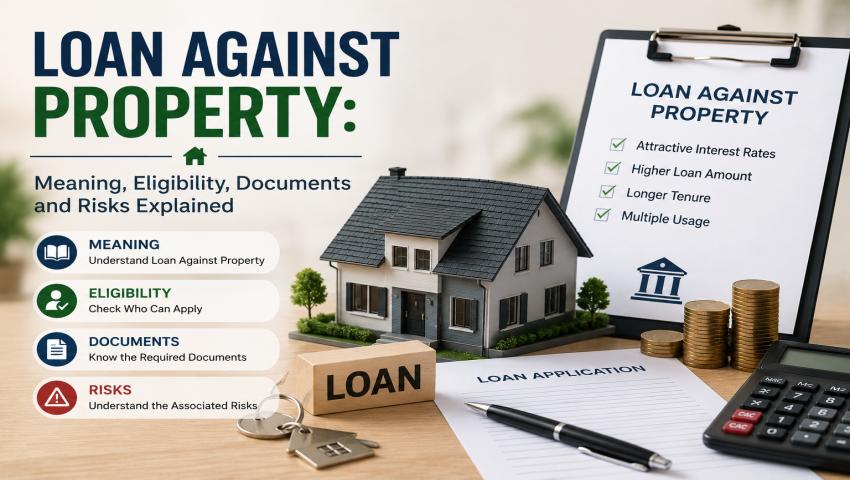
Loan Against Property: Meaning, Eligibility, Documents and Risks Explained
If you own a house, shop, office or another eligible property, you can use it to raise money without selling it. This type of secured loan is called a Loan Against Property (LAP). In this guide, My Finance Gyan explains everything you need to know about utilizing your property to secure high-value funding.
People commonly use LAP for business expansion, education, medical expenses, debt consolidation, working capital and other major financial needs. Because the loan is secured by property, lenders may offer a higher loan amount and longer repayment period than an unsecured personal loan.
However, there is an important risk: if you do not repay the loan, the lender can take steps to recover the outstanding amount from the mortgaged property.
So, before applying, it is important to understand the eligibility, documents, interest rates, charges and risks involved.
What Is a Loan Against Property?
A Loan Against Property (LAP) is a secured loan that you take by offering an eligible property as security to the lender.
The property may be:
- A residential house
- A flat
- A commercial shop or office
- Another eligible immovable property
You generally continue to own and use the property while repaying the loan. However, the property is mortgaged in favour of the lender until the loan is fully repaid.
The loan is usually repaid through monthly EMIs. Depending on the lender and product, other repayment structures may also be available.
Different banks and financial institutions have different rules regarding property types, loan amounts, locations and repayment periods.
How Does a Loan Against Property Work?
The amount you can borrow depends on both the value of the property and your ability to repay the loan.
For example,
- suppose your property is worth ₹80 lakh.
- After legal and technical verification, the lender may consider its acceptable value to be ₹70 lakh.
- If the lender allows a loan of 60% of that value:
- ₹70 lakh × 60% = ₹42 lakh
- So, you may be eligible for a loan of around ₹42 lakh.
This is only an example. The actual loan amount depends on the lender’s loan-to-value rules, your income, credit history, existing EMIs and other factors.
A valuable property does not automatically mean that you will receive a large loan.
The lender must also be satisfied that you have enough income or cash flow to repay the EMIs.
Which Properties Can Be Used for LAP?
The properties accepted by lenders vary. Depending on the lender’s policy, you may be able to offer:
- Self-occupied residential property
- Rented residential property
- Commercial shops
- Commercial offices
- Certain industrial properties
- Certain mixed-use properties
- Jointly owned property, subject to lender conditions
The property should generally have a clear and marketable title.
Problems such as the following can make approval difficult:
- Unclear ownership
- Family disputes
- Missing title documents
- Unauthorised construction
- Pending legal cases
- Missing government approvals
- Existing charges or mortgages
- Property outside the lender’s approved location
An open plot may not be accepted under every LAP product, so check the lender’s rules before paying application, valuation or processing charges.
Who Can Apply for a Loan Against Property?
Both salaried and self-employed individuals can generally apply for a LAP, subject to the lender’s eligibility rules.
Lenders usually look at:
- Age
- Monthly or annual income
- Job or business stability
- Existing loans and EMIs
- Credit score
- Repayment history
- Property ownership
- Property value
- Loan amount requested
- Loan tenure
- Income of co-applicants
For self-employed applicants, lenders may also examine:
- Business turnover
- Profit
- Cash flow
- Bank transactions
- Income-tax returns
- GST records, where applicable
- Business continuity
A low credit score does not always mean automatic rejection because LAP is a secured loan. However, it can affect the interest rate, loan amount or other loan conditions.
Documents Required for a Loan Against Property:
1. Identity and Address Proof
You may need:
- PAN card
- Aadhaar card
- Passport
- Voter ID
- Driving licence
- Recent photographs
- Address proof
2. Documents for Salaried Applicants
A salaried applicant may be asked to provide:
- Recent salary slips
- Salary bank statements
- Form 16
- Income-tax returns, where applicable
- Employment-related documents
- Details of existing loans
3. Documents for Self-Employed Applicants
Self-employed applicants may need:
- Income-tax returns
- Income computation
- Profit and loss statement
- Balance sheet
- Business bank statements
- GST returns, where applicable
- Business registration documents
Details of existing loans
4. Property Documents
The lender may ask for documents such as:
- Sale deed or conveyance deed
- Previous title documents
- Approved building plan
- Property tax receipts
- Occupancy or completion certificate, where applicable
- Society share certificate
- Possession documents
- Encumbrance-related documents
- No-objection certificate, where required
The lender will tell you the exact documents required for your property and loan application.
Legal and Technical Verification:
Legal Verification:
A legal expert may check:
- Ownership of the property
- Previous ownership records
- Title documents
- Government records
- Existing loans or charges
- Required permissions and approvals
- Whether the property can legally be mortgaged
The lender wants to make sure that the property has a clear and transferable title.
Technical Valuation:
A technical valuer may inspect the property and consider:
- Location
- Property size
- Age of the building
- Construction quality
- Accessibility
- Local market demand
- Approved construction
- Actual construction
- Expected resale value
The lender’s valuation may be lower than the price you believe your property can get in the market.
This is because the lender generally takes a cautious approach while deciding how much it is willing to lend.
Interest Rate and Other Charges:
A LAP generally has a lower interest rate than an unsecured personal loan because the lender has property as security.
However, the rate can be higher than a standard home loan.
The interest rate may depend on:
- Credit score
- Income
- Employment or business stability
- Property type
- Property value
- Loan amount
- Loan-to-value ratio
- Loan tenure
- Fixed or floating interest rate
Apart from interest, you should also check other charges, such as:
- Processing fee
- Legal verification fee
- Property valuation fee
- Documentation charges
- Stamp duty and mortgage-related expenses
- Insurance, where applicable
- Charges for delayed payments
- Part-payment or foreclosure charges, where applicable
Before accepting the loan, carefully check the Key Fact Statement (KFS) and understand the total cost of borrowing.
Fixed Rate vs Floating Rate:
A fixed-rate loan generally keeps the interest rate unchanged for the agreed period, depending on the loan terms. A floating-rate loan can change when the lender’s applicable benchmark or reset rate changes.
If the interest rate increases, your EMI may increase, your loan tenure may become longer, or another permitted adjustment may be made.
Before choosing a floating-rate loan, understand how a change in interest rates could affect your monthly EMI and total repayment.
For eligible floating-rate loans to individual borrowers, applicable RBI rules may restrict certain prepayment or foreclosure charges. However, the rules can differ depending on the purpose and type of loan. Always check your sanction letter and Key Fact Statement before signing.
How Long Is the Repayment Period?
LAP usually offers a longer repayment period than a personal loan.
The maximum tenure depends on:
- Lender’s policy
- Borrower’s age
- Income
- Loan amount
- Property
- Repayment capacity
A longer tenure means a lower monthly EMI, but it also means you may pay more interest over the entire loan period.
Example:
Suppose you take a ₹30 lakh loan at 11% interest. A 15-year tenure will generally have a lower EMI than a 7-year tenure.
However, because the loan remains outstanding for a longer period, the total interest paid will be significantly higher.
Therefore, don’t select the longest tenure only because the EMI looks comfortable. Choose a repayment period that balances your monthly cash flow and total interest cost.
What Can You Use a Loan Against Property For?
The permitted use of the loan depends on the lender and product.
Common purposes include:
- Business expansion
- Working capital
- Medical expenses
- Higher education
- Wedding expenses
- Purchase of business equipment
- Debt consolidation
- Other legitimate personal or business requirements
Some uses may be restricted.
You should always tell the lender the actual purpose of the loan instead of providing incorrect information.
Is There Any Tax Benefit on LAP?
A Loan Against Property does not automatically provide a tax benefit just because property is used as security.
The tax treatment generally depends on how you use the borrowed money and whether the applicable conditions under the Income-tax law are satisfied.
For example, the tax treatment may be different when borrowed funds are used for business purposes compared with certain housing-related purposes.
Therefore, do not assume that every LAP automatically qualifies for a home-loan tax deduction.
For a significant loan, it is advisable to check the applicable tax rules with a tax professional.
What Happens If You Cannot Repay the Loan?
This is the biggest risk of a Loan Against Property.
If you regularly miss your EMIs, you may face:
- Additional charges
- Damage to your credit score
- Collection or recovery notices
- Legal expenses
- Classification of the loan account as a non-performing asset
- Enforcement of the mortgage
- Sale of the mortgaged property to recover eligible outstanding dues
Applicable laws, including the SARFAESI Act, provide mechanisms for eligible secured creditors to enforce security interests subject to the required conditions and procedures.
Important point:
Do not mortgage your family home for an uncertain business idea or speculative investment simply because the interest rate appears attractive.
If the investment fails and you cannot repay the loan, your property could be at risk. If you think you may have difficulty paying your EMI, contact the lender as early as possible rather than ignoring payment reminders.
What Happens After the Loan Is Fully Repaid?
Once you have paid the entire loan and all applicable dues, the lender should release the security, subject to any valid outstanding claim or lien.
You should check that you receive the necessary documents, such as:
- Original property documents
- Loan closure letter
- No-dues certificate
- Mortgage release or satisfaction documents
- Updated charge records, where applicable
Keep these documents safely after closing the loan. Also verify that the lender’s charge or mortgage has been properly released wherever required.
Frequently Asked Questions:
No.
A home loan is generally taken to purchase, construct or improve a residential property. A Loan Against Property is taken by mortgaging an existing property that you already own.
Possibly.
Some lenders accept rented residential or commercial properties, subject to their property, valuation, title and eligibility requirements.
Yes, it may be possible.
However, all property owners generally need to provide their consent and may need to be included in the loan or mortgage documentation.
You generally cannot sell the property with a clear title while it is mortgaged without settling the loan or obtaining the lender’s approval.
The lender’s mortgage normally needs to be released as part of the sale process.
It depends on the lender and loan terms. A lender may require suitable insurance for the property against certain risks.
Generally, LAP may have a lower interest rate than an unsecured personal loan because the loan is secured by property.
However, you should compare the total cost, including interest, processing fees, legal charges, valuation charges, mortgage expenses and other applicable costs.
Conclusion:
A Loan Against Property can be a useful way to raise a large amount of money at a comparatively reasonable interest rate.
It can help with:
- Business expansion
- Education
- Medical expenses
- Working capital
- Debt consolidation
- Other major financial requirements
But remember that your property is being used as security.
Before taking the loan, compare lenders, check the interest rate and total charges, understand the EMI, read the Key Fact Statement and carefully check the foreclosure and prepayment conditions.
Most importantly, borrow only an amount that you can comfortably repay from your regular income or business cash flow.
A Loan Against Property can be a useful financial tool when planned properly. But if the repayment is not manageable, it can put one of your most valuable assets at risk.
Disclaimer:
This article is for general educational purposes only. Loan eligibility, interest rates, charges and terms vary between lenders. Tax treatment depends on the purpose of the loan and the applicable laws. Always read the Key Fact Statement and loan agreement carefully and seek professional advice where required.