
- 03/06/2026
- Govind S. Jethani
- 431 Views
- 2 Likes
- Company Law
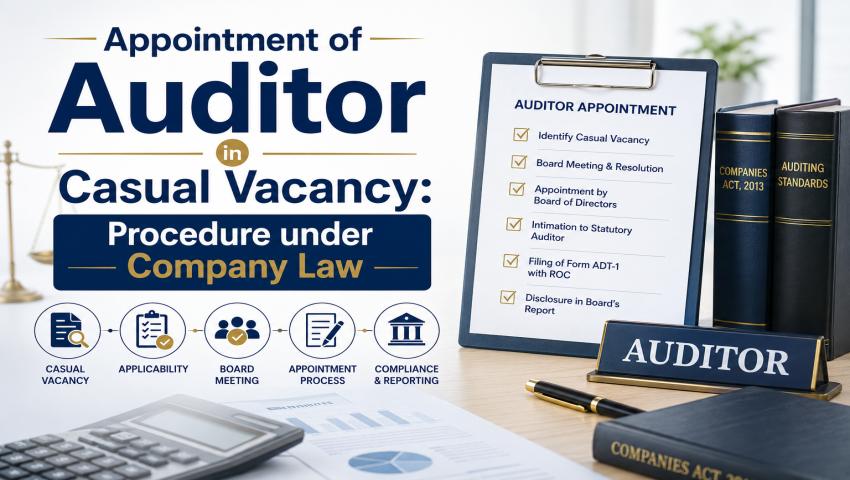
Appointment of Auditor in Casual Vacancy: Procedure under Company Law
The appointment of an auditor is one of the most important compliance requirements under the Companies Act, 2013. Auditors play a key role in ensuring transparency, accountability, and accuracy in a company’s financial reporting. However, situations may arise where an auditor vacates office before completing their term. Such an unexpected vacancy is known as a casual vacancy.
Understanding the appointment of auditor in casual vacancy is essential for companies to maintain uninterrupted audit functions and remain compliant with company law requirements. The Companies Act, 2013 provides a specific procedure for filling such vacancies depending on the reason for the vacancy.
This article by My Finance Gyan explains the meaning of casual vacancy, causes, legal provisions, appointment procedure, timelines, filings, and compliance requirements in a simplified manner.
What is a Casual Vacancy of Auditor?
A casual vacancy refers to a vacancy that occurs in the office of the auditor before the completion of the auditor’s term.
This vacancy arises unexpectedly due to reasons other than the normal expiry of tenure.
👉 In simple words, when an auditor leaves office before their term ends, it creates a casual vacancy.
Causes of Casual Vacancy:
A casual vacancy in the office of auditor may arise due to:
- Resignation of the auditor
- Death of the auditor
- Director Disqualification under the Companies Act
- Incapacity or inability to perform duties
- Removal of auditor by shareholders
Among these, resignation is the most common reason and involves additional compliance requirements.
Legal Provisions Governing Casual Vacancy:
The appointment of auditor in casual vacancy is governed under:
- Section 139(8) of the Companies Act, 2013
- Companies (Audit and Auditors) Rules, 2014
The law distinguishes between:
- Casual vacancy arising due to resignation
- Casual vacancy arising for reasons other than resignation
The procedure differs depending on the cause of vacancy.
Appointment of Auditor in Casual Vacancy Other Than Resignation:
When the casual vacancy arises due to:
- Death
- Disqualification
- Incapacity
- Other non-resignation reasons
the process is comparatively simpler.
Procedure:
- The Board of Directors has the authority to fill the vacancy
- The Board appoints a new auditor through a Board Resolution
- Shareholder approval is not required
- The appointed auditor holds office until the conclusion of the next AGM
👉 This ensures continuity of statutory audit without unnecessary delay.
Appointment of Auditor in Casual Vacancy Due to Resignation:
When the auditor resigns, the Companies Act requires a more detailed process involving shareholder approval.
Step-by-Step Procedure for Appointment Due to Resignation:
Step 1
Resignation by Existing Auditor:
The outgoing auditor must:
- Submit a resignation letter to the company
- File Form ADT-3 with the Ministry of Corporate Affairs (MCA)
Due Date:
Within 30 days of resignation.
The form should include:
- Reasons for resignation
- Relevant details of the company and audit assignment
Step 2
Conduct Board Meeting:
The Board of Directors must:
- Take note of the resignation
- Identify and appoint a new auditor
- Pass a Board Resolution for appointment subject to shareholder approval
The Board recommendation initiates the process for filling the vacancy.
Step 3
Obtain Shareholder Approval:
In case of resignation:
- Shareholder approval is mandatory
- Approval must be obtained in a General Meeting
Timeline:
The General Meeting must be held within 3 months from the Board’s recommendation.
The auditor appointed by shareholders will hold office until the conclusion of the next AGM.
Step 4
Filing of Form ADT-1:
After shareholder approval:
- The company must file Form ADT-1 with ROC
Due Date:
Within 15 days from the General Meeting.
Form ADT-1 includes:
- Details of the newly appointed auditor
- Date of appointment
- Auditor consent and eligibility details
Eligibility and Consent of New Auditor:
Before appointing the new auditor, the company must ensure that the proposed auditor:
- Is eligible under Section 141 of the Companies Act, 2013
- Is not disqualified
- Falls within permissible audit limits
- Provides written consent for appointment
- Submits certificate of eligibility
Proper documentation is essential for a legally valid appointment.
Tenure of Auditor Appointed in Casual Vacancy:
An auditor appointed in a casual vacancy holds office:
👉 Until the conclusion of the next Annual General Meeting (AGM).
At the AGM:
- The company may reappoint the auditor for a regular term
- Or appoint another eligible auditor
The casual vacancy appointment is therefore temporary in nature.
Applicability to Different Types of Companies:
The provisions relating to casual vacancy apply to various types of companies, including:
- Private Limited Companies
- Public Limited Companies
- Listed Companies
- One Person Company (OPC)
- Section 8 Company
However, certain procedural relaxations may apply based on company type and exemptions.
Important ROC Forms Involved:
These forms are filed through the MCA Portal.
Consequences of Non-Compliance:
Failure to fill casual vacancy properly may result in:
- Violation of statutory audit requirements
- Penalties on company and officers in default
- Adverse compliance remarks
- Legal and regulatory complications
Timely compliance is therefore extremely important.
Practical Importance of Timely Appointment:
Filling the vacancy promptly helps ensure:
- Continuity in statutory audit
- Smooth financial reporting
- Better corporate governance
- Confidence of regulators and shareholders
- Avoidance of compliance risks
A proactive compliance approach reflects strong corporate governance practices.
Common Mistakes to Avoid:
Companies should avoid the following errors:
- Delayed appointment of new auditor
- Failure to obtain shareholder approval in resignation cases
- Non-filing of ADT-1 or ADT-3
- Appointing an ineligible auditor
- Improper Board documentation
Frequently Asked Questions (FAQs):
A casual vacancy arises when an auditor leaves office before completing their term.
The provisions are governed under Section 139(8) of the Companies Act, 2013.
No. Shareholder approval is required only when the vacancy arises due to resignation of the auditor.
The resigning auditor must file Form ADT-3 with ROC.
The auditor holds office until the conclusion of the next AGM.
Conclusion:
The appointment of auditor in casual vacancy is a regulated process under the Companies Act, 2013 aimed at ensuring uninterrupted audit oversight and financial transparency. The procedure differs depending on whether the vacancy arises due to resignation or other reasons, and companies must carefully follow the prescribed legal requirements.
Timely Board action, shareholder approval where required, and proper ROC filings are essential for maintaining compliance and avoiding penalties. By understanding these provisions clearly, companies can ensure smooth audit continuity and uphold strong corporate governance standards.
Disclaimer: This article is for general informational purposes only and should not be considered legal, financial, or professional advice