
- 01/08/2026
- Govind S. Jethani
- 409 Views
- 2 Likes
- Investment, Finance
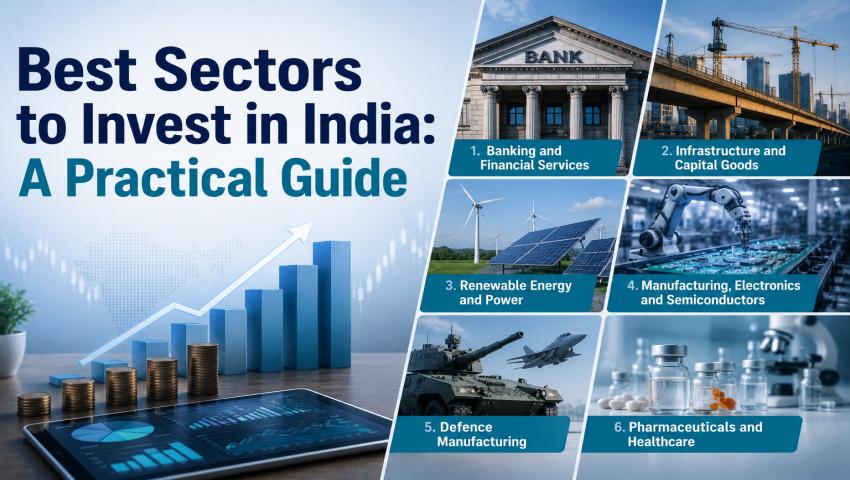
Best Sectors to Invest in India: A Practical Guide
Many investors first search for the “best sectors to invest” before choosing stocks. The idea seems simple: find a growing industry, invest in a few companies and wait for good returns.
However, investing does not always work that way.
A sector may have excellent long-term growth potential, but its stocks may already be very expensive. Another sector may appear weak today but may offer better opportunities because market expectations are low.
A good sector should generally have:
- Strong and sustainable demand
- Financially healthy companies
- Long-term growth opportunities
- Supportive economic or policy conditions
- Reasonable stock valuations
Based on India’s current economic and policy direction, several key sectors deserve closer attention. In this practical guide from My Finance Gyan, we will break down these sectors to invest and analyze their long-term growth drivers. Please note that these are not guaranteed investment recommendations; every company must still be studied individually before investing.
1. Banking and Financial Services:
Banks and financial institutions play an important role in economic growth.
Businesses need loans to expand. Families borrow money to purchase homes and vehicles. Consumers also use banking, insurance, mutual funds and digital payment services.
India’s public-sector banks reported aggregate business of approximately ₹283.3 lakh crore as of 31 March 2026. Their profitability, capital strength and asset quality also improved.
The financial sector includes:
- Private-sector banks
- Public-sector banks
- Non-banking financial companies
- Insurance companies
- Asset management companies
- Stock exchanges
- Depositories
- Payment companies
- Financial-technology businesses
However, every bank or lender is not a good investment.
Rapid loan growth may become risky when a lender gives loans without properly checking the borrower’s repayment capacity.
Before investing in a bank or NBFC, review:
- Gross and net non-performing assets
- Loan-loss provisions
- Deposit growth
- Cost of funds
- Capital adequacy
- Loan growth
- Exposure to risky industries or borrowers
- Management quality
A bank may appear cheap based on valuation, but weak asset quality can keep the stock undervalued for many years.
2. Infrastructure and Capital Goods:
India continues to invest in:
- Roads
- Railways
- Power networks
- Urban infrastructure
- Transport systems
- Public facilities
Public capital expenditure increased from around ₹2 lakh crore in FY 2014-15 to a Budget Estimate of ₹12.2 lakh crore for FY 2026-27.
The Union Budget also planned significant capital spending for Indian Railways.
This may create opportunities for:
- Engineering companies
- Construction companies
- Cement manufacturers
- Building-material producers
- Railway-equipment manufacturers
- Power-transmission companies
- Industrial machinery businesses
- Logistics companies
However, a large order book does not always guarantee strong profits.
Infrastructure projects may face:
- Delays
- Higher costs
- Payment problems
- Land issues
- Regulatory approvals
- Working-capital pressure
Investors should check whether the company regularly converts orders into revenue and cash.
Important factors include:
- Debt levels
- Cash flow
- Operating margins
- Project execution record
- Working-capital requirements
- Customer payment history
A company may show rapid revenue growth while depending heavily on borrowed money. This can increase investment risk.
3. Renewable Energy and Power:
India’s demand for electricity is increasing.
At the same time, renewable energy is becoming an important part of the country’s power-generation capacity.
As of 30 May 2026, India had approximately 162.15 GW of cumulative solar-power capacity. Non-fossil sources represented more than half of the country’s installed electricity capacity. Investment opportunities in this sector are not limited to solar-panel manufacturers.
The sector may include:
- Renewable-power producers
- Solar-component manufacturers
- Transmission companies
- Power-grid businesses
- Battery manufacturers
- Energy-storage companies
- Power-equipment manufacturers
- Engineering and project-management companies
The sector also has important risks.
Renewable-energy projects require:
- Land
- Large amounts of capital
- Transmission access
- Government approvals
- Long-term power-purchase agreements
- Strong project execution
Equipment manufacturers may face intense price competition and rapid technological changes.
Some companies may announce large projects before arranging enough funding. Others may report high revenue growth without generating strong cash flow.
Do not invest only because a company uses popular terms such as:
- Green energy
- Hydrogen
- Battery storage
- Clean technology
Check the company’s actual capacity, debt, customers, project progress and signed agreements.
4. Manufacturing, Electronics and Semiconductors:
India is working to increase domestic manufacturing and reduce dependence on imported products and components. The Production Linked Incentive schemes cover 14 sectors.
By 31 March 2026, these schemes had generated actual investment of more than ₹2.40 lakh crore, according to government data. Electronics and semiconductor manufacturing remain important policy areas.
The Union Budget 2026-27 announced India Semiconductor Mission 2.0, focusing on:
- Semiconductor equipment
- Materials
- Indian intellectual property
- Supply-chain development
- Domestic manufacturing capability
Possible investment areas include:
- Electronic-component manufacturers
- Contract manufacturers
- Industrial-automation companies
- Semiconductor-design businesses
- Semiconductor testing and packaging companies
- Speciality chemical suppliers
- Advanced material manufacturers
However, semiconductor manufacturing requires:
- Very high capital expenditure
- Specialised technology
- Skilled professionals
- Long development periods
- Strong global partnerships
Government approval for a project does not guarantee that the project will become commercially successful.
Investors should check:
- Actual production capacity
- Customer contracts
- Revenue concentration
- Technical partnerships
- Project funding
- Debt requirements
- Expansion plans
- Management execution
Separate companies with genuine customers and production capability from those benefiting mainly from market excitement.
5. Defence Manufacturing:
India’s defence-manufacturing sector has attracted investor attention because of:
- Domestic procurement
- Private-sector participation
- Import substitution
- Export growth
- Government policy support
India’s defence production reached a record ₹1.78 lakh crore in FY 2025-26. Defence exports also reached ₹38,424 crore during the year.
The sector includes businesses involved in:
- Defence electronics
- Shipbuilding
- Communication systems
- Precision engineering
- Drones
- Surveillance equipment
- Ammunition
- Specialised components
- Aircraft systems
Defence orders can be large, but they may take several years to complete. Revenue may also be irregular because many companies depend heavily on government contracts.
An order announcement should not be treated as immediate revenue or profit.
Investors should study:
- Delivery schedules
- Existing order book
- Operating margins
- Working-capital requirements
- Customer concentration
- Past execution record
- Payment cycles
- Valuation
A strong sector outlook cannot protect an investor who purchases a stock at an extremely high price.
6. Pharmaceuticals and Healthcare:
Healthcare may offer both stable demand and long-term growth.
The sector includes:
- Pharmaceutical manufacturers
- Hospitals
- Diagnostic companies
- Medical-device manufacturers
- Contract research organisations
- Healthcare-service providers
India’s pharmaceutical policy is moving towards:
- Complex generic medicines
- Biosimilars
- Research and innovation
- Higher-value products
- Domestic manufacturing of bulk drugs
- Medical-device production
Healthcare demand may remain strong, but companies in this sector still face risks.
Pharmaceutical companies may face:
- Regulatory observations
- Product recalls
- Pricing pressure
- Failed product launches
- Dependence on limited export markets
- High research costs
Hospitals require heavy investment and may take several years to improve occupancy and profitability.
Diagnostic companies may face strong competition and price pressure.
Before investing, review:
- Regulatory history
- Research and development spending
- Product concentration
- Export-market exposure
- Capacity utilisation
- Cash generation
- Debt levels
- Management quality
A company selling essential healthcare products is not automatically a safe investment.
Business quality and purchase valuation remain important.
How Should You Select a Sector?
Start by asking whether the sector has genuine long-term demand or is only receiving temporary market attention.
You should also understand the business cycle of the sector.
Industries such as banking, metals, real estate and capital goods may perform differently during various stages of the economy.
Defensive sectors may remain more stable, but they can still provide poor returns when stocks are purchased at very high valuations.
After selecting a sector, compare individual companies using factors such as:
- Revenue growth
- Profit growth
- Debt
- Interest costs
- Return on capital
- Operating cash flow
- Management quality
- Competitive advantage
- Valuation
- Regulatory risk
- Customer concentration
Do not invest in a weak company only because it operates in a promising industry.
A good sector cannot correct poor management, excessive debt or an unsustainable business model.
Avoid Investing Everything in One Sector:
A sector may remain weak for much longer than investors expect.
The entire industry may be affected by:
- New regulations
- Rising costs
- Technological changes
- Lower demand
- Financing problems
- Policy changes
- Global competition
Sectoral and thematic funds also carry higher concentration risk because they invest in a limited group of related businesses.
For example, investing all your equity money in renewable-energy companies may appear attractive when the sector is performing well.
However, one major policy, financing or technology change could affect several portfolio companies at the same time.
Diversify your investments across different sectors and asset classes.
Your portfolio allocation should depend on:
- Financial goals
- Investment period
- Income stability
- Risk tolerance
- Ability to handle temporary losses
Frequently Asked Questions:
There is no single sector that remains the best forever. Banking, infrastructure, manufacturing, renewable energy, defence and healthcare currently have visible growth opportunities.
However, actual returns will depend on company quality, valuation and business execution.
Sectoral funds carry higher concentration risk.
Beginners may find diversified equity funds easier to understand and manage before investing heavily in one industry.
No.
A fast-growing industry may still provide poor returns when stock prices already assume very high future growth.
There is no compulsory number.
The portfolio should not depend too heavily on one sector. At the same time, it should remain simple enough for the investor to understand and monitor.
A lower stock price alone does not make the sector attractive.
Check whether the correction is caused by temporary market fear or a permanent change in the industry’s future prospects.
No.
Government policy may create growth opportunities, but companies still face:
- Execution risk
- Competition
- Financing problems
- Regulatory changes
- Technology risk
- Valuation risk
Conclusion:
Banking, infrastructure, renewable power, manufacturing, defence and healthcare are important sectors to study in India. Each sector has visible growth opportunities, but each also carries different risks.
Instead of asking only:
“Which sector will rise next?”
Ask:
“Which financially strong company can benefit from this sector’s growth without taking excessive debt or depending on unrealistic expectations?”
A promising sector may help a strong business grow.
Your investment returns will still depend on:
- Proper research
- Company quality
- Purchase valuation
- Diversification
- Risk management
- Patience
Disclaimer:
This article is for general educational purposes only and is not personalised investment advice; consider consulting a SEBI-registered investment adviser before investing.