
- 30/05/2026
- Govind S. Jethani
- 390 Views
- 2 Likes
- Other
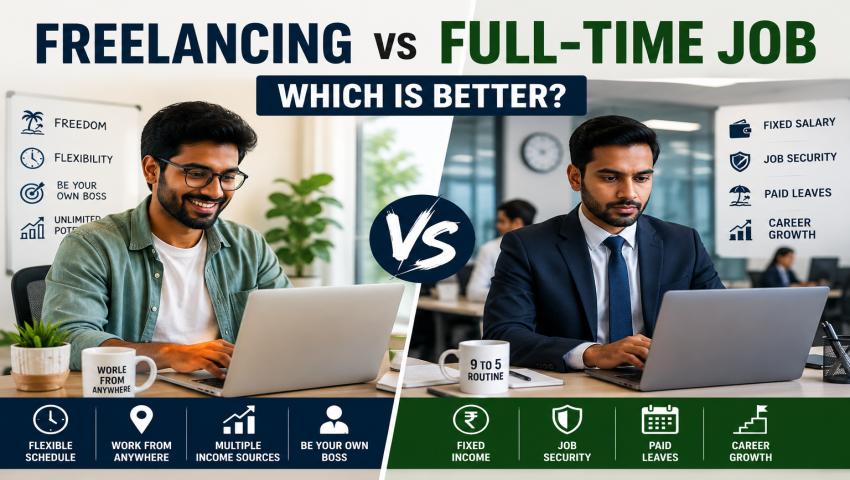
Freelancing vs Full-Time Job – Which is Better?
Today, many professionals and students ask one common career question: Should I continue with a full-time job or start freelancing?
At first, the answer may seem simple, but in reality, it depends completely on your goals, financial condition, skills, and lifestyle preferences. Some people prefer fixed salary, job security, employee benefits, and structured work culture. Others prefer flexibility, freedom, multiple clients, and control over their own work schedule.
Both freelancing and full-time jobs have advantages and challenges. Instead of saying one is universally better, it is important to understand both properly before making a career decision. In this comprehensive guide by My Finance Gyan, we will break down the key differences, pros, and cons to help you choose the path that best aligns with your future.
What is Freelancing?
Freelancing means working independently for clients instead of working as a permanent employee for one company.
For example:
- A freelance content writer may write blogs for multiple businesses
- A graphic designer may create logos and branding for different clients
- A web developer may build websites on a project basis
- A consultant may provide professional advice without joining a company full-time
In freelancing, you are responsible for:
- Finding clients
- Setting pricing
- Delivering work
- Managing timelines
- Collecting payments
- Handling communication
Freelancing offers freedom, but it also brings additional responsibility.
What is a Full-Time Job?
A full-time job means working as an employee for a company or organization with fixed responsibilities and structured working conditions.
Typically, a full-time employee receives:
- Fixed monthly salary
- Defined work timings
- Paid leave
- Reporting structure
- Employee benefits
- Long-term role stability
Examples include:
- Accountant
- Software developer
- HR executive
- Sales manager
- Teacher
- Graphic designer
- Marketing executive
In a job, the company provides regular work and monthly salary, so employees usually do not need to search for new clients continuously.
This creates stability, although flexibility may be limited.
Income Difference Between Freelancing and Full-Time Jobs:
Full-Time Job Income
In a full-time job, salary is usually fixed. Employees know how much money they will receive every month, which helps with:
- EMI planning
- Rent and household expenses
- Savings
- Insurance
- Family responsibilities
For example, if your monthly salary is ₹40,000, your financial planning becomes easier because income is predictable.
Freelancing Income
Freelancing income is often irregular. One month you may earn ₹20,000, while another month you may earn ₹80,000 or more. Some months may bring multiple projects, while others may have no work at all.
This means:
- Freelancing has higher earning potential
- But income may not always be stable
A skilled freelancer with strong clients and proper pricing may earn significantly more than a salaried employee. However, the initial phase of freelancing can be uncertain and slow.
Job Security and Stability:
A full-time job generally offers more stability compared to freelancing.
Employees usually receive:
- Monthly salary
- Structured work
- Company support
- Employee benefits
Although no job is completely secure, full-time employment is still considered more stable than freelancing.
Freelancing Challenges:
Freelancers may face:
- Sudden project cancellation
- Delayed payments
- Client loss
- Market competition
- Unpredictable workload
If someone has:
- Heavy financial responsibilities
- Family dependency
- EMIs
- Limited savings
then directly shifting to freelancing may become risky.
A practical approach is to start freelancing part-time while continuing a full-time job. Once freelance income becomes stable for several months, transitioning becomes safer.
Freedom and Flexibility:
This is one of the biggest reasons people choose freelancing.
Freelancers often have the flexibility to:
- Choose working hours
- Select clients
- Decide project types
- Work remotely
- Travel while working
However, flexibility does not mean less pressure.
Many freelancers work:
- Late nights
- Weekends
- Holidays
especially when handling tight deadlines or international clients.
Full-Time Job Flexibility:
In full-time jobs:
- Office timing is usually fixed
- Attendance policies apply
- Reporting managers exist
- Company rules must be followed
But after office hours, many employees can disconnect from work more easily than freelancers.
Freelancers often struggle with work-life separation because work requests can come anytime.
Career Growth Opportunities:
Growth in Full-Time Jobs
Career growth usually comes through:
- Promotions
- Salary increments
- Better designations
- Leadership roles
- Corporate experience
Employees also learn:
- Team management
- Company operations
- Workplace communication
- Business systems
This structured learning is especially valuable during the early career stage.
Growth in Freelancing
Freelancers can grow by:
- Increasing pricing
- Building personal brand
- Working with premium clients
- Starting an agency
- Hiring a team
- Selling digital products or services
But freelancers must create their own growth opportunities. No company automatically plans their career progression.
In simple words:
- Jobs provide structured growth
- Freelancing provides unlimited but self-managed growth
Work Pressure and Stress:
Many people assume freelancing is stress-free and jobs are stressful. In reality, both can become stressful in different ways.
Full-Time Job Stress:
Employees may face:
- Office politics
- Target pressure
- Long working hours
- Travel fatigue
- Manager expectations
- Limited control
Freelancing Stress:
Freelancers may deal with:
- Irregular income
- Client follow-ups
- Payment delays
- Continuous revisions
- Competition
- Constant search for work
In a job, you may have one boss.
In freelancing, every client can become a boss if boundaries are not set properly.
This is why freelancers need strong communication skills and clear agreements regarding:
- Scope of work
- Pricing
- Timelines
- Revisions
- Payment terms
Skill Requirements:
In a full-time job, employees mainly need role-specific skills.
For example:
- Developers need coding skills
- Accountants need accounting knowledge
- Sales professionals need sales skills
The company usually manages:
- Marketing
- Client acquisition
- Billing
- Administration
- Legal processes
Freelancing Requires Broader Skills:
Freelancers need multiple skills beyond their core expertise.
A freelance professional may need:
- Marketing skills
- Communication skills
- Negotiation ability
- Time management
- Invoicing knowledge
- Client handling skills
A freelancer is not only the worker but also the manager, salesperson, and customer support person.
Benefits and Employee Perks:
Full-time jobs often include benefits such as:
- Paid leave
- Provident Fund (PF)
- Gratuity
- Health insurance
- Bonus
- Training programs
- Office equipment
These benefits are important for long-term financial stability.
Freelancers Must Manage Everything Themselves:
Freelancers usually need to handle:
- Health insurance
- Retirement savings
- Taxes
- Software costs
- Laptop and internet expenses
- Emergency funds
Therefore, freelancers should not compare only monthly income.
For example:
- A job paying ₹50,000 with benefits
- vs freelancing earning ₹60,000 without benefits
may not necessarily make freelancing financially better.
Learning and Exposure:
Learning in Full-Time Jobs
Jobs provide exposure to:
- Corporate systems
- Seniors and mentors
- Team collaboration
- Client meetings
- Workplace discipline
This environment is extremely useful for beginners.
Learning in Freelancing
Freelancers gain exposure to:
- Multiple industries
- Different client types
- International projects
- Real market demands
This often improves confidence and business understanding quickly.
However, freelancing can sometimes feel isolated because there may be:
- No team support
- No direct mentorship
- No structured learning environment
Freelancers must learn independently
Which is Better for Beginners?
For most beginners, a full-time job is generally safer.
It provides:
- Stable income
- Training
- Work discipline
- Industry exposure
- Practical experience
After gaining 1–3 years of experience, freelancing becomes easier because skills and confidence improve.
That said, students and freshers can still start small freelancing projects such as:
- Content writing
- Social media management
- Graphic design
- Website editing
- Tutoring
- Data entry
The key is not to depend entirely on freelancing income immediately unless financial support or savings already exist.
Which is Better for Experienced Professionals?
Experienced professionals with strong skills and industry contacts may benefit significantly from freelancing.
Examples include:
- Chartered Accountants (CA)
- Company Secretaries (CS)
- Lawyers
- Designers
- Developers
- Digital marketers
- HR consultants
- Architects
- Trainers
Experienced professionals can often charge premium fees because they offer expertise, judgment, and results — not just time.
Still, proper planning is important before leaving a stable job. Having at least 6 months of emergency savings is usually recommended.
Work-Life Balance:
Both freelancing and full-time jobs can provide good work-life balance if managed properly.
Jobs may affect balance due to:
- Long office hours
- Heavy commuting
- Weekend work
- Constant availability expectations
Freelancing may affect balance due to:
- Overcommitting to projects
- Undercharging
- Difficulty saying no to clients
Many freelancers initially choose freelancing for freedom but eventually work more than full-time employees.
The real issue is not freelancing vs job — it is how boundaries are managed.
Tax and Compliance:
Full-Time Job Taxation:
In jobs:
- Employers deduct TDS
- Employees receive Form 16
- Salary taxation is relatively straightforward
Freelancing Taxation:
Freelancers must manage:
- Invoices
- Receipts
- Income tax
- Advance tax
- GST (if applicable)
- Expense records
Freelancers should maintain proper accounting from the beginning to avoid tax-related problems later.
Maintaining separate business records and consulting professionals when income grows is always beneficial.
So, Which is Better?
Freelancing is better if you:
- Want flexibility and freedom
- Have strong marketable skills
- Can manage clients independently
- Are comfortable with variable income
- Prefer working independently
A full-time job is better if you:
- Prefer stability
- Need fixed monthly income
- Value employee benefits
- Want structured career growth
- Prefer predictable work systems
There is no universal answer.
For some people, a full-time job is ideal. For others, freelancing creates better opportunities. For many professionals, combining both can be the smartest option.
Final Thoughts:
Do not choose freelancing only because social media makes it look easy. And do not remain in a full-time job only because society calls it safe.
Consider:
- Your financial condition
- Savings
- Family responsibilities
- Skills
- Confidence
- Career goals
- Risk tolerance
If you need stability, a full-time job may be the right choice right now. If you already have skills, savings, clients, and confidence, freelancing may offer greater flexibility and earning potential.
The best career choice is not based on trends or someone else’s success story. It is the option that aligns with your current life situation and long-term goals.
Disclaimer: The views expressed in this article/blog are personal and intended only for educational and awareness purposes. The content is not intended to provide financial, legal, career, or investment advice, nor does it recommend any specific product or service.