- 20/08/2026
- Govind S. Jethani
- 388 Views
- 2 Likes
- Finance
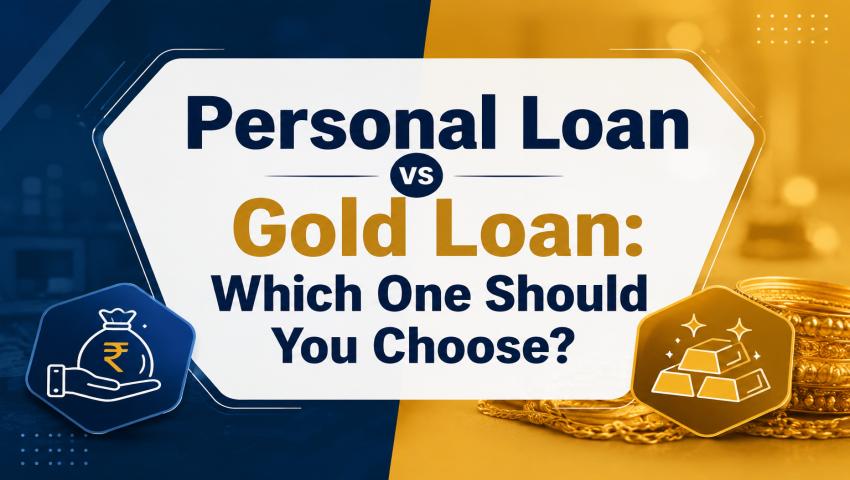
Personal Loan vs Gold Loan: Which One Should You Choose?
Unexpected expenses such as medical bills, home repairs, education costs or urgent family needs can create a sudden need for money. In this guide from My Finance Gyan, we break down two common ways to arrange funds: personal loans and gold loans.
When evaluating Personal Loan vs Gold Loan, it is important to understand that while both can be used for various personal expenses, they work quite differently:
- Personal Loan: Usually an unsecured loan where the lender mainly checks your income, credit score, repayment history, and overall financial stability.
- Gold Loan: A secured loan where you pledge eligible gold jewellery or gold coins with the lender and receive funds based on the evaluated value of the gold.
The right choice depends on your financial situation, how quickly you need the money, whether you own gold, and how easily you can repay the loan.
What Is a Personal Loan?
A personal loan is generally an unsecured loan, which means you do not need to pledge an asset such as gold or property.
The lender usually considers:
- Monthly income
- Employment or business stability
- Credit score
- Existing loans and EMIs
- Previous repayment history
- Relationship with the lender
You can generally use a personal loan for expenses such as:
- Medical treatment
- Education
- Wedding expenses
- Travel
- Home renovation
- Other personal needs
Because there is no collateral, personal loans usually have a higher interest rate than secured loans.
Getting a personal loan may also be more difficult if you have a low credit score, irregular income or a high existing debt burden.
What Is a Gold Loan?
A gold loan is a secured loan where you pledge eligible gold jewellery, ornaments or coins to a bank or financial institution.
The lender checks the:
- Purity of the gold
- Net weight
- Eligible gold value
Stones and other non-gold materials are generally not included when calculating the loan value. The lender then decides the loan amount based on the value of the eligible gold and the applicable loan-to-value (LTV) limit.
Once you repay the loan, interest and applicable charges, your pledged gold is returned.
However, if you fail to repay the loan, the lender can auction the pledged gold after following the required notice and auction process.
Personal Loan vs Gold Loan: Key Difference
The biggest difference between the two loans is security.
Which Loan Has a Lower Interest Rate?
A gold loan generally has a lower interest rate because the lender has gold as security.
Personal loans are unsecured, so lenders usually charge a higher rate to compensate for the additional risk.
For example, SBI listed rates of 9.15% for a 12-month bullet gold loan and 10.10% for an EMI-based gold loan as of 16 June 2026. Bank of Baroda’s personal loan rates ranged from 10.15% to 18%, depending on factors such as the borrower’s profile and credit score.
These are only examples. Actual rates can vary between lenders and borrowers.
When comparing loans, don’t look at the interest rate alone. Also check:
- Processing fees
- Gold valuation charges
- Penal charges
- Prepayment charges
- Other applicable fees
- Total repayment amount
Always read the Key Fact Statement (KFS) before accepting a loan.
How Much Gold Loan Can You Get?
You generally cannot borrow the entire market value of your gold. The loan amount depends on the value of the eligible gold and the applicable LTV limit.
Under the RBI’s current directions for consumption loans against eligible gold or silver collateral, the maximum LTV is:
- 85% for loans up to ₹2.5 lakh
- 80% for loans above ₹2.5 lakh and up to ₹5 lakh
- 75% for loans above ₹5 lakh
These directions were required to be implemented by regulated lenders by 1 April 2026.
Example:
Suppose your eligible gold is valued at ₹4 lakh.
For a loan in that slab, the regulatory maximum LTV would be 80%.
So:
₹4 lakh × 80% = ₹3.2 lakh
The lender may still approve a lower amount based on its own rules and your repayment capacity.
Remember that making charges, emotional value and the value of gemstones are generally not included in the eligible gold value.
Which Loan Is Easier to Get?
A gold loan can be easier to obtain if you have eligible gold but have a limited credit history or difficulty providing extensive income documents.
Since the lender has gold as security, the credit score may have less importance than it does for an unsecured personal loan. However, the lender will still consider your ability to repay.
A personal loan generally requires more financial information, such as:
- PAN and identity proof
- Address proof
- Salary slips or income documents
- Bank statements
- Income-tax returns, where applicable
- Employment or business proof
- Details of existing loans
A stable income and good credit score can improve your chances of getting a personal loan at a competitive rate.
Which Loan Has a Longer Repayment Period?
Personal loans generally offer longer repayment periods than gold loans.
For example, Bank of Baroda lists personal loan tenures of up to 84 months for certain eligible borrowers.
Gold loans usually have shorter repayment periods. SBI currently offers up to 36 months for certain EMI and overdraft gold-loan options, while its bullet repayment option has a 12-month term.
A longer tenure can reduce your monthly EMI, but you may pay more interest over the entire loan period.
Therefore, choose a tenure that keeps the EMI affordable without unnecessarily increasing your total interest cost.
How Do Repayment Options Differ?
Personal loans are generally repaid through monthly EMIs that include both principal and interest.
Gold loans may provide different repayment options.
- Regular EMI: You pay a fixed amount every month towards the principal and interest.
- Bullet Repayment: The principal and interest are paid at or before the end of the agreed loan period. This can be useful if you are expecting a known lump-sum payment. However, it can become difficult if that expected money does not arrive.
- Overdraft Facility: Some gold loans provide an overdraft facility against pledged gold. You may pay interest based on the amount you actually use, subject to the lender’s terms. Don’t choose a bullet repayment option simply because the monthly payment appears low. Make sure you have a realistic plan to repay the full amount on time.
What Happens If You Cannot Repay?
Missing personal loan EMIs can lead to:
- Penal charges
- Damage to your credit score
- Recovery action
- Additional financial pressure
Since there is normally no collateral in a personal loan, the lender does not have gold to auction. However, it can still take appropriate recovery action according to the loan agreement and applicable law.
With a gold loan, the risk is different. If you default, the lender can auction your pledged gold after following the required notice and auction process.
Under the RBI’s current directions, lenders must follow a transparent auction process and provide the required notice to the borrower. This is particularly important if the pledged jewellery has family or emotional value.
When Does a Personal Loan Make More Sense?
A personal loan may be a better option when:
- You don’t own enough eligible gold
- You don’t want to pledge family jewellery
- You need a longer repayment period
- You have a stable income
- You have a good credit score
- You can get a competitive interest rate
- You need an amount that is higher than what your available gold can support
Compare offers from different regulated lenders instead of accepting the first loan offer you receive.
When Does a Gold Loan Make More Sense?
A gold loan may be suitable when:
- You need money quickly
- You own eligible gold
- Your credit history is limited or not very strong
- You need money for a short period
- The gold loan has a significantly lower total cost
- You have a clear and reliable repayment plan
However, don’t pledge valuable family jewellery if your repayment depends on uncertain income.
Losing jewellery can create a much bigger financial and emotional problem.
Frequently Asked Questions:
Yes. A gold loan is a credit facility. Late or missed payments can negatively affect your credit record.
Yes, in some cases. Self-employed professionals and business owners may qualify by providing income, banking and business-related documents. Eligibility depends on the lender.
No. The lender applies the applicable LTV limit and calculates the value based on eligible gold content, purity and net weight.
Not necessarily. A gold loan often has a lower interest rate, but you should compare the total cost, including processing fees, valuation charges and other applicable costs.
A gold loan may be useful when you need funds quickly and have eligible gold available. A personal loan may be better if you need a longer repayment period and qualify for a reasonable interest rate.
The lender must follow the loan agreement and applicable RBI requirements, including the required notice and auction process before selling pledged gold.
Personal Loan or Gold Loan: Which Is Better?
There is no single answer for everyone.
Choose a personal loan if you want to keep your assets free, have a stable income and good credit profile, and need a longer repayment period.
Choose a gold loan if you need funds quickly, have eligible gold and can comfortably repay the loan within the required period.
Before making a decision, compare:
- Interest rate
- Processing and other charges
- Loan tenure
- EMI or repayment structure
- Total repayment amount
- Prepayment conditions
- Risk involved in case of default
Most importantly, borrow only what you can comfortably repay.
Conclusion:
A personal loan gives you access to funds without pledging an asset, but it may come with a higher interest rate and stricter eligibility requirements.
A gold loan can offer faster access to funds and may have a lower interest rate, but your pledged gold remains at risk until the loan is fully repaid.
Don’t choose a loan only because it has a lower EMI or advertised interest rate. Look at the total borrowing cost and repayment terms.
The best loan is not necessarily the cheapest one. It is the loan that meets your needs and can be repaid comfortably and on time.
Disclaimer:
This article is for general educational purposes only. Loan interest rates, eligibility criteria, charges and terms vary between lenders and may change over time. Always read the Key Fact Statement and loan agreement carefully before borrowing.