- 22/04/2026
- Govind S. Jethani
- 486 Views
- 5 Likes
- Company Law
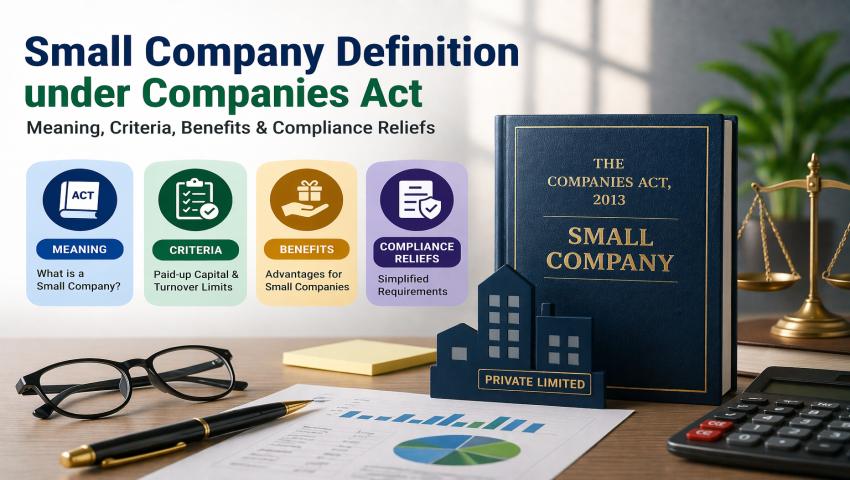
Small Company Definition under Companies Act: Meaning, Criteria, Benefits & Compliance Reliefs
The idea of a Small Company under the Companies Act was introduced to help small businesses grow easily. Since small companies usually have limited resources, the law gives them simpler rules and fewer compliance requirements.
Understanding the definition of a small company under the Companies Act, 2013 is important for business owners, startup founders, and finance professionals. It helps them know whether they can get benefits like fewer filings and lower compliance costs.
This article explains the meaning, eligibility, exclusions, benefits, and compliance requirements of a small company in a simple way. My Finance Gyan helps you understand these concepts with clear and practical insights.
What Is a Small Company?
A Small Company is a type of private limited company defined under Section 2(85) of the Companies Act, 2013. It is classified based on its capital and turnover.
The main purpose of this concept is to:
- Reduce compliance burden on small businesses
- Encourage businesses to register as companies
- Promote ease of doing business
- Support startups and small enterprises
Only private limited companies can be classified as small companies. Public companies are not eligible.
Legal Definition (Effective from Dec 1, 2025):
A company is considered a small company if:
- Its paid-up share capital is up to ₹10 crore, and
- Its annual turnover is up to ₹100 crore (based on the previous financial year)
👉 Important: The company must meet both conditions to qualify.
Companies That Are Not Considered Small Companies:
Even if a company meets the above limits, it will not be treated as a small company if it is:
- A public company
- A holding company or subsidiary company
- A Section 8 company (non-profit organization)
- A company governed by special laws (like banking or insurance companies)
Why Small Company Status Matters?
Being classified as a small company is helpful because it:
- Reduces legal and compliance work
- Lowers overall costs
- Makes company management easier
- Encourages small businesses to grow
It is especially useful for startups moving from proprietorship or partnership to a private limited company.
Benefits and Exemptions for Small Companies:
Small companies get several advantages under the Companies Act:
1. Fewer Annual Filings: They have simpler filing requirements, which reduces paperwork and costs.
2. Less Number of Board Meetings:
- Only 2 board meetings per year are required
- At least 90 days gap between meetings
3. No Cash Flow Statement Required: They do not need to prepare a cash flow statement, making financial reporting easier.
4. Lower Penalties: If there is any non-compliance, penalties are lower compared to other companies.
5. Relaxation in Auditor Rules: Some rules like mandatory auditor rotation are not applicable.
Compliance Requirements (Still Important):
Even with relaxations, small companies must follow basic rules such as:
- Maintaining statutory records
- Filing annual returns (AOC-4 and MGT-7A)
- Conducting Annual General Meetings (AGMs)
- Appointing an auditor
Non-compliance can still lead to penalties.
Difference Between Small Company and Other Companies:
A small company provides a balance between flexibility and credibility.
What Happens If Limits Are Exceeded?
A company will stop being a small company if:
- Paid-up capital exceeds ₹10 crore, or
- Turnover exceeds ₹100 crore
This change applies from the next financial year, and the company must follow normal compliance rules after that.
Small Company vs Startup:
These two terms are different:
- A startup is recognized under government (DPIIT) guidelines
- A small company is defined under the Companies Act
However, many startups qualify as small companies in their early stages and benefit from these relaxations.
Example of a Small Company:
Let’s understand with an example:
ABC Private Limited has:
- Paid-up capital: ₹1.5 crore
- Turnover: ₹12 crore
It is not a holding, subsidiary, or Section 8 company.
👉 So, it qualifies as a small company and can enjoy compliance benefits.
Why Government Supports Small Companies?
Small businesses play a big role in the economy. To support them, the government:
- Promotes ease of doing business
- Encourages company registration
- Reduces compliance burden
- Supports growth and job creation
This aligns with initiatives like Startup India and Make in India.
Conclusion:
The concept of a small company under the Companies Act, 2013 helps small businesses grow with fewer compliance challenges. It allows them to focus more on business activities instead of paperwork.
Business owners should regularly check their capital and turnover to ensure they still qualify. This helps in better compliance planning and cost management.
Using the benefits of small company status properly can make a big difference during the early and growth stages of a business.
Disclaimer:
The views expressed in this article are personal and for educational purposes only. This content is meant to create awareness and does not provide any professional or legal advice.