- 18/04/2026
- Govind S. Jethani
- 598 Views
- 4 Likes
- Startup Funding
Seed Funding vs Series A Funding: Key Differences Every Founder Should Understand
Raising funds is a major step for any startup. But not all funding rounds are the same. Two common early-stage rounds—Seed Funding and Series A Funding—are often confusing for new founders.
Both help a startup grow, but they are different in terms of purpose, stage of business, investor expectations, and risk.
Understanding the difference between seed funding and Series A funding helps founders raise money at the right time and from the right investors — a key insight brought to you by My Finance Gyan.
What Is Seed Funding?
Seed funding is usually the first official funding round of a startup. It helps the business get started and grow in the early stage.
At this point, the startup may have:
- An idea or concept
- A prototype or MVP (Minimum Viable Product)
- Little or no revenue
The main goal is to test the idea and find product–market fit.
Common Sources of Seed Funding:
- Angel investors
- Early-stage venture capital firms
- Accelerators and incubators
- Friends and family
- Crowdfunding
The funding amount is usually small compared to later stages.
What Is Series A Funding?
Series A funding comes after seed funding. At this stage, the startup has already shown some success.
The company usually has:
- A working product
- Paying customers
- Early growth
Now, the focus is on scaling the business.
Common Series A Investors:
- Venture capital firms
- Institutional investors
- Strategic investors
Series A funding is larger and comes with more expectations andstricter terms.
- Seed Stage:
- Idea validation
- MVP or early product
- Limited or no revenue
- Small team
- Series A Stage:
- Product–market fit achieved
- Growing customer base
- Stable or growing revenue
- Clear business model
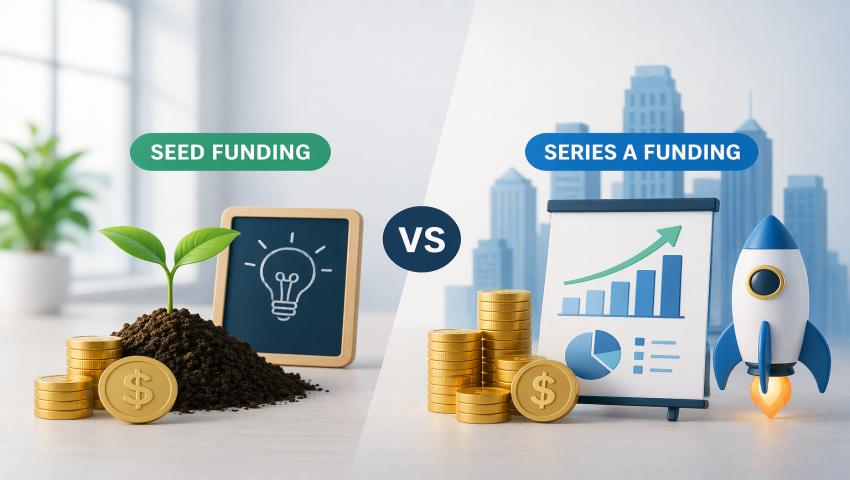
👉 In simple terms: Seed funding proves the idea, while Series A scales the business.
Purpose of Funding:
- Seed Funding Purpose:
- Build and improve the product
- Test the market
- Hire core team members
- Start initial operations
At this stage, experimentation is common.
- Series A Funding Purpose:
- Scale operations
- Expand team
- Increase marketing and sales
- Enter new markets
Here, the focus is on growth, not experimentation.
Investment Size and Valuation:
- Seed funding:
- Smaller investment
- Lower valuation
- Based on idea and potential
- Series A funding:
- Larger investment
- Higher valuation
- Based on actual performance
As the startup grows and risk reduces, valuation increases.
Investor Expectations:
- Seed Investors:
- Focus on the founder’s vision
- Believe in the idea and market
- Accept higher risk
- Series A Investors:
- Focus on data and performance
- Expect strong growth metrics
- Look for scalability
Risk tolerance is lower, and expectations are higher.
Equity Dilution and Control:
In seed funding:
- Founders give less equity
- Investors have limited control
In Series A:
Investors may ask for:
- Board seats
- Voting rights
- Special protections
Founders must balance funding needs with control of the company.
Legal Documentation:
Seed Stage:
- Simple agreements
- Convertible notes or SAFEs
- Basic terms
Series A Stage:
- Detailed agreements
- Shareholders’ agreements
- Investor rights documents
- Complex term sheets
Legal complexity increases as funding grows.
Important Metrics:
Seed Stage Metrics:
- User engagement
- Early adoption
- Customer feedback
- Growth potential
Revenue may still be low.
Series A Metrics:
- Monthly recurring revenue (MRR)
- Customer acquisition cost (CAC)
- Lifetime value (LTV)
- Churn rate
Investors expect clear and measurable growth.
Timeline Between Seed and Series A:
There is no fixed timeline, but many startups take 12 to 24 months to move from seed to Series A.
This depends on:
- Market conditions
- Startup performance
- Industry type
- Funding availability
Common Mistakes Founders Make:
- Raising Series A too early
- Not using seed money properly
- Choosing the wrong investors
- Overvaluing the company
- Ignoring scalability issues
Understanding each stage helps avoid these mistakes.
When Are You Ready for Series A?
You may be ready if:
- Your product has steady demand
- Customers are paying regularly
- Growth is consistent
- Your team can scale operations
- You have a clear growth plan
If not, you may need more time or additional seed funding.
Final Thoughts:
Seed funding and Series A funding are very different stages in a startup’s journey.
- Seed funding = Proving the idea
- Series A funding = Scaling the business
Founders who understand this difference can raise funds more effectively and build stronger, more sustainable companies.
Disclaimer:
The views expressed in this article are personal and for educational purposes only. This content is meant to create awareness and does not provide any professional or financial advice.