- 31/07/2026
- Govind S. Jethani
- 448 Views
- 3 Likes
- Tax
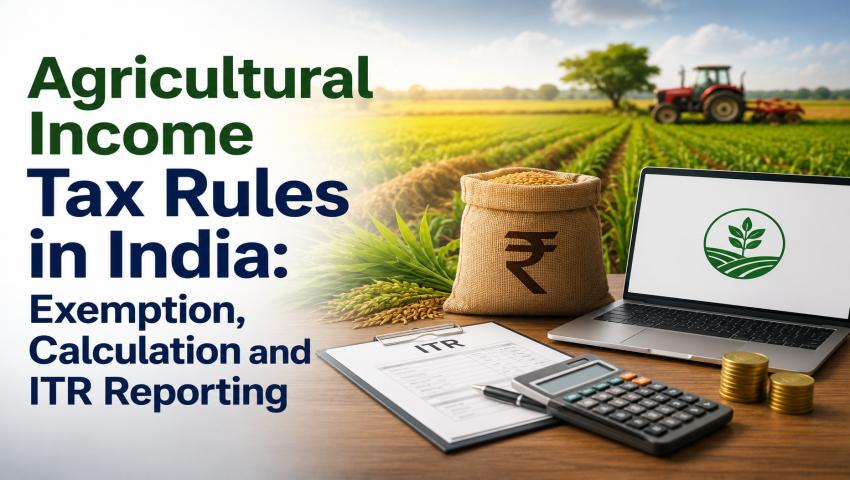
Agricultural Income Tax Rules in India: Exemption, Calculation and ITR Reporting
Many people believe that all income related to farming is completely tax-free. However, this is not always true.
Income earned by growing crops on agricultural land may be exempt from income tax. But income from dairy farming, poultry, fisheries, food processing, trading agricultural products or selling urban agricultural land may be taxable. Even when agricultural income is exempt, it can sometimes increase the tax rate applied to your salary, business income or other taxable income.
The Income-tax Act, 2025 applies from 1 April 2026. However, income-tax returns (ITR) for earlier years, including AY 2026-27 for FY 2025-26, will continue to be governed by the Income-tax Act, 1961.
In this detailed guide from My Finance Gyan, we will help you understand the essential agricultural income tax rules, including what qualifies as exempt agricultural income, how partial integration impacts your tax liability, and how to correctly report these earnings in your Income Tax Return (ITR).
What Is Agricultural Income?
Agricultural income generally means income earned from land located in India and used for agricultural activities.
It may include:
- Rent or income received from agricultural land
- Income from growing crops
- Income from basic processing needed to make crops ready for sale
- Income from selling crops grown by the farmer
- Income from certain farm buildings
- Income from saplings or seedlings grown in a nursery
Income from nursery-grown saplings and seedlings is specifically treated as agricultural income.
The income must have a direct connection with agricultural land. Simply running a business in a village or selling agricultural products does not make the income agricultural.
Is Agricultural Income Tax-Free?
Qualifying agricultural income is exempt from central income tax.
Under the Income-tax Act, 2025, this exemption is covered under Schedule II read with Section 11.
However, exempt agricultural income may still be considered while deciding the tax rate on your non-agricultural income. This method is known as partial integration.
Some States may also have separate tax rules for agricultural or plantation income. Large plantation businesses should therefore check both central and State laws.
What Is Partial Integration?
Partial integration means agricultural income is added only to calculate the tax rate on taxable income. The agricultural income itself is not directly taxed.
It generally applies when:
- Agricultural income is more than ₹5,000.
- Non-agricultural income is more than the applicable basic exemption limit.
- The taxpayer is an individual, HUF, association of persons, body of individuals or artificial juridical person.
How Is Tax Calculated?
The tax calculation broadly follows these steps:
- First, calculate tax on : Agricultural income + Non-agricultural income
- Then calculate tax on : Agricultural income + Basic exemption limit
Subtract the second tax amount from the first.
After this, rebate, surcharge and health and education cess are applied wherever required.
Simple Example:
Suppose a person earns:
- Agricultural income: ₹3 lakh
- Taxable salary and other income: ₹9 lakh
Since agricultural income is above ₹5,000 and taxable income is above the basic exemption limit, partial integration may apply.
The ₹3 lakh agricultural income will not be taxed directly. However, it may increase the tax rate used to calculate tax on the ₹9 lakh taxable income.
The final tax amount will depend on the chosen tax regime, slab rates, deductions, rebates and other rules applicable for that year.
Which Farming-Related Income Is Taxable?
Not every income connected with farming or rural activities is treated as agricultural income.
The following types of income are generally taxable:
- Profit from buying and reselling agricultural produce
- Dairy farming income
- Poultry or livestock business income
- Fisheries income
- Rent from agricultural land used for non-agricultural purposes
- Income from large-scale commercial processing
- Salary earned for managing a farm
- Interest earned on compensation or deposits
- Income from renting a farmhouse for tourism, weddings or residential use
For example, income from selling wheat grown on your own land may qualify as agricultural income.
However, if you purchase wheat from farmers and sell it as a trader, the profit is treated as business income.
Basic activities such as cleaning, drying, sorting or grading crops may still be considered part of agricultural operations.
But if the crop is converted into a completely different commercial product, part or all of the income may become taxable business income.
Partly Agricultural and Partly Business Income:
Some businesses grow agricultural produce and also manufacture a commercial product from it. In such cases, the income is divided into agricultural income and business income.
The commonly prescribed division is:
- Tea grown and manufactured in India: 60% agricultural and 40% business income
- Rubber grown and manufactured: 65% agricultural and 35% business income
- Coffee grown and cured: 75% agricultural and 25% business income
- Coffee grown, cured, roasted and ground: 60% agricultural and 40% business income
Only the agricultural portion is exempt. The business portion is taxable. In other businesses where a person uses produce grown on their own land, the market value of that produce is generally deducted while calculating taxable business profit.
Is Farmhouse Income Exempt?
Income from a farmhouse is not automatically agricultural income.
The farmhouse should normally:
- Be located on or near agricultural land
- Be used by the cultivator or person receiving agricultural rent
- Be used as a residence, storehouse or building connected with agricultural activities
If the farmhouse is rented for holidays, weddings, events or commercial accommodation, the rental income will generally be taxable.
The income does not become agricultural only because the building is located on farmland.
Is Profit From Selling Agricultural Land Taxable?
The tax treatment depends on whether the land is rural agricultural land or urban agricultural land.
Rural Agricultural Land:
Rural agricultural land is generally not treated as a capital asset. Therefore, profit from selling rural agricultural land is normally not subject to capital gains tax.
Urban Agricultural Land:
Agricultural land may be treated as urban land when it is located within specified municipal limits or within a certain aerial distance from a municipality.
Depending on the population, the specified distance may be:
- 2 kilometres
- 6 kilometres
- 8 kilometres
Profit from selling urban agricultural land may be taxable as capital gains.
Tax exemptions may still be available in certain cases, such as:
- Reinvesting the amount in another agricultural land
- Eligible compulsory acquisition of agricultural land
These exemptions are subject to specific legal conditions.
Income earned from farming and profit earned from selling land are two different matters. The full sale value of agricultural land should not be shown as ordinary agricultural income.
Should Agricultural Income Be Reported in the ITR?
Yes. Exempt agricultural income should still be disclosed in the correct schedule of the income-tax return.
For AY 2026-27, ITR-1 may be used only when agricultural income does not exceed ₹5,000 and all other conditions for using ITR-1 are satisfied.
If agricultural income is above ₹5,000, the taxpayer must choose the return form that applies to their other income and circumstances.
Correct reporting is especially important when:
- Partial integration applies
- Large cash deposits are made from crop sales
- Agricultural land is sold
- The taxpayer also earns salary or business income
- A large amount is claimed as exempt agricultural income
What Records Should Be Maintained?
A person claiming agricultural income should keep proper documents to prove how the income was earned.
Useful records include:
- Land ownership documents
- Lease agreements
- Land revenue records
- Crop and cultivation details
- Bills for seeds, fertilisers, labour and irrigation
- Mandi receipts
- Sale invoices
- Bank statements
- Transport and storage records
- Buyer details
- Crop yield records
- Agricultural expense records
Agricultural income should not be shown at an unrealistically high amount without supporting evidence.
If the income does not match the size of the land, type of crop or normal crop yield, the income-tax department may ask for proof.
Frequently Asked Questions:
Qualifying agricultural income is exempt from central income tax. However, it may be considered while calculating the tax rate on non-agricultural income.
No. Dairy farming income is generally treated as business income, even when the cattle are kept on agricultural land.
Yes. Income from saplings or seedlings grown in a nursery is treated as agricultural income.
It may qualify as agricultural income if the land is located in India and is genuinely used for agricultural purposes. Rent from land used for a warehouse, factory or other commercial purpose will generally not qualify.
Normally, agricultural loss cannot be adjusted against taxable salary or business income. It is handled separately under the rules for calculating agricultural income.
It depends on the person’s total income, transactions and return-filing requirements. Even when no tax is payable, filing an income-tax return may be useful when the agricultural income is substantial and needs to be properly recorded.
Conclusion:
Agricultural income receives special tax treatment in India. However, the exemption is available only when the income genuinely comes from agricultural land and agricultural activities.
Income from growing crops, eligible rent from agricultural land and nursery activities may qualify for exemption.
Income from trading, dairy farming, poultry, fisheries, commercial processing and the sale of urban agricultural land may be taxable.
Taxpayers should keep proper records, disclose exempt agricultural income correctly in the ITR and check whether partial integration applies.
A clear and complete paper trail is especially important when the agricultural income is large.
Disclaimer:
This article is meant only for general educational purposes.
The tax treatment may depend on the source of income, location of the land, type of taxpayer and applicable financial year.
Professional tax advice should be obtained for large agricultural income, plantation businesses or agricultural land transactions.