- 29/07/2026
- Govind S. Jethani
- 789 Views
- 2 Likes
- GST, Tax
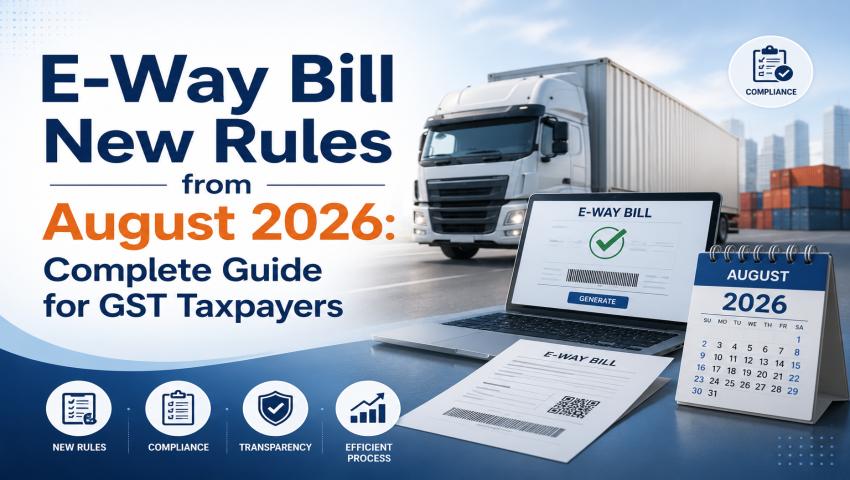
E-Way Bill New Rules from August 2026: Complete Guide for GST Taxpayers
The e-way bill system is getting one of its biggest updates since it was introduced. From 1st August 2026, two new requirements come into force — a mandatory Ship-To GSTIN field for certain transactions, and a new e-way bill closure facility. If you deal with GST e-way bill generation, e-way bill rules 2026, or GST compliance for goods movement, this guide covers what has changed, why it changed, and what you need to do before the deadline.
In this article by My Finance Gyan, we explain the new e-way bill rules coming into effect from August 2026, and what they mean for GST taxpayers, traders, transporters and accountants.
What Is an E-Way Bill?
Before jumping into the new changes, let’s do a quick recap for beginners.
An e-way bill (Electronic Way Bill) is a document you must generate on the GST portal before moving goods worth more than ₹50,000. It is compulsory under Rule 138 of the CGST Rules, 2017, and the government’s power to seek it arises from Section 68 of the CGST Act, 2017.
Some quick facts:
- It is generated in Form GST EWB-01.
- Standard limit is ₹50,000, but some states have different limits for intrastate (within state) movement.
- Validity of the e-way bill starts only after Part B (vehicle number) is filled.
- Supplier, recipient or a registered transporter can generate it.
Simple example: If a business owner who obtained GST registration in pune sends goods worth ₹80,000 to a customer in Nashik, an e-way bill is a must before the truck leaves.
Now let’s come to the real topic — what is changing from August 2026.
What's Changing from 1st August 2026? — Two Big Updates
GSTN (Goods and Services Tax Network) has announced two major changes to the e-way bill system. These were originally supposed to start from 15th June 2026, but after requests from businesses and software companies for more preparation time, the date was pushed to 1st August 2026.
Let’s understand both changes one by one, in simple language.
1. Mandatory Ship-To GSTIN:
This is the bigger and more important change.
In many businesses, the person who is billed (Bill-To party) and the person who actually receives the goods (Ship-To party) are different. This is called a Bill-To/Ship-To transaction, and it’s very common in Indian trade.
Simple example: A company in Delhi orders goods from a supplier in Gujarat, but asks the supplier to send the goods directly to its warehouse in Pune. Here, the invoice is billed to the Delhi office, but the goods actually go to Pune.
From 1st August 2026, when you generate an e-way bill for such a transaction, you must enter the correct Ship-To GSTIN — meaning the GST number of the place where goods are actually delivered (in our example, the Pune warehouse).
- If the receiver is a registered GST dealer, you enter their GSTIN.
- If the receiver is not registered under GST, you must enter “URP” (Unregistered Person) in that field.
This field already existed on the portal, but it was optional. From August 2026, it becomes compulsory — the system will simply not allow you to generate the e-way bill without filling it.
Why this matters: This change is meant to bring more transparency and help tax officers track exactly where goods are actually going, not just who is being billed.
2. New Voluntary E-Way Bill Closure Facility:
The second change is a brand-new feature — e-way bill closure.
Right now, once goods reach the destination, there is no formal way to mark the e-way bill as “delivery done.” Businesses simply let it expire. From August 2026, GSTN is introducing a voluntary closure facility so you can officially confirm that delivery is complete.
Key points to remember:
- Closure is different from cancellation. Cancelling an e-way bill means the transaction never happened (it’s void). Closing an e-way bill means the goods were delivered successfully — the transaction is complete.
- Who can close it: the supplier, the recipient, the transporter, or the authorised driver.
- Time window: You can close it on the actual delivery date, or the next calendar day, and the closure option stays open till one day after the e-way bill’s validity expires.
- It also supports mobile number-based closure, so even a driver can close it using an OTP-based process, without needing full portal login.
This closure facility is voluntary for now — meaning it’s not compulsory to use it — but it’s a good practice for cleaner GST records.
Why the Deadline Was Postponed?
Originally, both these changes were supposed to go live on 15th June 2026. But ERP software companies, GST Suvidha Providers (GSPs), Application Service Providers (ASPs) and system integrators needed more time to update their systems and test the new API properly.
So GSTN pushed the date to 1st August 2026, and released an official update — Advisory No. 664 dated 17th June 2026 — confirming the new Ship-To GSTIN requirement and the extended timeline. The updated API specifications were made available in the sandbox (testing) environment well before the go-live date, so businesses and software vendors could test everything before the real launch.
Why Should You Care? Impact on Your Business
If you are wondering “why does this matter to me,” here’s the honest answer — this is not a small tweak.
- If your ERP or billing software is not updated in time, you may not be able to generate e-way bills after 1st August 2026, especially for Bill-To/Ship-To transactions.
- This could stop your goods dispatch, delay shipments, and even affect your relationship with customers waiting for delivery.
- Businesses that regularly do bulk dispatch, or work through distributors, branches, or third-party warehouses, are most affected.
- Wrong or missing Ship-To GSTIN can lead to compliance issues and unwanted scrutiny later.
In short — if e-way bill generation stops even for one day, your supply chain feels it immediately.
Action Checklist: What to Do Before 1st August 2026?
Here’s a simple to-do list from My Finance Gyan to help you get ready:
- Talk to your software vendor. If you use Tally, ERP software, or any billing tool, ask them whether the Ship-To GSTIN field has been updated as mandatory. Ask for their deployment timeline.
- Test on the sandbox. If you use direct API integration (through your own developer team or a GSP), test the updated Ship-To GSTIN and closure APIs in the NIC sandbox environment before go-live.
- Clean your master data. Check that your customer, branch and warehouse GSTIN records are correct and updated in your system.
- Train your billing and dispatch team. Make sure your staff know about the new mandatory field and how the closure process works.
- Set internal reminders. Note the closure time window (delivery day, next day, or till one day after expiry) so your team doesn’t miss it.
Doing this now will save you a lot of last-minute stress in the final week of July 2026.
How to Generate an E-Way Bill Under the New Rules? (Step-by-Step)
- Log in to the e-way bill portal and select the Bill-To/Ship-To transaction type.
- On the left side, enter the Bill-To party’s GSTIN and name (the party being invoiced).
- On the right side, enter the Ship-To GSTIN — the actual delivery location’s GSTIN, or “URP” if unregistered.
- Fill the rest of the details as usual — invoice value, goods description, transporter details, and vehicle number (Part B).
- Generate the e-way bill. The system will not allow submission if the Ship-To GSTIN field is left blank.
Once the goods are delivered, use the new closure option to mark the e-way bill as complete, within the allowed time window.
Common Mistakes to Avoid:
- Mixing up closure with cancellation — remember, cancelling means the transaction is void; closing means delivery is done.
- Missing the closure time window — you only get till one day after expiry, so don’t delay.
- Leaving Ship-To GSTIN blank or entering the wrong GSTIN — double-check before submitting.
- Waiting till the last week of July to update your ERP software — start early to avoid dispatch delays.
Conclusion:
The new e-way bill rules from August 2026 are a step towards better transparency in GST compliance. The changes themselves — mandatory Ship-To GSTIN and voluntary closure — are not complicated to understand, but they do require your systems and team to be ready in advance.
Don’t wait for the last week of July. Talk to your software vendor today, test your systems, train your staff, and keep your GST compliance smooth and stress-free.
That’s it for today’s My Finance Gyan guide. If you found this useful, share it with your accountant, business partner, or anyone who deals with GST and logistics — they’ll thank you later!
If you need help understanding how these changes apply to your business, or want assistance updating your GST compliance process, contact Startup Portal Business services for consultation.