- 11/08/2026
- Govind S. Jethani
- 352 Views
- 2 Likes
- GST
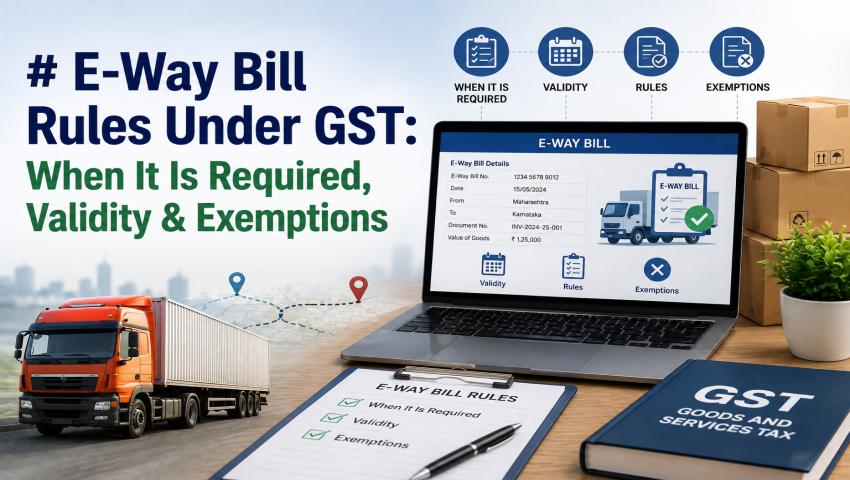
E-Way Bill Rules Under GST: When It Is Required, Validity & Exemptions?
When goods are transported from one place to another, preparing an invoice is not always enough. In many cases, you also need to generate an E-Way Bill before the goods start moving.
An E-Way Bill is not required only for sales. It may also be needed when goods are:
- Sent for job work
- Transferred to another branch
- Returned to the supplier
- Sent for repair, testing, exhibition, or any other purpose
Even a small mistake in the vehicle number, invoice value, or destination can delay the shipment and may lead to inspection or penalties under GST.
This guide by My finance Gyan explains the basic E-Way Bill rules in simple language.
What Is an E-Way Bill?
An E-Way Bill is an electronic document used to track the movement of goods under GST.
It is generated online in Form GST EWB-01. After generation, the system provides a unique 12-digit E-Way Bill Number (EBN).
The person carrying the goods should have:
- Invoice, bill of supply, bill of entry, or delivery challan, and
- The E-Way Bill or its number in electronic form.
In most cases, showing the EBN is enough for verification.
When Is an E-Way Bill Required?
Generally, an E-Way Bill is required when the value of goods exceeds ₹50,000 and the goods are moved:
- For a sale
- For any purpose other than sale
- For inward supply from an unregistered person
The E-Way Bill must be generated before the movement of goods begins. For the latest updates regarding the mandatory Ship-To GSTIN field and voluntary E-Way Bill closure facility, read our detailed guide on E-Way Bill New Rules from August 2026.
Examples:
An E-Way Bill may be required when goods worth ₹75,000 are:
- Sold to a customer
- Sent for job work
- Transferred to another branch
- Returned after rejection
- Sent for exhibition
- Sent for repair, testing, or approval
Note: The ₹50,000 limit is the general GST rule. Some States may have different rules for movement within the State, so always check the latest State notification.
How Is the Consignment Value Calculated?
The consignment value is generally the value mentioned in the invoice, bill of supply, or delivery challan.
It includes:
- CGST
- SGST
- UTGST
- IGST
- Compensation Cess
However:
- The value of exempt goods is ignored if both taxable and exempt goods are in the same invoice.
- Freight charged separately by the transporter is not included.
Example:
- Taxable goods: ₹46,000
- GST: ₹8,280
- Total value: ₹54,280
Since the value exceeds ₹50,000, an E-Way Bill is generally required.
When Is an E-Way Bill Required Even Below ₹50,000?
In some situations, an E-Way Bill is compulsory even if the value is less than ₹50,000.
These include:
- Goods sent by a principal to a job worker in another State.
- Inter-State movement of specified handicraft goods by persons exempt from GST registration.
Who Can Generate an E-Way Bill?
An E-Way Bill can be generated by:
- Registered supplier
- Registered recipient
- Transporter
- Unregistered transporter (after enrolment)
- A citizen moving goods for personal use, where applicable
An unregistered transporter must first register on the E-Way Bill portal and obtain a Transporter ID.
What Are Part A and Part B?
Form GST EWB-01 has two sections.
Part A:
Part A contains transaction details such as:
- Supplier and recipient GSTIN
- Place of dispatch and delivery
- Invoice or challan number
- Invoice date
- Goods value
- HSN Code
- Reason for transport
- Transporter details
Part B:
Part B contains transport details.
For road transport, it mainly includes:
- Vehicle number
For rail, air, or ship:
- Transport document number
Only filling Part A does not complete the E-Way Bill. For road transport, Part B must also be filled.
Vehicle details may not be required when goods are moved within 50 km inside the same State between the consignor and transporter (or transporter and consignee).
How Long Is an E-Way Bill Valid?
Validity depends on the distance travelled.
Regular Cargo:
- Up to 200 km – 1 day
- Every additional 200 km or part – 1 extra day
Over-Dimensional Cargo:
- Up to 20 km – 1 day
- Every additional 20 km or part – 1 extra day
Example:
Distance: 450 km
Validity:
- First 200 km – 1 day
- Next 200 km – 1 day
- Remaining 50 km – 1 day
Total validity = 3 days
The validity starts when Part B is first updated. Changing the vehicle later does not restart the validity period.
Can the Validity Be Extended?
Yes.
Validity can be extended when goods cannot reach their destination because of:
- Vehicle breakdown
- Natural disasters
- Law and order issues
- Delay during trans-shipment
- Other genuine transport problems
The transporter can request an extension by providing:
- Reason
- Current location
- Remaining distance
An E-Way Bill cannot be extended beyond 360 days from its original generation.
Can an E-Way Bill Be Edited or Cancelled?
Once generated, most details cannot be edited. Only transport details like the vehicle number can be updated.
If there is an error in Part A, the E-Way Bill should be cancelled and a fresh one generated.
Rules:
- Cancellation is allowed within 24 hours.
- It cannot be cancelled after verification during transit.
The recipient can reject the E-Way Bill within 72 hours or before delivery, whichever is earlier.
What If the Vehicle Changes During Transit?
If goods are shifted to another vehicle due to breakdown or any other reason:
- Update Part B before continuing the journey.
- The vehicle number can be changed multiple times while the E-Way Bill remains valid.
A new E-Way Bill is generally not required just because the vehicle changes.
Common E-Way Bill Exemptions:
An E-Way Bill is generally not required for:
- Goods carried by non-motorised vehicles
- Goods listed in Rule 138 exemption list
- Certain movements under Customs control
- Goods moved from ports or airports to customs stations
- Movement in areas exempted by State notifications
- Goods taken to a weighbridge and returned within 20 km in the same State with a valid delivery challan
Important Portal Restrictions:
- 180-Day Rule: From 1 January 2025, an E-Way Bill cannot be generated if the invoice or challan is more than 180 days old.
- Return Filing Restriction: If a taxpayer has not filed GSTR-3B for two or more consecutive tax periods, E-Way Bill generation may be blocked until returns are filed or permission is granted.
Frequently Asked Questions:
No. It is required only for the movement of goods.
Yes, if the value and other conditions are satisfied.
Yes. An unregistered transporter can enrol on the portal, and a citizen can generate an E-Way Bill for eligible personal movement.
No.
A Consolidated E-Way Bill only combines multiple E-Way Bill numbers for one vehicle. Each eligible consignment still needs its own E-Way Bill.
The transporter can report the detention on the E-Way Bill portal, which informs the concerned GST officer.
Conclusion:
An E-Way Bill should be prepared before goods leave your premises.
Before dispatch, always check:
- Consignment value
- Nature of the transaction
- Destination
- State-specific rules
- Invoice details
- GSTIN
- PIN code
- Vehicle number
- Validity period
Most E-Way Bill problems happen because of small mistakes like:
- Wrong vehicle number
- Missing Part B
- Incorrect distance
- Expired E-Way Bill
Taking a few minutes to verify these details before dispatch can save time, avoid delays, and prevent GST-related issues.
Disclaimer:
This article is for general educational purposes only. E-Way Bill rules may vary depending on the type of goods, transaction, and State notifications. Always check the latest GST provisions before transporting goods.