- 22/08/2026
- Govind S. Jethani
- 290 Views
- 3 Likes
- GST
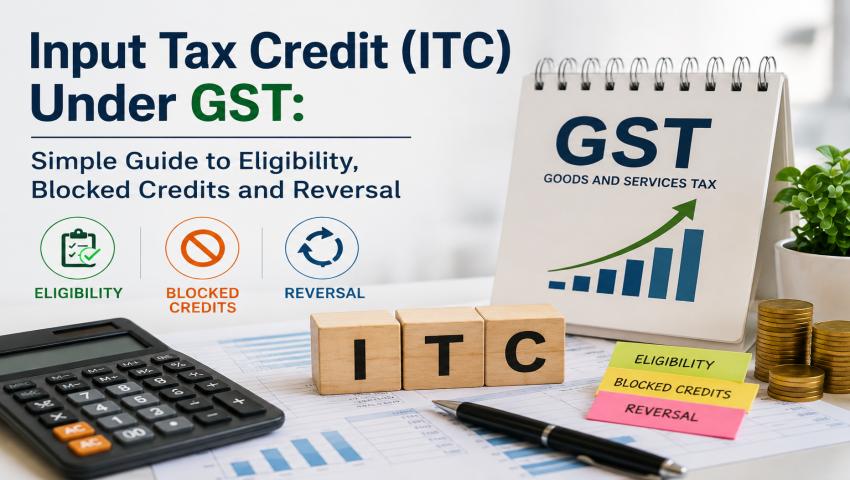
Input Tax Credit (ITC) Under GST: Simple Guide to Eligibility, Blocked Credits and Reversal
Input Tax Credit (ITC) is one of the most useful benefits of GST. In this guide, My Finance Gyan explains how claiming Input Tax Credit under GST allows a registered business to reduce its overall GST liability by using the GST already paid on eligible business purchases.
For example, if you collect ₹80,000 GST from your customers and have ₹50,000 of eligible ITC from your business purchases, you may generally need to pay only ₹30,000 after adjusting the eligible credit.
However, you cannot claim ITC simply because you have a GST invoice. There are several conditions that must be followed. The purchase should be related to business, the goods or services should be received, the supplier should report the invoice correctly, and the expense should not fall under the blocked-credit rules.
If ITC is claimed incorrectly, it may have to be reversed and could also lead to interest or a GST notice.
What Is Input Tax Credit?
Input Tax Credit, or ITC, is the GST paid by a business on eligible goods or services purchased for business purposes.
Simple example:
Suppose a business has:
- GST collected from customers: ₹80,000
- Eligible GST paid on purchases: ₹50,000
The calculation would generally be:
- GST collected: ₹80,000
- Less: Eligible ITC: ₹50,000
- Net GST payable: ₹30,000
This helps prevent GST from becoming an unnecessary cost at every stage of the supply chain.
Who Can Claim ITC?
A person generally needs to be registered under GST to claim ITC. The goods or services must be used, or intended to be used, for business purposes.
For example:
- GST paid on office software used for business may be eligible.
- GST paid on a television purchased for the owner’s home would generally not be eligible.
Simply having the business GSTIN on an invoice does not make a personal expense eligible for ITC.
Main Conditions for Claiming ITC:
Before claiming ITC, a business should check the following important conditions.
1. You Must Have a Valid Invoice or Document:
You should have a proper tax invoice, debit note, bill of entry or another prescribed document.
The invoice should contain important details such as:
- GSTIN
- Invoice number
- Invoice date
- Taxable value
- GST amount
- Description of goods or services
A quotation or simple payment receipt is generally not enough to claim ITC.
2. You Must Receive the Goods or Services:
The goods or services mentioned in the invoice should actually be received. If goods under one invoice are delivered in different lots, ITC can generally be claimed after the last lot is received.
There are also special rules for situations where goods are delivered to another person on the buyer’s instructions.
3. The Supplier Should Report the Invoice:
The supplier should correctly report the invoice or debit note in the GST system. Businesses should regularly check their GSTR-2B to make sure eligible purchase invoices are appearing correctly.
4. GST Should Be Paid to the Government:
The GST charged by the supplier should ultimately be paid to the government. This can create problems when a supplier reports an invoice but does not complete the required GST return filing. Rule 37A provides rules for reversal and later re-claim of ITC in certain such cases.
5. GSTR-3B Should Be Filed:
The taxpayer must file the applicable GST return. ITC is generally claimed through Table 4 of GSTR-3B.
What Is GSTR-2B?
GSTR-2B is an auto-generated statement that shows ITC information based on details reported through the GST system.
It can contain information about:
- Purchase invoices
- Debit notes
- Input Service Distributor (ISD) credits
- Import-related credits
- Available or unavailable ITC
However, GSTR-2B alone should not be used to decide whether ITC can be claimed.
For example, an invoice may appear in GSTR-2B but still be ineligible because:
- It was for personal use.
- It relates to an exempt supply.
- It is a blocked credit.
- The goods or services were not actually received.
Similarly, a genuine invoice may not appear in GSTR-2B because the supplier made an error or did not report it correctly.
Best practice:
Before filing GSTR-3B, reconcile these three records:
- Purchase register
- Tax invoices and supporting documents
- GSTR-2B
Any difference should be checked and corrected before claiming the credit.
Time Limit for Claiming ITC:
For a normal invoice or debit note, ITC generally needs to be claimed by 30 November following the end of the relevant financial year, or before filing the relevant annual return, whichever is earlier.
For example, ITC relating to FY 2025-26 would generally need to be claimed by 30 November 2026, unless the relevant annual return is filed earlier.
This deadline does not mean that you can delay your normal monthly GST return filing. It is better to complete your purchase and ITC reconciliation well before November rather than waiting until the last moment.
The 180-Day Payment Rule:
After claiming ITC, the buyer generally needs to pay the supplier the invoice amount, including GST, within 180 days from the invoice date.
If the amount is not paid within this period, the ITC relating to the unpaid amount generally has to be reversed along with applicable interest.
The ITC can generally be claimed again after payment is made. This rule does not apply in the same manner to supplies covered by reverse charge.
Example:
Suppose an invoice is:
- Total invoice value: ₹1,18,000
- GST: ₹18,000
If only half of the invoice amount remains unpaid after 180 days, the ITC reversal is generally proportionate to the unpaid amount rather than automatically reversing the entire ₹18,000 credit.
Businesses should regularly check their outstanding supplier payments to avoid missing this requirement.
What Is Blocked ITC?
Some types of expenses do not qualify for ITC even when they are related to business. These are commonly referred to as blocked credits under Section 17(5) of the CGST Act.
Common examples include:
- Certain passenger motor vehicles and related expenses
- Food and beverages
- Outdoor catering
- Beauty treatment
- Certain health services
- Club memberships
- Certain rent-a-cab services
- Certain life and health insurance services
- Employee vacation travel benefits
- Certain works-contract services
- Goods or services used for construction of an immovable property on one’s own account
- Personal expenses
- Goods that are lost, stolen, destroyed or written off
- Gifts and free samples
- Purchases from a person paying tax under the composition scheme
However, there are exceptions to some of these categories.
For example, ITC on certain passenger vehicles may be available when the vehicle is used for activities such as further supply of similar vehicles, passenger transportation or driving training, subject to the applicable conditions.
Therefore, blocked-credit rules should always be checked based on the exact nature and use of the expense.
Business Use vs Personal Use:
If a purchase is used partly for business and partly for personal purposes, ITC is generally available only for the eligible business portion.
For example, if a mobile connection is used 70% for business and 30% personally, claiming 100% of the GST without proper justification may create a compliance issue.
The same principle applies when goods or services are used for both taxable and exempt supplies.
Credit related to exempt supplies may need to be reversed according to the prescribed rules.
Rules 42 and 43 provide the calculation mechanism for certain common-credit reversals.
ITC Reversal Under Rule 37A:
Rule 37A deals with a situation where a supplier reports an invoice or debit note but does not file the corresponding GSTR-3B within the specified time.
In certain cases, the recipient may have to reverse the ITC through GSTR-3B by 30 November following the relevant financial year.
If the supplier later files the required GSTR-3B, the recipient may be able to reclaim the credit, subject to the applicable conditions.
This is why checking your suppliers’ GST compliance is important.
Even if you have paid your supplier, you may temporarily have to reverse ITC if the supplier has not completed the required return filing.
Depreciation and ITC:
When you purchase a capital asset, you generally cannot claim both:
- ITC on the GST component, and
- Income-tax depreciation on the same GST component.
If depreciation is claimed on the GST portion of the asset’s cost, ITC on that GST amount is not allowed.
Therefore, the GST component should be properly accounted for when recording capital assets.
Common ITC Mistakes:
Businesses often make ITC mistakes because of simple accounting or reconciliation problems.
Some common mistakes include:
- Claiming the same invoice twice
- Claiming an invoice belonging to another GST registration
- Ignoring supplier credit notes
- Claiming ITC before receiving goods or services
- Claiming ITC on blocked expenses
- Claiming ITC on personal expenses
- Not reversing credit related to unpaid invoices
- Not checking GSTR-2B regularly
- Ignoring supplier return compliance
- Claiming incorrect ITC because of a place-of-supply issue
A monthly reconciliation is much easier than trying to find and correct mistakes at the end of the financial year.
Frequently Asked Questions:
You should first investigate the mismatch and ask the supplier to correct the reporting, where required. The invoice and other legal conditions for claiming ITC must also be satisfied.
Yes, GST paid on commercial office rent may generally be eligible when the premises are used for eligible business activities and the other ITC conditions are satisfied.
Generally, no. A person paying tax under the composition scheme cannot normally claim Input Tax Credit.
ITC may be blocked unless the insurance is required under an applicable law or another specific exception applies.
Some temporary reversals can be reclaimed after the required conditions are fulfilled.
For example, ITC reversed under the 180-day payment rule or certain Rule 37A situations may be reclaimed when the relevant conditions are met.
However, permanently blocked ITC cannot be reclaimed simply because it appears in GSTR-2B.
Conclusion:
Input Tax Credit can significantly reduce the GST cost of running a business. But every ITC claim should be properly checked before it is included in the GST return.
Before claiming ITC, make sure:
- The purchase is for business purposes.
- You have a valid invoice or prescribed document.
- The goods or services have been received.
- The invoice is correctly reported in the GST system.
- The credit is not blocked under Section 17(5).
- Any required reversal has been completed.
- Supplier compliance has been checked.
- Your purchase register matches GSTR-2B.
A simple monthly ITC reconciliation can help prevent unnecessary reversals, interest and GST notices.
Disclaimer:
This article is for general educational purposes only. Actual ITC eligibility depends on the nature of the transaction, documents, business use and applicable GST provisions. For business-specific situations, consult a qualified GST professional.