- 07/08/2026
- Govind S. Jethani
- 250 Views
- 4 Likes
- GST
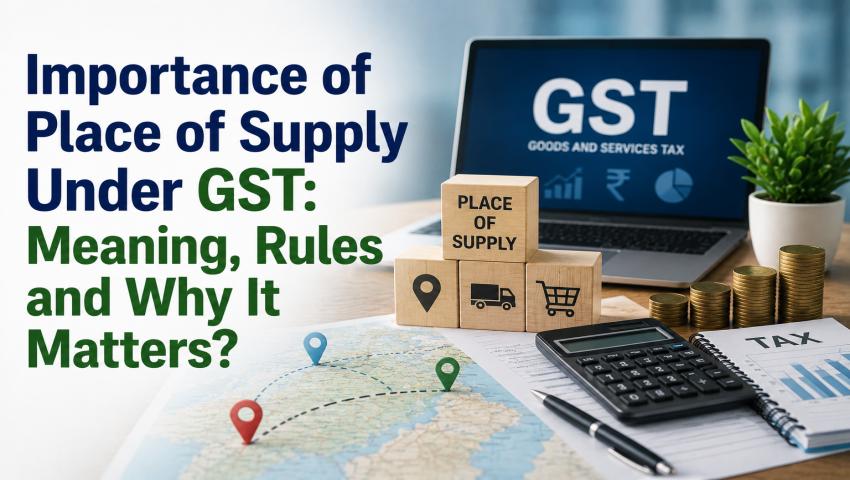
Importance of Place of Supply Under GST: Meaning, Rules and Why It Matters?
Many businesses correctly calculate the GST rate and taxable value but still make mistakes while issuing invoices. One of the main reasons is not identifying the place of supply correctly.
The place of supply decides whether a transaction is treated as an intra-State supply or an inter-State supply. Based on this, the supplier charges either CGST and SGST/UTGST or IGST.
It also affects:
- Input Tax Credit (ITC)
- GST return filing
- Export benefits
- The State that receives the GST revenue
For local sales, identifying the place of supply is usually straightforward. However, things become more complicated when goods are delivered to another State, services relate to property located elsewhere, or an Indian business provides services to an overseas customer.
Let’s understand the concept by My Finance Gyan in simple words.
What Is Place of Supply Under GST?
The place of supply is the location where goods or services are considered to have been supplied under the GST law.
To decide which GST to charge, the place of supply is compared with the location of the supplier.
- If both are in the same State or Union Territory, the supply is generally treated as an intra-State supply, and CGST + SGST (or UTGST) is charged.
- If they are in different States or Union Territories, it is generally treated as an inter-State supply, and IGST is charged.
Supplies involving a Special Economic Zone (SEZ) follow separate provisions under the IGST Act.
Example:
A business registered in Maharashtra sells goods to a customer in Karnataka, and the goods are delivered in Karnataka.
Since the place of supply is Karnataka while the supplier is in Maharashtra, IGST is generally applicable.
Why Is Place of Supply Important?
1. It Decides Which GST to Charge:
The place of supply tells you whether your invoice should include:
- CGST + SGST
- CGST + UTGST
- IGST
Charging the wrong type of GST can lead to correction of invoices, refund claims, notices, and unnecessary cash flow issues.
2. It Affects Input Tax Credit (ITC):
If GST is charged under the wrong tax head or the invoice contains an incorrect State code or GSTIN, the buyer may face problems while claiming Input Tax Credit.
For example, if a supplier incorrectly charges Maharashtra CGST and SGST instead of IGST on a supply to Karnataka, the recipient may not be able to claim credit properly.
3. It Determines Which State Gets the Tax:
GST is a destination-based tax, meaning the tax generally belongs to the State where the goods or services are finally consumed.
The place-of-supply provisions help determine which State receives the GST revenue.
4. It Affects GST Returns:
Place of supply details are reported in GST returns such as GSTR-1.
Businesses making inter-State B2C sales, supplies to composition taxpayers, or supplies to UIN holders also have to report State-wise details.
5. It Helps Decide Whether a Service Is an Export:
Receiving payment from a foreign customer alone does not make a service an export. One of the important conditions is that the place of supply must generally be outside India.
Therefore, determining the place of supply correctly is essential for claiming export benefits.
Place of Supply Rules for Goods:
1. Goods Involving Movement:
If goods are transported from one place to another, the place of supply is generally the place where the movement ends and the goods are delivered.
Example: A supplier in Maharashtra sends machinery to a factory in Gujarat. The place of supply is Gujarat.
2. Bill-to, Ship-to Transactions:
Sometimes one customer places the order but asks the supplier to deliver the goods directly to another person. In such cases, the GST law contains special rules.
Example: A company in Delhi purchases goods from a supplier in Maharashtra but asks the supplier to deliver them directly to its customer in Haryana. For the supplier’s sale to the Delhi company, the place of supply is generally Delhi.
3. Goods Without Movement:
If goods are sold without being transported, the place of supply is the location where the goods are situated at the time of delivery.
4. Installation or Assembly at Site:
If machinery or equipment is installed at the customer’s location, the place of supply is the place where installation takes place.
Example: A supplier from Pune installs machinery at a factory in Chennai. The place of supply is Tamil Nadu.
5. Goods Supplied on a Train, Aircraft or Ship:
When goods are sold onboard a train, aircraft, vessel, or motor vehicle, the place of supply is where those goods were loaded onto the vehicle.
6. Imports and Exports:
- For imported goods, the place of supply is generally the location of the importer.
- For exported goods, the place of supply is outside India.
7. Supplies to Unregistered Customers:
Special rules apply when goods are sold to an unregistered person. If the customer’s address is recorded on the invoice, that address generally determines the place of supply. If no address is available, the supplier’s location is treated as the place of supply.
Example: A customer living in Maharashtra orders a mobile phone but asks for delivery in Gujarat. If the Gujarat delivery address is mentioned on the invoice, Gujarat becomes the place of supply. This rule is especially important for online sellers and e-commerce businesses.
Place of Supply Rules for Services:
When both the supplier and recipient are located in India, the general rule is:
- For a registered customer, the place of supply is usually the customer’s registered location.
- For an unregistered customer, the place of supply is generally the customer’s address available in the supplier’s records.
- If no address is available, the supplier’s location is considered the place of supply.
However, several services have special rules.
Services Related to Immovable Property:
Services connected with land or buildings generally follow the location of the property.
Examples include:
- Architecture
- Interior Designing
- Property Brokerage
- Construction Services
- Hotel Accommodation
- Renting of Property
Example: An architect in Maharashtra designs a hotel located in Goa. The place of supply is Goa, even if the client is based in Delhi.
1. Restaurant, Beauty and Health Services:
Restaurant services, beauty treatments, fitness services, and certain healthcare services generally follow the place where the service is actually provided.
2. Training Services:
- If training is provided to a registered business, the place of supply is generally the recipient’s location.
- If provided to an unregistered person, the place of supply is usually where the training is conducted.
3. Event Services:
For admission to events, the place of supply is generally where the event is held. For event management services, different rules may apply depending on whether the customer is registered or unregistered.
4. Transportation Services:
For transportation of goods:
- Registered customer → Recipient’s location
- Unregistered customer → Place where goods are handed over for transport
Passenger transportation generally follows the place where the passenger starts the journey.
5. Banking and Insurance Services:
For banking and financial services, the place of supply is generally the recipient’s address available in the supplier’s records. Insurance services usually follow the registered person’s location or the address available with the insurer.
6. Cross-Border Services:
When either the supplier or the customer is located outside India, the provisions of Section 13 of the IGST Act apply. Generally, the place of supply is the recipient’s location.
However, several special rules continue to apply for:
- Services relating to immovable property
- Services requiring physical presence
- Passenger transportation
- Event services
- Certain other specified services
Latest Update: Intermediary Services
The Finance Act, 2026 has brought an important change for intermediary services. Earlier, intermediary services provided by an Indian business to a foreign customer were generally treated as supplied in India, making export benefits unavailable.
After the amendment, intermediary services generally follow the normal rule under Section 13(2), where the place of supply is the recipient’s location, provided all other export conditions are satisfied.
However, every marketing, consultancy, or support service is not automatically an intermediary service. The actual agreement and nature of services should always be examined carefully.
Common Place of Supply Mistakes:
Businesses often make mistakes such as:
- Using the billing address instead of the delivery address
- Assuming the customer’s GSTIN alone determines the place of supply
- Treating every foreign invoice as an export
- Ignoring special rules for property, transportation, events, or personal services
Before issuing an invoice, always verify:
- Customer’s GSTIN
- Billing address
- Delivery address
- Place where goods are delivered
- Location of property or event
- Customer’s registration status
- Country of the overseas customer
- Nature of service provided
Frequently Asked Questions (FAQs):
No. It depends on the type of transaction. Several services have special place-of-supply rules.
Usually yes, but always compare the supplier’s location with the legally determined place of supply before issuing the invoice.
If the billing and delivery addresses are different, the delivery address mentioned on the invoice generally decides the place of supply.
No. The transaction must satisfy all the conditions prescribed for export of services.
After the Finance Act, 2026, intermediary services generally follow the recipient-location rule under Section 13(2), subject to fulfilment of all applicable conditions.
Conclusion:
The place of supply is much more than just a field on a GST invoice.
It decides:
- Which GST to charge
- Which State receives the tax
- Whether the buyer can claim Input Tax Credit
- How the transaction is reported in GST returns
- Whether a service qualifies as an export
Before issuing any invoice, always identify where the goods are delivered or determine the correct place of supply for services under the GST law.
Getting it right at the beginning is much easier than correcting invoices, GST returns, and tax payments later.
Disclaimer:
This article is intended only for educational and awareness purposes. The place-of-supply provisions under GST depend on the nature of the transaction, contractual terms, and applicable legal provisions. Businesses should seek professional advice for complex transactions such as bill-to-ship-to arrangements, multi-State operations, and cross-border supplies.