- 04/06/2026
- Govind S. Jethani
- 337 Views
- 2 Likes
- Company Law
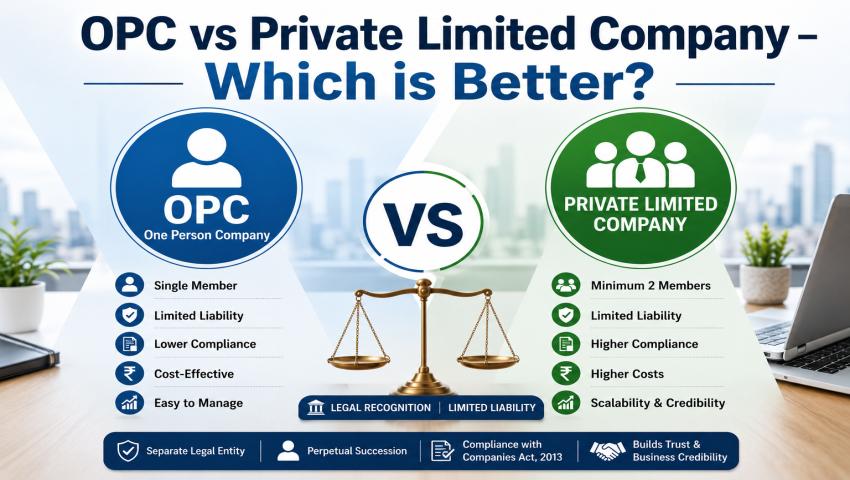
OPC vs Private Limited Company – Which is Better?
Choosing the right business structure is one of the most important decisions for any entrepreneur. In India, One Person Company (OPC) and Private Limited Company are two of the most popular business structures registered under the Companies Act, 2013.
Both structures provide:
- Limited liability protection
- Separate legal identity
- Better business credibility
- Perpetual succession
However, they differ significantly in terms of ownership, compliance, fundraising capability, scalability, and management structure.
Understanding the differences between OPC vs Private Limited Company can help entrepreneurs choose the most suitable structure based on their business goals, investment plans, and future expansion strategy.
This article by My Finance Gyan provides a detailed comparison between OPC and Private Limited Company in a practical and easy-to-understand manner.
What is an OPC (One Person Company)?
A One Person Company (OPC) is a company structure that allows a single individual to establish a corporate entity with limited liability protection.
Introduced under the Companies Act, 2013, OPC was designed to support solo entrepreneurs who want the advantages of a company without requiring partners or multiple shareholders.
Key Features of OPC:
- Only one shareholder
- Minimum one director
- Separate legal entity
- Limited liability protection
- Mandatory nominee appointment
The same individual can act as both shareholder and director.
👉 OPC is ideal for individual entrepreneurs, freelancers, consultants, and small business owners.
What is a Private Limited Company?
A Private Limited Company is a corporate entity owned by two or more shareholders with a maximum limit of 200 members.
It is one of the most preferred business structures for:
- Startups
- Growing businesses
- Technology companies
- Investment-driven ventures
Key Features of Private Limited Company:
- Minimum two shareholders
- Minimum two directors
- Limited liability
- Separate legal entity
- Better fundraising capability
- Strong corporate governance
👉 Private Limited Companies are generally preferred for scalable businesses and startups seeking investment.
OPC vs Private Limited Company: Major Differences
1. Ownership and Management:
OPC: An OPC is owned and controlled by a single person.
Advantages:
- Complete control over business decisions
- Faster decision-making
- No disputes among partners
This makes OPC suitable for entrepreneurs who prefer independent management.
Private Limited Company:
A Private Limited Company has:
- Multiple shareholders
- Shared ownership
- Collective decision-making
Advantages:
- Better governance structure
- Shared responsibilities
- Diverse management expertise
However, decision-making may take longer due to involvement of multiple stakeholders.
2. Legal Structure and Compliance:
OPC Compliance Benefits
- No requirement to hold Annual General Meeting (AGM)
- Fewer compliance requirements
- Simplified governance
- Reduced procedural formalities
Private Limited Company Compliance Requirements
Private Limited Companies must:
- Conduct Board Meetings
- Hold AGM
- Maintain statutory registers
- File annual returns and financial statements
Although compliance is higher, it improves transparency and investor confidence.
3. Minimum Members Requirement:
👉 OPC is suitable for solo ownership, while Private Limited Company supports multiple owners and co-founders.
4. Fundraising and Investment Opportunities:
OPC Limitations
An OPC:
- Cannot issue shares to multiple investors
- Has limited fundraising options
- Is generally less preferred by venture capital firms
Investors usually avoid OPC due to ownership restrictions.
Private Limited Company Advantages
A Private Limited Company can:
- Raise equity funding
- Issue shares
- Attract venture capital and angel investment
- Secure institutional funding
👉 If your business plans involve external funding, Private Limited Company is usually the better option.
5. Growth and Scalability:
OPC
OPC is mainly suitable for:
- Small businesses
- Freelancers
- Consultants
- Single-owner enterprises
It has limitations in expansion and ownership diversification.
Private Limited Company
Private Limited Company offers:
- Better scalability
- Easy ownership expansion
- Possibility of converting into Public Company
- Better long-term growth potential
👉 Startups with aggressive expansion plans generally prefer Private Limited Company structure.
6. Capital Requirement:
There is currently no mandatory minimum paid-up capital requirement for either OPC or Private Limited Company.
However:
- Private Limited Companies can raise capital from multiple shareholders
- OPC funding remains limited to a single owner
7. Taxation:
Both OPC and Private Limited Company are taxed as corporate entities under Indian income tax laws.
Common Tax Features:
- Corporate tax rates apply
- Tax audit requirements based on turnover
- Business expense deductions allowed
There is no major tax advantage between the two structures.
However, tax planning flexibility may differ depending on:
- Shareholding pattern
- Director remuneration
- Dividend distribution
8. Compliance Cost and Ease of Management:
OPC
Compliance cost is lower because:
- Fewer filings are required
- No AGM is mandatory
- Simpler management structure
This makes OPC easier and more economical to manage.
Private Limited Company
Compliance cost is comparatively higher due to:
- More statutory filings
- Board meetings
- Annual compliances
- Corporate governance requirements
However, these compliances increase credibility and legal strength.
9. Credibility and Market Perception:
In the business ecosystem, a Private Limited Company is generally considered more credible.
Why Private Limited Companies Have Better Market Acceptance?
- Multiple stakeholders involved
- Better governance structure
- Easier investor trust
- Stronger reputation among banks and vendors
OPC Market Position
OPCs are ideal for:
- Freelancers
- Individual consultants
- Small-scale service providers
- Independent professionals
They are suitable for businesses with limited operational scale.
OPC vs Private Limited Company – Which is Better?
The right choice depends entirely on your business objectives and future plans.
Choose OPC If:
✔️ You are a solo entrepreneur
✔️ You want full control over decisions
✔️ Your business is small or service-oriented
✔️ You prefer lower compliance burden
✔️ External funding is not a priority
Choose Private Limited Company If:
✔️ You have co-founders
✔️ You plan to raise investment
✔️ You want business scalability
✔️ You need higher market credibility
✔️ You aim for long-term expansion
👉 There is no universally “better” option. The ideal structure depends on your present needs and future growth strategy.
Common Mistakes to Avoid While Choosing Business Structure:
❌ Choosing OPC despite future funding plans
❌ Ignoring compliance obligations
❌ Selecting structure only for tax reasons
❌ Not planning long-term scalability
❌ Failing to evaluate ownership requirements
Frequently Asked Questions (FAQs):
OPC is owned by one person, while Private Limited Company requires at least two shareholders.
OPC has limited fundraising capability and is generally less preferred by investors.
OPC has lower compliance requirements compared to Private Limited Company.
Private Limited Company is generally better for startups seeking growth and investment.
Yes, OPC can be converted into a Private Limited Company subject to legal provisions and conditions.
Conclusion:
The comparison of OPC vs Private Limited Company ultimately depends on control, compliance, funding requirements, and scalability.
An OPC is an excellent option for solo entrepreneurs seeking limited liability with simplified compliance and complete business control. On the other hand, a Private Limited Company is more suitable for businesses planning expansion, investment, multiple stakeholders, and long-term growth.
Before selecting a business structure, entrepreneurs should carefully evaluate:
- Business goals
- Funding requirements
- Compliance capacity
- Growth plans
- Operational scale
A well-informed decision during incorporation can save significant time, cost, and restructuring efforts in the future.
Disclaimer: This article is for general informational purposes only and should not be considered legal, tax, or professional advice